Structural Core Build Up Materials: 2026 Cost Analysis
Compare 2026 costs for structural core build up materials including PET foam, PVC, balsa, and honeycomb. Includes pricing matrices and assembly tips.

Executive Cost Summary & 2026 Market Outlook
2026 Market Baseline: Structural core build up materials for architectural sandwich panels, modular pods, and structural insulated facades are experiencing a 4.2% average price stabilization following the supply chain volatility of the early 2020s. Cross-linked PET foams are rapidly gaining market share over traditional PVC cores due to strict LEED v5 recyclability mandates in commercial construction.
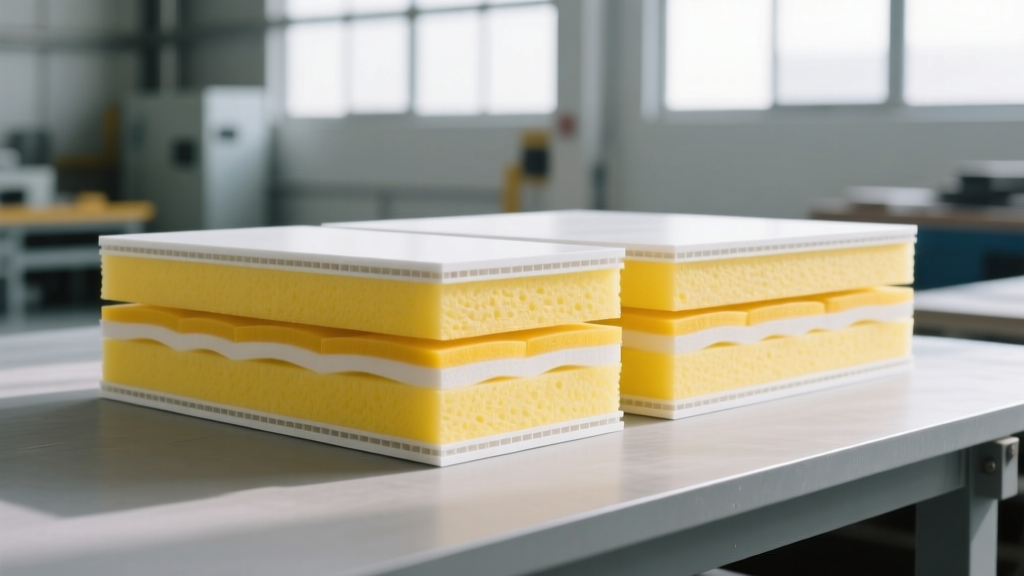
When engineering composite sandwich panels for building envelopes, marine structures, or modular construction, the core material dictates the panel's shear strength, thermal resistance, and overall weight. Selecting the wrong core build up material doesn't just compromise structural integrity; it drastically inflates assembly labor and resin consumption. This cost analysis breaks down the exact pricing, hidden assembly costs, and performance trade-offs of the four dominant core materials used in modern construction.
2026 Core Build Up Material Pricing Matrix
The following matrix reflects Q1 2026 wholesale pricing for standard 1-inch (25.4mm) thickness core materials, purchased in full-sheet volumes (typically 4x8 ft or 5x10 ft).
| Core Material Type | Industry Brand Examples | Cost per Sq. Ft. (1" Thick) | Density (pcf) | Max Service Temp |
|---|---|---|---|---|
| Cross-Linked PET Foam | 3A Composites ArmaCORE, Airex T92 | $8.50 - $12.00 | 5.0 - 8.0 | 150°C (302°F) |
| Closed-Cell PVC Foam | DIAB Divinycell H, Corecell M | $12.50 - $18.00 | 3.5 - 6.0 | 80°C (176°F) |
| End-Grain Balsa Wood | 3A Composites Baltek, Nida Core | $4.00 - $7.50 | 6.0 - 10.0 | 120°C (248°F) |
| Aluminum Honeycomb | Plascore, Hexcel HexWeb | $28.00 - $45.00 | 2.0 - 4.5 | 350°C (662°F) |
Deep Dive: Cost vs. Performance by Material Type
Cross-Linked PET Foam (The Sustainable Standard)
Polyethylene terephthalate (PET) foam has become the default core build up material for architectural cladding and modular bathroom pods. Made largely from recycled PET (rPET), it satisfies modern green building codes without sacrificing shear strength.
- Cost Driver: While the raw material cost ($8.50-$12.00/sq ft) is moderate, PET foam requires less resin during vacuum infusion than balsa, saving roughly $1.50 per square foot in epoxy or vinyl ester resin costs.
- Edge Case: PET foam has a higher thermal expansion coefficient than PVC. In exterior facade applications spanning over 40 feet, engineers must incorporate expansion joints to prevent face-sheet buckling during summer thermal loading.
Closed-Cell PVC Foam (The Fatigue Specialist)
Linear and cross-linked PVC foams (like DIAB's Divinycell) remain the premium choice for high-fatigue environments, such as kinetic architectural facades or marine-grade modular components.
- Cost Driver: At $12.50-$18.00/sq ft, PVC is expensive. Furthermore, PVC is highly sensitive to the exothermic reaction of curing resins. If the laminate exceeds 80°C during curing, the PVC will outgas, causing catastrophic delamination. This requires strict temperature-controlled factory environments, adding 8-12% to overhead labor costs.
- Best Application: High-impact zones where point-load resistance is critical, such as modular floor panels for heavy equipment.
End-Grain Balsa Wood (The Budget Option)
End-grain balsa is the most economical core material ($4.00-$7.50/sq ft) and offers excellent compressive strength. However, its use in modern building envelopes is declining due to moisture vulnerability.
- Hidden Cost: Balsa acts like a sponge. If used in hand lay-up processes, it will absorb massive amounts of resin, negating the initial material savings. To prevent this, balsa must be pre-sealed or used with a scrim-backed resin barrier, adding $2.00/sq ft to the prep phase.
- Failure Mode: Core shear failure under concentrated point loads. Balsa lacks the shear elongation properties of synthetic foams, making it prone to sudden, brittle cracking if the fiberglass face sheet is too thin.
Aluminum & Nomex Honeycomb (The Ultra-Lightweight Premium)
Honeycomb cores are rarely used in standard building envelopes due to cost ($28.00-$45.00/sq ft), but they are indispensable for aerospace-grade modular components, elevator cab interiors, and high-end acoustic wall panels.
- Assembly Challenge: Honeycomb cannot be infused with liquid resin. It requires film adhesives and autoclave or hot-press curing. This restricts honeycomb core build up to highly specialized, capital-intensive manufacturing facilities.
Hidden Assembly Costs: Resins, Adhesives, and Kitting
Focusing solely on the per-square-foot cost of the core material is a common estimating error. The true cost of a core build up assembly includes the secondary materials and labor required to bond it to the face sheets.
Estimator Warning: Never budget for core materials without factoring in CNC kitting and structural adhesives. Raw core sheets are rarely installed flat; they must be scored, beveled, and contoured to fit architectural geometries.
- CNC Kitting & Scoring: To allow flat core sheets to bend around curved facade elements, manufacturers use CNC routers to score the core halfway through. Expect to pay an additional $1.75 to $3.50 per square foot for custom kitting and contour scoring.
- Methacrylate Adhesives (MMA): When bonding core materials to pre-cured face sheets (secondary bonding), structural MMAs like Plexus MA420 are required. At approximately $45 to $60 per gallon, adhesive consumption can add $1.20 per square foot to the final panel cost.
- Vacuum Infusion Consumables: If utilizing resin infusion to wet out the core, budget for single-use consumables (flow media, peel ply, vacuum bagging film). This adds roughly $2.50 per square foot in non-recoverable material waste.
Decision Framework: Selecting the Right Core for Your Budget
Use this practical decision matrix to specify the correct core build up material based on your project's primary constraints, aligning with guidelines often referenced by the Department of Energy Building Technologies Office for high-performance envelopes.
- IF your budget is strictly under $6.00/sq ft AND the environment is interior/dry → Specify End-Grain Balsa with a resin-seal primer.
- IF the project requires LEED v5 certification AND involves modular pod manufacturing → Specify Cross-Linked PET Foam (minimum 80kg/m3 density for structural rigidity).
- IF the panels will experience high dynamic fatigue or impact loads (e.g., kinetic sunshades) → Specify Cross-Linked PVC Foam and enforce strict exothermic temperature monitoring during curing.
- IF weight reduction is the absolute priority for acoustic/interior cladding regardless of cost → Specify Aluminum Honeycomb with epoxy film adhesive bonding.
Real-World Failure Modes & Costly Mistakes
According to composite manufacturing data tracked by CompositesWorld, the majority of sandwich panel failures in construction stem from improper core preparation rather than material defects.
The 'Dry Core' Delamination Trap: When using PVC or PET foam in vacuum infusion, failing to properly groove or perforate the core prevents resin from flowing through the thickness of the material. This leaves a 'dry' unbonded section in the center of the core. Under wind-load deflection, these dry zones become initiation points for internal delamination, resulting in total panel replacement costs that exceed 400% of the original material savings.
Another frequent error is ignoring the core-to-resin chemical compatibility. Using a standard polyester resin with a high-styrene content on bare balsa or certain low-density PVC foams can cause the styrene to attack and dissolve the core surface, destroying the shear transfer mechanism. Always use a vinyl ester or epoxy resin system, or apply a specialized core-compatible tie-coat before the primary lamination.
By accurately forecasting not just the raw sheet price, but the kitting, resin consumption, and labor overhead associated with specific core build up materials, project managers can prevent budget overruns and ensure the long-term structural viability of composite architectural elements.
Written by
Priya KapoorPriya Kapoor is a real estate market analyst and construction economics researcher with expertise in housing affordability, development feasibility, and infrastructure investment. She holds a Master of Regional Planning from Cornell University and previously worked as a senior analyst at CBRE's Investment Properties group, where she modeled returns for $4B in mixed-use development pipelines. Priya now runs an independent research practice advising developers, municipalities, and REITs on construction cost forecasting and market timing. She publishes the quarterly "BuildMat Market Pulse" report tracking material price indices across 12 commodity categories. Based in Austin, TX, Priya serves on the board of Habitat for Humanity Austin and is a marathon runner.
More from Priya Kapoor
View all
Construction Cost
Cost to Build a 1600 Sq Ft Home in 2026: Full Breakdown
Accurate 2026 cost to build a 1600 sq ft home—material, labor, and regional pricing breakdowns included. Plan your budget with real-time estimates.
Aug 11, 2026

Wood & Lumber
Name the Types of Wood for Pressure Treatment and Preservation
Learn how to name the types of wood best suited for pressure treatment. Compare species treatability, chemical retention levels, and 2026 preservation costs.
Aug 4, 2026

Stone & Masonry
Stone Veneer Suppliers Lindenhurst: 2026 Cost Analysis
Analyze 2026 stone veneer costs in Lindenhurst, NY. Compare local supplier pricing, delivery fees, and Suffolk County installation labor rates.
Aug 4, 2026