Examples of Materials That Make Good Conductors vs Insulators
Discover practical examples of materials that make good conductors vs insulators in construction to optimize your building envelope's thermal dynamics.

The Physics of Heat Transfer in Building Envelopes
Thermal dynamics dictate the performance, durability, and energy efficiency of every building envelope. At the molecular level, heat transfer occurs via conduction, convection, and radiation. In solid building assemblies, conduction is the primary driver of thermal loss or gain. When architects and engineers ask us to provide examples of materials that make good conductors vs insulators, the answer relies on a material's thermal conductivity (k-value), measured in Watts per meter-Kelvin (W/m·K). A low k-value indicates high resistance to heat flow (an insulator), while a high k-value indicates rapid heat transfer (a conductor).
Understanding these properties is not merely an academic exercise; it is a code-mandated necessity. With the widespread adoption of the 2024 IECC (International Energy Conservation Code) across most U.S. jurisdictions in 2026, continuous insulation (ci) and thermal break requirements are stricter than ever. Misidentifying a conductive material as a neutral structural element can lead to catastrophic thermal bridging, interstitial condensation, and mold proliferation.
Thermal Conductivity Matrix: Conductors vs. Insulators
To provide examples of materials that make good conductors vs insulators in a practical context, we must look at the exact k-values of common building materials. The following matrix illustrates the massive disparity in heat transfer rates across structural and insulating components.
| Material Category | Specific Material | Thermal Conductivity (W/m·K) | Thermal Resistance (R-value per inch) |
|---|---|---|---|
| High Conductor | Copper (Flashing/Pipes) | 398.000 | 0.0006 |
| High Conductor | Aluminum (Window Frames) | 237.000 | 0.0010 |
| Moderate Conductor | Carbon Steel (Structural) | 50.000 | 0.0050 |
| Moderate Conductor | Poured Concrete (Standard) | 1.700 | 0.1500 |
| Low Conductor | Soda-Lime Glass (Glazing) | 1.000 | 0.2500 |
| Insulator | Softwood Lumber (Framing) | 0.120 | 1.2500 |
| High Insulator | Mineral Wool (Rockwool) | 0.036 | 4.2000 |
| High Insulator | Polyisocyanurate (Polyiso) | 0.022 | 6.5000 |
| Ultra Insulator | Silica Aerogel Blankets | 0.014 | 10.3000 |
Notice the exponential gap between metals and foams. Aluminum conducts heat roughly 10,000 times faster than polyisocyanurate foam. When detailing parapets or balcony connections, even a small cross-sectional area of unprotected metal will completely bypass the R-value of the surrounding cavity insulation.
High-Conductivity Materials: When and How to Use Them
Conductors are essential for structural integrity, weatherproofing, and mechanical systems, but they are the enemy of thermal retention. Identifying examples of materials that make good conductors vs insulators helps builders isolate these conductive elements using thermal breaks.
Structural Steel and Fasteners
Carbon steel (k ≈ 50 W/m·K) is the backbone of commercial construction. However, steel studs in a commercial exterior wall can reduce the overall effective R-value of the wall assembly by up to 50% due to thermal bridging. According to the U.S. Department of Energy's guide on insulation types, mitigating this requires continuous rigid insulation installed outboard of the steel framing. Furthermore, structural fasteners (screws and bolts) that penetrate from the interior to the exterior act as micro-thermal bridges. In high-performance Passive House projects, builders must calculate the heat loss of every steel anchor.
Aluminum Fenestration Systems
Aluminum (k ≈ 237 W/m·K) is highly durable and resistant to corrosion, making it the premier choice for commercial curtain walls and storefronts. However, an unbroken aluminum frame will transfer heat almost instantly. Modern thermally broken aluminum windows utilize a polyamide strut (a low-conductivity plastic) injected between the interior and exterior aluminum extrusions to sever the conductive path. When specifying aluminum windows in 2026, ensure the thermal break strut is at least 15mm to 24mm wide to meet modern ASHRAE 90.1-2022 U-factor requirements.
High-Resistance Insulators: Specifying for Energy Efficiency
When looking for examples of materials that make good conductors vs insulators, the insulating category offers diverse chemical and physical structures designed to trap air or utilize low-conductivity gases.
Mineral Wool vs. Rigid Polyiso
Mineral wool (such as Rockwool Comfortbatt or Thermafiber) is a dense, fibrous insulator with an R-value of roughly R-4.2 per inch. Its primary advantage is not just thermal resistance, but acoustic dampening and fire resistance (non-combustible up to 2,000°F). It is highly vapor-permeable, making it ideal for exterior continuous insulation in mixed-humid climates where walls need to dry to the exterior.
Conversely, Polyisocyanurate (Polyiso) rigid foam boards (such as Owens Corning FOAMULAR NGX or Carlisle R-TECH) offer an impressive R-6.0 to R-6.5 per inch. Polyiso utilizes a closed-cell structure filled with low-conductivity blowing agents. It is the standard for commercial roof insulation and exterior wall ci. However, Polyiso experiences a phenomenon called 'thermal drift'—its R-value can drop slightly in extreme cold (below 40°F) due to the condensation of blowing gases within the cells. In cold climates, pairing Polyiso with a layer of exterior mineral wool ensures consistent performance.
Aerogel: The Ultra-Insulator
For retrofit projects where spatial constraints prohibit adding 4 inches of rigid foam, silica aerogel blankets (like Spaceloft) provide R-10.3 per inch. Aerogel is composed of over 90% air trapped in a nano-scale silica matrix, effectively halting conductive and convective heat transfer. While expensive (often exceeding $8.00 per board foot), it is the ultimate insulator for historic masonry renovations where preserving interior square footage and original moldings is critical.
High-performance insulators like closed-cell spray foam and rigid Polyiso are vapor-impermeable. If installed on the exterior of a wall assembly without calculating the dew point, they can trap moisture inside the sheathing, leading to structural rot. Always run a WUFI hygrothermal analysis before specifying thick, impermeable insulators in Climate Zones 5 and higher.
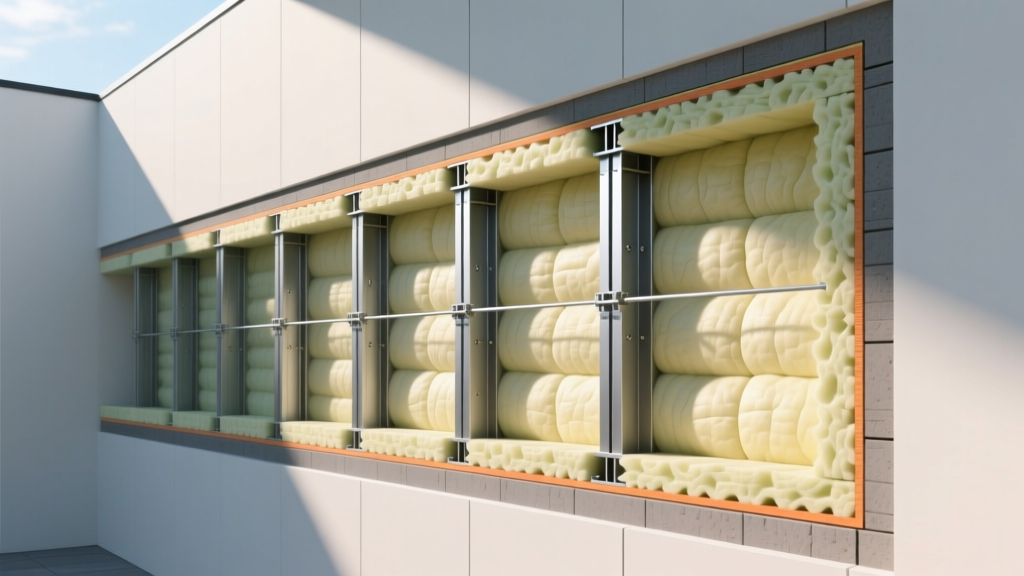
Calculated Decision Framework: Sizing Thermal Breaks
Knowing examples of materials that make good conductors vs insulators is only the first step. The application requires calculating the necessary thickness of a thermal break to prevent condensation. Use this framework when detailing structural penetrations:
- Identify the Conductive Element: Determine the cross-sectional area and k-value of the penetrating material (e.g., a 4-inch steel beam).
- Calculate the Heat Flux: Use the formula Q = (k × A × ΔT) / d, where A is area, ΔT is the temperature difference, and d is thickness.
- Specify the Break Material: Select a structural thermal break pad (e.g., Armatherm 500 or Schöck Isokorb) with a compressive strength matching the structural load (often 10,000+ psi) and a k-value below 0.25 W/m·K.
- Verify Surface Temperature: Ensure the interior surface temperature of the connection remains above the dew point of the interior conditioned air to prevent condensation.
For comprehensive modeling of these thermal bridges, professionals rely on 2D and 3D heat transfer software like THERM (developed by Lawrence Berkeley National Laboratory) to validate assembly U-factors before construction begins. The ENERGY STAR commercial building guidelines heavily emphasize the elimination of these bypasses to achieve top-tier energy certifications.
FAQ: Conductors and Insulators in Modern Architecture
Does wood act as an insulator or a conductor?
Wood is a natural insulator compared to metals and masonry, with an R-value of approximately R-1.25 per inch. However, in modern high-performance building codes, wood framing is still considered a thermal bridge relative to the cavity insulation (like R-23 fiberglass). Therefore, even wood-framed walls require continuous exterior insulation to meet 2026 energy codes in most northern climate zones.
Can concrete be used as an insulator?
Standard poured concrete is a moderate conductor (R-0.15 per inch). However, Insulating Concrete Forms (ICFs) and Autoclaved Aerated Concrete (AAC) alter the material's physical structure. AAC incorporates millions of microscopic air voids during manufacturing, dropping its conductivity and raising its R-value to roughly R-1.25 per inch, blurring the line between structural mass and insulation.
Why do metal roofs feel hotter than asphalt shingles?
Metal is a high conductor. When exposed to solar radiation, a metal roof rapidly conducts that heat to its underside. Without a ventilated air gap and a high-R radiant barrier or rigid foam insulation directly beneath the metal panels, the heat will immediately transfer into the attic space. Asphalt shingles, while still absorbing heat, have lower thermal conductivity and higher thermal mass, slowing the transfer rate.
Written by
Marcus ChenMarcus Chen is a licensed structural engineer (PE) and building materials analyst with over 12 years of experience across residential, commercial, and industrial construction. He holds a Master of Science in Civil Engineering from UC Berkeley and spent six years at Thornton Tomasetti before transitioning to independent consulting and technical writing. Marcus specializes in material selection for seismic-prone regions, concrete reinforcement strategies, and lifecycle cost analysis. His work has been cited by the American Concrete Institute (ACI) and the Structural Engineers Association of California (SEAOC). When he is not on a job site or at his desk, you will find him hiking the Sierra Nevada or restoring a 1920s craftsman bungalow in Oakland, CA.
More from Marcus Chen
View all
Construction Cost
How Much Did the Eiffel Tower Cost to Build?
How much did the Eiffel Tower cost to build in 1889? We adjust for inflation and compare its budget to modern skyscraper construction.
Aug 4, 2026

Fire Resistance
What Is a Fire Resistant Material? Testing & Certification Guide
Discover what is a fire resistant material through ASTM and UL testing. Learn how fire ratings, certifications, and assemblies work in construction.
Aug 4, 2026

Construction Cost
How Much Did the Burj Khalifa Cost to Build?
How much did the Burj Khalifa cost to build? We break down the $1.5B project and extract 5 money-saving strategies for your next build.
Jul 30, 2026