Material Insulation: A Climate-Zone Selection Framework
Master material insulation selection with our climate-zone framework. Compare R-values, moisture risks, and costs for optimal building envelopes.

The Core Physics of Material Insulation Selection
Selecting the correct material insulation requires moving beyond basic R-value comparisons. Building envelope performance is governed by three intersecting physics domains: thermal conductivity (λ), hygrothermal moisture transport, and thermal bridging. A material that performs exceptionally in IECC Climate Zone 2 (hot-humid) may cause catastrophic condensation in Climate Zone 6 (cold).
Thermal resistance is not static. For example, closed-cell spray polyurethane foam (ccSPF) and polyisocyanurate (polyiso) rely on blowing agents trapped within their cellular structure. As these gases diffuse and are replaced by air over time, thermal drift occurs. Furthermore, polyiso exhibits a phenomenon known as 'reverse thermal conductivity'—its R-value per inch drops from roughly R-6.5 at 75°F to R-5.0 at 20°F due to the condensation of blowing agents within the cells. Understanding these material-specific behaviors is the foundation of the selection framework outlined below.
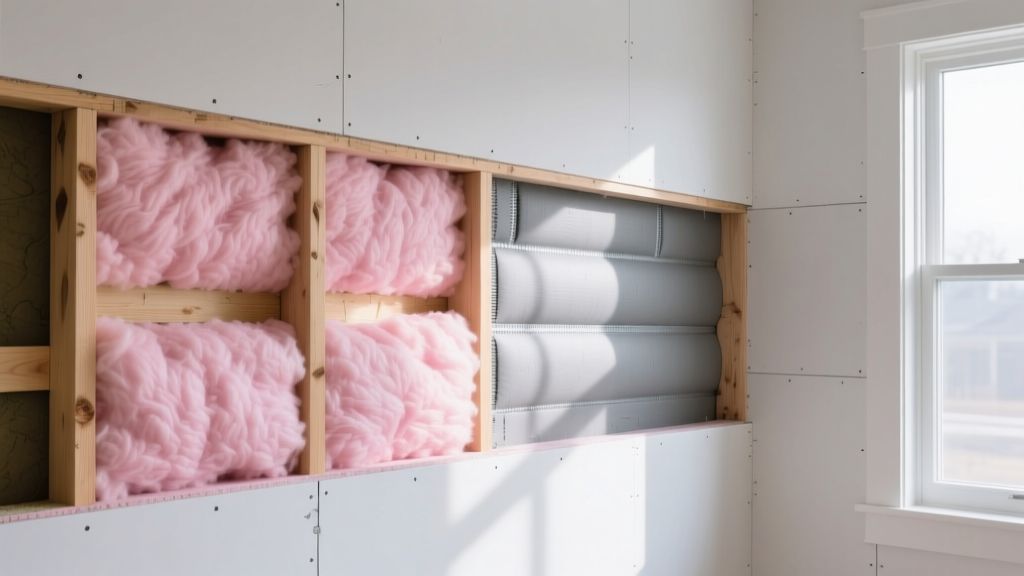
The 4-Step Material Insulation Decision Matrix
To systematically evaluate material insulation for any project, apply this four-step decision framework before finalizing specifications.
Step 1: Climate Zone and Code Baseline
Identify the project's IECC Climate Zone. Zones 4 through 8 generally mandate continuous insulation (ci) on exterior walls to mitigate thermal bridging through wood or steel framing. According to the U.S. Department of Energy, attics in Zones 5-8 require a minimum of R-49 to R-60, while wall cavities demand R-20 plus R-5 ci (or R-13 + R-10 ci). Your baseline material must achieve these targets without exceeding the physical depth of the framing cavity.
Step 2: Hygrothermal Risk and Vapor Permeability
Calculate the dew point within the wall assembly. The interior vapor retarder's perm rating must align with the exterior sheathing's drying potential. If you select an exterior rigid foam with a perm rating below 1.0 (e.g., foil-faced polyiso), the assembly cannot dry to the exterior. In this scenario, you must use a Class III vapor retarder (like standard latex paint) on the interior to allow inward drying. Misaligning these material insulation layers traps moisture, leading to mold and structural rot.
Step 3: Acoustic and Fire Rating Prioritization
For multi-family or commercial partitions, thermal resistance is secondary to Sound Transmission Class (STC) and fire containment. Mineral wool (rock wool) inherently achieves STC ratings of 45-50 in standard 2x4 partitions and is non-combustible (ASTM E136), making it the mandatory choice for fire-stopping and acoustic separation, despite its higher cost compared to fiberglass.
Step 4: Embodied Carbon and Budget Alignment
Evaluate the Global Warming Potential (GWP) of the material. Traditional ccSPF utilizes HFC-245fa blowing agents with a GWP over 1,000. Modern alternatives use HFO (hydrofluoroolefin) blowing agents with a GWP of less than 5. Always request Environmental Product Declarations (EPDs) from manufacturers to verify embodied carbon metrics for LEED or WELL certification requirements.
Framework Quick-Reference: Assembly Drying Rules
- Cold Climates (Zones 5-8): Use interior Class I or II vapor retarders. Ensure exterior sheathing is uninsulated or uses vapor-open mineral wool to allow outward drying.
- Hot-Humid Climates (Zones 1-3): Avoid interior vapor retarders entirely. Use exterior rigid foam or spray foam to keep the interior drywall above the dew point.
- Mixed Climates (Zone 4): Use 'smart' vapor retarders (e.g., CertainTeed MemBrain) that shift from <1 perm in winter to >10 perms in summer.
2026 Material Insulation Performance & Cost Matrix
The following matrix benchmarks current market products, providing exact specifications for cost estimation and performance modeling. Pricing reflects Q1 2026 national averages for material costs, excluding labor.
| Material Category | Product Benchmark | R-Value / Inch | Cost (per sq ft) | Permeability | Primary Use Case |
|---|---|---|---|---|---|
| Fiberglass Batts | Owens Corning EcoTouch R-15 | 3.1 - 3.4 | $0.65 - $0.85 | High (>10) | Standard interior wall cavities, vented attics |
| Mineral Wool | ROCKWOOL Comfortbatt R-23 | 4.2 - 4.3 | $1.20 - $1.55 | High (>10) | Acoustic partitions, fire-stopping, exterior ci |
| Polyisocyanurate | Dow Thermax Sheathing | 5.6 - 6.5* | $1.10 - $1.40 | Very Low (<1) | Exterior continuous insulation, roof decks |
| Open-Cell SPF | BASF ENERTITE | 3.5 - 3.7 | $0.90 - $1.20 | High (>10) | Complex framing, underside of roof decks (warm climates) |
| Closed-Cell SPF | Icynene ProSeal Eco (HFO) | 6.5 - 7.0 | $1.80 - $2.40 | Low (<1) | Below-grade, flood zones, space-constrained cavities |
*Note: Polyiso R-values degrade in sub-freezing temperatures. Always model polyiso at R-5.0 per inch for winter heating load calculations in northern climates.
Critical Failure Modes in Material Selection
Even high-performance material insulation will fail if installed incorrectly or specified for the wrong assembly. The Building America Solution Center highlights several recurring field failures that compromise envelope integrity.
1. Fiberglass Compression and Convective Looping
Fiberglass batts rely on trapped air for thermal resistance. Compressing a 6.25-inch R-19 batt into a 5.5-inch 2x6 cavity reduces its effective R-value to approximately R-17. More critically, leaving gaps at the top or bottom of the cavity creates convective loops—air that cools against the exterior sheathing drops, while warm interior air rises, transferring heat via convection rather than conduction. To prevent this, specify batts that match the exact cavity depth, or switch to dense-pack cellulose or spray foam for irregular framing.
2. Open-Cell Spray Foam in Cold Climates
Open-cell spray foam is vapor-permeable and holds moisture. When applied to the interior of roof sheathing in Climate Zones 5 or higher, interior moisture vapor can migrate through the foam and condense on the cold underside of the roof deck during winter. This hidden condensation leads to sheathing rot. In cold climates, roof assemblies must utilize closed-cell spray foam (which acts as its own vapor retarder) or a vented airspace above open-cell foam.
3. Mineral Wool Moisture Retention
While mineral wool is highly resistant to fire and maintains its R-value when exposed to temperature extremes, it is not hydrophobic in the same way closed-cell foam is. If a bulk water leak occurs from a roof flashing failure, mineral wool will absorb and hold water against the structural framing. It must always be paired with a robust exterior weather-resistive barrier (WRB) and proper flashing details.
Navigating Code Compliance and Industry Standards
Material insulation specifications must align with the latest iterations of the International Energy Conservation Code (IECC) and ASHRAE 90.1. For commercial projects, continuous insulation (ci) is no longer optional in most of the United States. The definition of ci requires that the insulation layer is uninterrupted by structural framing, fasteners, or other thermal bridges.
When specifying exterior rigid foam, verify the product's flame spread and smoke developed indices per ASTM E84. Many standard expanded polystyrene (EPS) products require a thermal barrier (like 1/2-inch gypsum board) to be used in occupied spaces. For exposed applications, such as basement rim joists, specify products with specific fire-retardant coatings or opt for mineral wool boards, which inherently meet non-combustible standards without additional coverings. The North American Insulation Manufacturers Association (NAIMA) provides detailed compliance guides for meeting NAIMA 202-96 standards regarding facing materials and vapor retarder classifications.
Procurement Warning: Blowing Agent Transitions
As of 2025/2026, the EPA has heavily restricted HFC blowing agents under the AIM Act. When ordering closed-cell spray foam or extruded polystyrene (XPS), explicitly verify that the manufacturer has transitioned to HFO or hydrocarbon blowing agents. Older inventory utilizing HFC-134a or HFC-245fa may be illegal to install in certain jurisdictions and carries a massive carbon footprint that will disqualify your project from green building certifications.
By applying this climate-zone framework and respecting the hygrothermal properties of each product, architects and builders can specify material insulation that guarantees long-term durability, code compliance, and optimal energy performance.
Written by
Marcus ChenMarcus Chen is a licensed structural engineer (PE) and building materials analyst with over 12 years of experience across residential, commercial, and industrial construction. He holds a Master of Science in Civil Engineering from UC Berkeley and spent six years at Thornton Tomasetti before transitioning to independent consulting and technical writing. Marcus specializes in material selection for seismic-prone regions, concrete reinforcement strategies, and lifecycle cost analysis. His work has been cited by the American Concrete Institute (ACI) and the Structural Engineers Association of California (SEAOC). When he is not on a job site or at his desk, you will find him hiking the Sierra Nevada or restoring a 1920s craftsman bungalow in Oakland, CA.
More from Marcus Chen
View all
Construction Cost
How Much Did the Eiffel Tower Cost to Build?
How much did the Eiffel Tower cost to build in 1889? We adjust for inflation and compare its budget to modern skyscraper construction.
Aug 4, 2026

Fire Resistance
What Is a Fire Resistant Material? Testing & Certification Guide
Discover what is a fire resistant material through ASTM and UL testing. Learn how fire ratings, certifications, and assemblies work in construction.
Aug 4, 2026

Construction Cost
How Much Did the Burj Khalifa Cost to Build?
How much did the Burj Khalifa cost to build? We break down the $1.5B project and extract 5 money-saving strategies for your next build.
Jul 30, 2026