R Values of Insulation Materials: Energy Efficiency Guide
Compare R-values of insulation materials to maximize energy efficiency. Includes climate zone matrices, cost data, and real-world thermal performance tips.
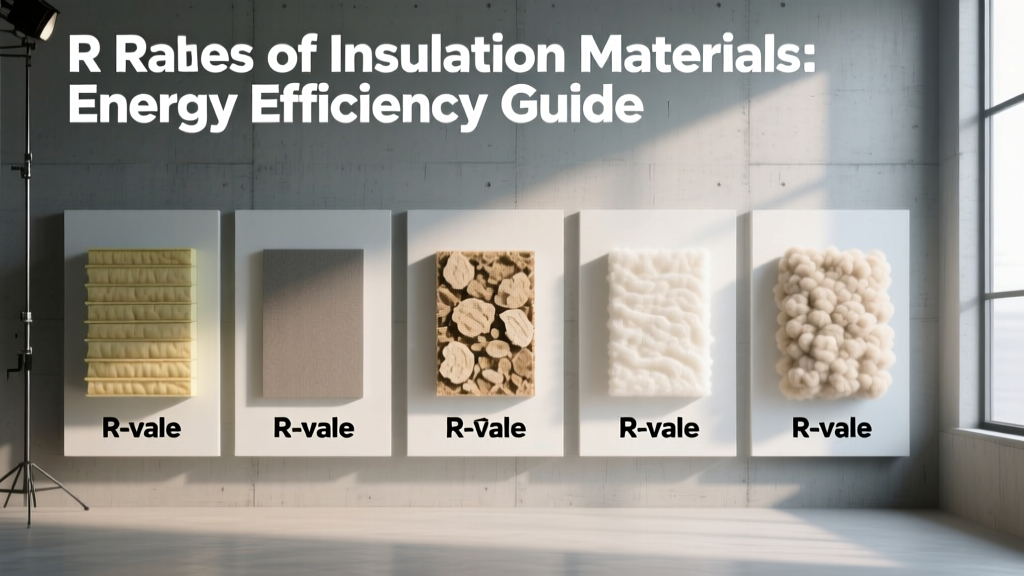
The Physics of Thermal Resistance: Decoding the Numbers
When evaluating the R-values of insulation materials, it is critical to understand that R-value measures thermal resistance, not thermal mass or heat capacity. The "R" stands for resistance to heat flow. Mathematically, it is the temperature difference across a material divided by the heat flux (R = ΔT / Q). A higher number indicates greater insulating power, but the relationship between R-value and actual energy savings is non-linear.
Center-of-Cavity vs. Whole-Wall R-Values
The most common mistake in residential and commercial energy modeling is relying on the "center-of-cavity" R-value printed on insulation packaging. This number only accounts for the insulation itself, ignoring the structural framing. Wood studs have an R-value of roughly R-1.25 per inch, while steel studs are highly conductive and can create severe thermal bridges.
According to research by the Building Science Corporation, a standard 2x6 wood-framed wall cavity filled with R-21 fiberglass batts does not perform at R-21. Because the wood studs comprise roughly 20% to 25% of the wall area, the whole-wall R-value drops to approximately R-16. To achieve a true R-21 whole-wall performance, energy-efficient building codes now mandate continuous insulation (ci) on the exterior of the sheathing, such as a layer of 1-inch polyisocyanurate rigid foam, to break the thermal bridge.
Comprehensive Matrix: R-Values of Insulation Materials
The following matrix details the thermal performance, density, and current market costs for the most prevalent insulation categories. Pricing reflects 2026 material and professional installation averages for standard residential applications.
| Material Type | R-Value per Inch | Density (pcf) | Installed Cost (per sq ft) | Best Application |
|---|---|---|---|---|
| Closed-Cell Spray Foam (e.g., Icynene ProSeal) | R-6.0 - R-7.0 | 1.75 - 2.0 | $1.80 - $3.00 | Roof decks, below-grade, flood zones |
| Polyisocyanurate (Polyiso) Rigid Board | R-5.6 - R-6.5 | 1.5 - 2.0 | $1.10 - $1.60 | Exterior continuous insulation (ci), commercial roofs |
| Extruded Polystyrene (XPS) (e.g., Owens Corning FOAMULAR NGX) | R-4.7 - R-5.0 | 1.3 - 1.5 | $0.90 - $1.40 | Below-grade foundations, inverted roof assemblies |
| Mineral Wool (e.g., ROCKWOOL Comfortbatt) | R-4.0 - R-4.3 | 3.5 - 5.0 | $1.20 - $1.70 | Fire-stopping, acoustic separation, exterior ci |
| Fiberglass Batts (High-Density) | R-3.6 - R-4.3 | 1.5 - 2.0 | $0.80 - $1.20 | Standard wood-framed wall cavities, attics |
| Open-Cell Spray Foam | R-3.5 - R-3.8 | 0.4 - 0.6 | $1.00 - $1.50 | Interior wall soundproofing, unvented attics (warm climates) |
| Blown-In Cellulose (Dense-packed) | R-3.2 - R-3.8 | 3.0 - 3.5 | $1.10 - $1.50 | Retrofit wall cavities, attic floor overlays |
Climate Zone Targeting Framework
The U.S. EPA Energy Star program and the International Energy Conservation Code (IECC) divide the country into distinct climate zones. Selecting the correct R-value requires aligning your material choice with your specific zone to prevent condensation risks and maximize ROI.
- Zones 1-3 (Hot-Humid / Hot-Dry): Focus on blocking radiant heat. Target Attic: R-30 to R-49. Target Walls: R-13 to R-15. Pro-Tip: Use open-cell spray foam or radiant barrier sheathing. Avoid vapor barriers on the interior; the wall must dry to the inside.
- Zones 4-5 (Mixed-Humid / Marine): Requires balanced heating and cooling strategies. Target Attic: R-49 to R-60. Target Walls: R-20 to R-21 (or R-13 cavity + R-5 continuous ci). Pro-Tip: Mineral wool or high-density fiberglass paired with a smart vapor retarder (like MemBrain) allows seasonal drying.
- Zones 6-8 (Cold / Subarctic): Focus on extreme heat retention and preventing interstitial condensation. Target Attic: R-60+. Target Walls: R-20+ cavity + R-10 to R-15 exterior ci. Pro-Tip: Closed-cell spray foam or thick exterior Polyiso is mandatory to keep the interior sheathing above the dew point during winter months.
Real-World Performance Traps
Laboratory R-values rarely survive contact with a real job site. The Department of Energy notes that installation defects can degrade thermal performance by up to 30%. Watch for these specific failure modes:
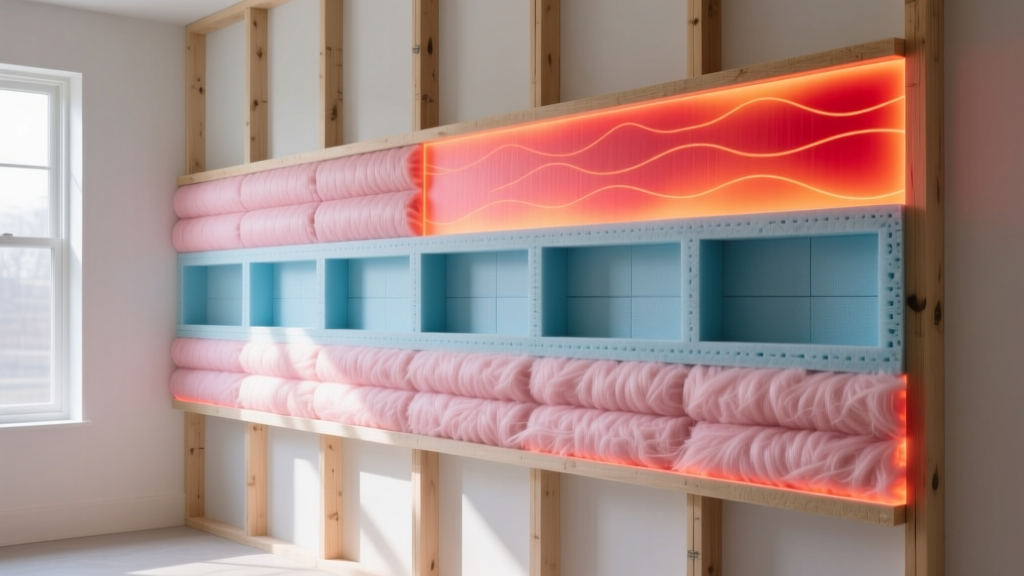
Fiberglass batts rely on trapped pockets of air for their thermal resistance. If you compress a 6.25-inch R-21 batt into a 5.5-inch 2x6 wall cavity, you are not getting R-21. The compression increases the material's density but reduces its total R-value to roughly R-19. Always buy batts specifically sized for your framing depth, or use blown-in materials that conform without compressing.
Thermal Drift in Polyiso: Polyisocyanurate insulation uses blowing agents that slowly diffuse out of the foam over time, replaced by air. This process, known as thermal drift, causes the R-value to drop from an initial R-6.5 down to an aged, stabilized R-5.6 over several years. Always use the aged R-value when performing energy modeling for code compliance.
Moisture Saturation: Water is a highly efficient thermal conductor. If mineral wool or fiberglass gets wet from a roof leak or bulk water intrusion, its R-value plummets to near zero. While mineral wool is hydrophobic and will drain and dry relatively quickly, fiberglass holds water against the wood framing, leading to rot and total thermal failure. In moisture-prone areas, specify closed-cell spray foam or XPS.
Calculating Your Insulation Payback Period
Before specifying a premium insulation product, run a basic payback calculation to justify the capital expenditure. The formula is straightforward:
Payback Period (Years) = Total Installed Cost / Annual Energy Savings
Scenario: Upgrading an attic from R-19 to R-60 in Climate Zone 5 using blown-in cellulose.
Cost: 1,500 sq ft attic × $1.40/sq ft = $2,100 total installed cost.
Savings: Based on local utility rates ($0.14/kWh) and heating degree days, the upgrade saves roughly $380 annually on HVAC loads.
Payback: $2,100 / $380 = 5.5 years.
Because the R-values of insulation materials remain stable over decades (provided they stay dry and uncompressed), a 5.5-year payback yields 25+ years of pure profit in energy savings over the lifespan of a standard 30-year roof assembly.
Future-Proofing: GWP and Code Compliance
When selecting rigid foams like XPS or closed-cell spray foam, look beyond just the R-value. Older formulations utilized HFC blowing agents with massive Global Warming Potential (GWP). Modern building codes are aggressively phasing these out. Specify next-generation materials like Owens Corning FOAMULAR NGX or Demilec Heatlok Soya HFO, which utilize hydrofluoroolefin (HFO) blowing agents. These provide the same high R-values per inch but drop the GWP by over 99%, ensuring your building envelope remains compliant with evolving environmental regulations while delivering maximum thermal resistance.
Written by
David NakamuraDavid Nakamura is a licensed architect (AIA) and construction technology writer focused on sustainable building methods, mass timber engineering, and high-performance building envelopes. He holds a Master of Architecture from the University of Washington and is a certified Passive House Consultant (CPHC). David spent eight years at the Seattle firm Mithun, where he led the design of three LEED Platinum projects, before founding his own practice specializing in net-zero residential design. He serves on the editorial advisory board of GreenBuilder Magazine and has authored peer-reviewed papers on cross-laminated timber (CLT) connections for the Journal of Structural Engineering. In his spare time, David teaches woodworking at Pratt Fine Arts Center and kayaks the Puget Sound.
More from David Nakamura
View all
Construction Cost
Labor Cost to Build a Deck Per Sq Ft: 2026 Installation Guide
Discover the exact labor cost to build a deck per sq ft in 2026. This installation guide breaks down contractor rates, complexity factors, and hidden fees.
Aug 4, 2026

Construction Cost
How Much Does It Cost to Build a 3 Bedroom House? Financing Guide
Learn exactly how much it costs to build a 3 bedroom house and explore 2026 financing options, construction loan types, and budget frameworks for your build.
Aug 4, 2026

Construction Cost
Cost to Build a Tennis Court: 2026 Guide
How much does it cost to build a tennis court in 2026? Breakdowns for asphalt, concrete, and synthetic surfaces plus fencing and lighting.
Jul 30, 2026