R Value of Insulation Materials: A Climate-Zone Selection Framework
Master the R value of insulation materials with our selection framework. Compare costs, thickness, and climate zone requirements for optimal efficiency.
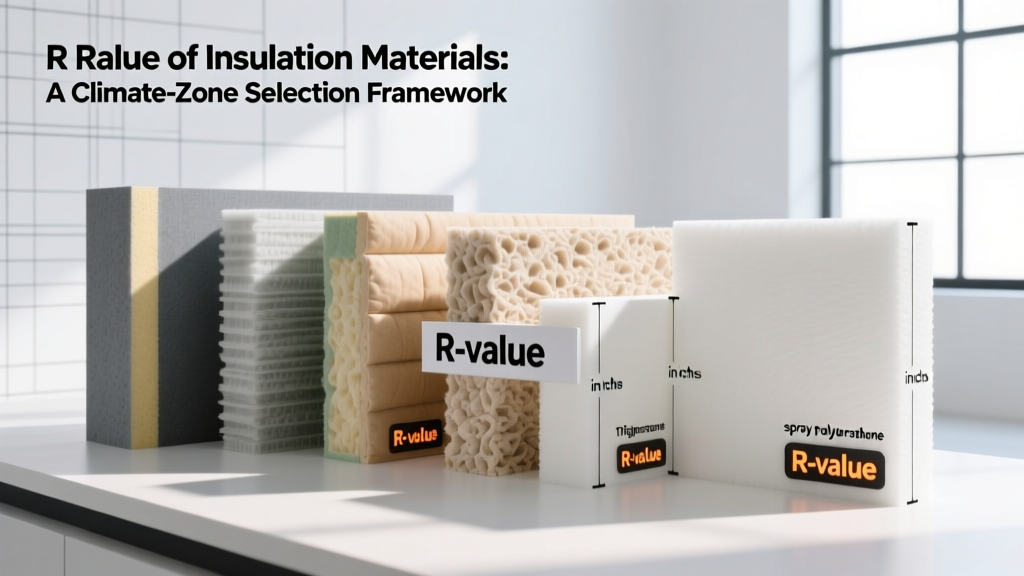
The labeled R-value on insulation packaging rarely reflects the thermal resistance your building will actually experience. While the Federal Trade Commission mandates strict testing for the R value of insulation materials, these laboratory metrics assume perfect installation in a vacuum. In real-world construction, thermal bridging, material compression, and temperature extremes drastically alter performance. Selecting the right insulation requires a framework that bridges the gap between labeled R-value and effective whole-wall R-value.
The 'Effective R-Value' Matrix: Labeled vs. Installed
According to the Pacific Northwest National Laboratory (PNNL), standard wood framing reduces the overall thermal resistance of a wall cavity by 15% to 20% due to thermal bridging through the studs. If you install R-19 fiberglass batts in a 2x6 wall, the whole-wall R-value drops to approximately R-15.2.
Doubling the cavity insulation from R-19 to R-38 in a standard wood-framed wall will not double the effective wall R-value. The framing factor remains the bottleneck. To achieve high-performance envelopes, you must pair cavity insulation with continuous exterior insulation (ci) to break the thermal bridge.
Material R-Value Comparison & Cost Per R-Unit
Evaluating the R value of insulation materials requires analyzing the cost per R-unit (the cost to achieve one unit of thermal resistance per square foot). The table below reflects 2026 market pricing for residential and light-commercial applications.
| Material Type | Product Example | Labeled R/inch | Effective R/inch | Cost / Sq Ft (1") | Cost per R-Unit |
|---|---|---|---|---|---|
| Fiberglass Batt | Owens Corning EcoTouch | R-3.1 - R-3.4 | R-2.8 | $0.42 | $0.15 |
| Mineral Wool | ROCKWOOL Comfortbatt | R-4.2 | R-4.0 | $0.68 | $0.17 |
| Open-Cell SPF | Icynene Classic Max | R-3.7 | R-3.7 | $0.75 | $0.20 |
| Closed-Cell SPF | Demilec Heatlok H2 | R-6.5 | R-6.5 | $1.65 | $0.25 |
| XPS Rigid Foam | Owens Corning FOAMULAR NGX | R-5.0 | R-4.5 (Aged) | $0.85 | $0.19 |
| Polyiso Rigid | Carlisle SecurShield HD | R-6.5 | R-5.0 (Cold) | $0.78 | $0.16 |
XPS experiences thermal drift as its blowing agents off-gas over 5 to 10 years, dropping its effective R-value from R-5.0 to R-4.5 per inch. Polyiso suffers from the 'reverse thermal effect'—its R-value drops significantly in temperatures below 40°F (4°C). For cold-climate exterior applications, mineral wool or specialized cold-weather polyiso is required.
Climate Zone Selection Framework
The Department of Energy (DOE) categorizes North America into distinct climate zones. Your selection framework must align the material's vapor permeability and R-value density with the local climate's primary moisture drive.
Zones 1-3: Hot-Humid & Hot-Dry (Cooling-Dominated)
In cooling-dominated climates, the primary goal is keeping heat and moisture out. The vapor drive moves from the exterior to the interior during summer months.
- Cavity Strategy: Open-cell spray foam (R-3.7/inch) or unfaced fiberglass batts. Open-cell allows the wall cavity to dry inward if moisture breaches the exterior cladding.
- Exterior Strategy: Avoid exterior vapor-impermeable rigid foams like foil-faced polyiso, which can trap condensation against the exterior sheathing when the AC cools the interior.
- Target Assembly: R-13 cavity + R-0 to R-5 continuous exterior (vapor-permeable mineral wool).
Zones 4-5: Mixed-Humid & Cool (Balanced)
These zones experience extreme seasonal swings. The vapor drive reverses between summer and winter, making moisture management the most complex.
- Cavity Strategy: The 'Flash and Batt' method is optimal. Apply 1.5 inches of closed-cell spray foam (R-9.75) directly to the exterior sheathing to seal air leaks and raise the sheathing temperature above the dew point, then fill the remainder with mineral wool or fiberglass.
- Exterior Strategy: R-5 to R-10 continuous insulation. Use semi-permeable XPS or unfaced polyiso.
- Target Assembly: R-20 cavity + R-7.5 continuous exterior.
Zones 6-8: Cold & Subarctic (Heating-Dominated)
In heating-dominated climates, the winter vapor drive moves from the warm, humid interior to the cold exterior. Preventing interior moisture from condensing inside the wall cavity is paramount.
- Cavity Strategy: Dense-pack cellulose or mineral wool. Avoid open-cell foam unless paired with an interior vapor retarder (like MemBrain or standard 6-mil poly, depending on exact zone).
- Exterior Strategy: High-R continuous insulation is mandatory. You must use enough exterior rigid foam to keep the wall sheathing above the dew point during winter. Rule of thumb: In Zone 6, exterior ci must be at least R-11.25 for a 2x4 wall, and R-7.5 for a 2x6 wall.
- Target Assembly: R-21 cavity + R-15 continuous exterior.
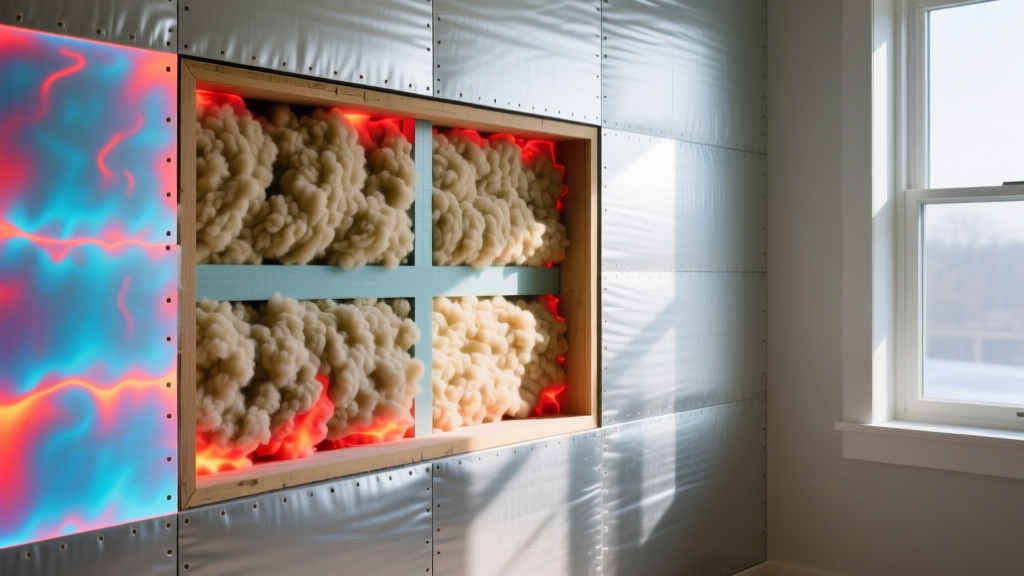
Space Constraints: High R-Value Solutions for Tight Cavities
When retrofitting historic buildings or designing spaces with strict dimensional limits, standard materials fail to provide adequate thermal resistance within a 3.5-inch or 5.5-inch cavity.
- Aerogel Blankets (e.g., Spaceloft): Offering an astonishing R-10 per inch, aerogel is highly hydrophobic and vapor-permeable. However, at roughly $4.50 to $6.00 per board foot, it is reserved for critical thermal bridges, rim joists, or historic masonry retrofits where preserving interior square footage is worth the premium.
- Vacuum Insulation Panels (VIPs): VIPs deliver R-25 to R-30 per inch. They are used in high-end commercial facades and ultra-thin appliance walls. The critical failure mode: if the foil envelope is punctured during installation, the panel loses its vacuum and drops to R-4 per inch instantly. They cannot be cut or nailed on-site.
- High-Density Closed-Cell SPF: At 2.0 to 2.2 lbs/ft³ density, modern closed-cell foams achieve R-6.5 to R-7.0 per inch while acting as a Class II vapor retarder and adding structural racking strength to the framing.
Common Selection Mistakes & Failure Modes
Compressing an R-19 fiberglass batt (designed for a 6.25" cavity) into a standard 2x4 wall (3.5" depth) does not yield R-19 in a thinner profile. The compression increases the material's density but destroys the trapped air pockets that provide thermal resistance. The compressed batt will perform at approximately R-13 to R-14, while completely filling the cavity and leaving no room for wiring or plumbing without severe pinching. Always match the batt thickness to the cavity depth.
Another frequent error is misplacing the vapor retarder. The FTC's R-Value Rule governs how manufacturers label products, but it does not dictate building science. A Class I vapor barrier (like polyethylene sheeting) installed on the exterior side of a wall in a hot-humid climate will trap moisture inside the wall cavity, leading to rapid sheathing rot and mold proliferation. Always place the primary vapor retarder on the warm-in-winter side of the assembly.
Summary Decision Checklist
Before finalizing your insulation schedule, verify the following parameters:
- Whole-Wall Calculation: Have you factored in the 15-20% framing penalty for cavity-only assemblies?
- Dew Point Analysis: Does the exterior continuous insulation provide enough R-value to keep the sheathing above the dew point in your specific climate zone?
- Thermal Drift: If using XPS or Polyiso, have you used the aged/cold-weather R-value for your energy modeling rather than the labeled day-one value?
- Drying Potential: Does the assembly allow moisture to dry to at least one side (interior or exterior) based on the local vapor drive?
By shifting focus from the labeled R value of insulation materials to the effective, climate-adjusted thermal resistance of the entire assembly, you eliminate the most common causes of energy loss and moisture damage in modern construction.
Written by
Marcus ChenMarcus Chen is a licensed structural engineer (PE) and building materials analyst with over 12 years of experience across residential, commercial, and industrial construction. He holds a Master of Science in Civil Engineering from UC Berkeley and spent six years at Thornton Tomasetti before transitioning to independent consulting and technical writing. Marcus specializes in material selection for seismic-prone regions, concrete reinforcement strategies, and lifecycle cost analysis. His work has been cited by the American Concrete Institute (ACI) and the Structural Engineers Association of California (SEAOC). When he is not on a job site or at his desk, you will find him hiking the Sierra Nevada or restoring a 1920s craftsman bungalow in Oakland, CA.
More from Marcus Chen
View all
Construction Cost
How Much Did the Eiffel Tower Cost to Build?
How much did the Eiffel Tower cost to build in 1889? We adjust for inflation and compare its budget to modern skyscraper construction.
Aug 4, 2026

Fire Resistance
What Is a Fire Resistant Material? Testing & Certification Guide
Discover what is a fire resistant material through ASTM and UL testing. Learn how fire ratings, certifications, and assemblies work in construction.
Aug 4, 2026

Construction Cost
How Much Did the Burj Khalifa Cost to Build?
How much did the Burj Khalifa cost to build? We break down the $1.5B project and extract 5 money-saving strategies for your next build.
Jul 30, 2026