R-Value Guide: Selecting the Best Thermal Insulation Blanket Material
Compare R-value performance, compression limits, and 2026 costs for fiberglass and mineral wool thermal insulation blanket materials in residential walls.
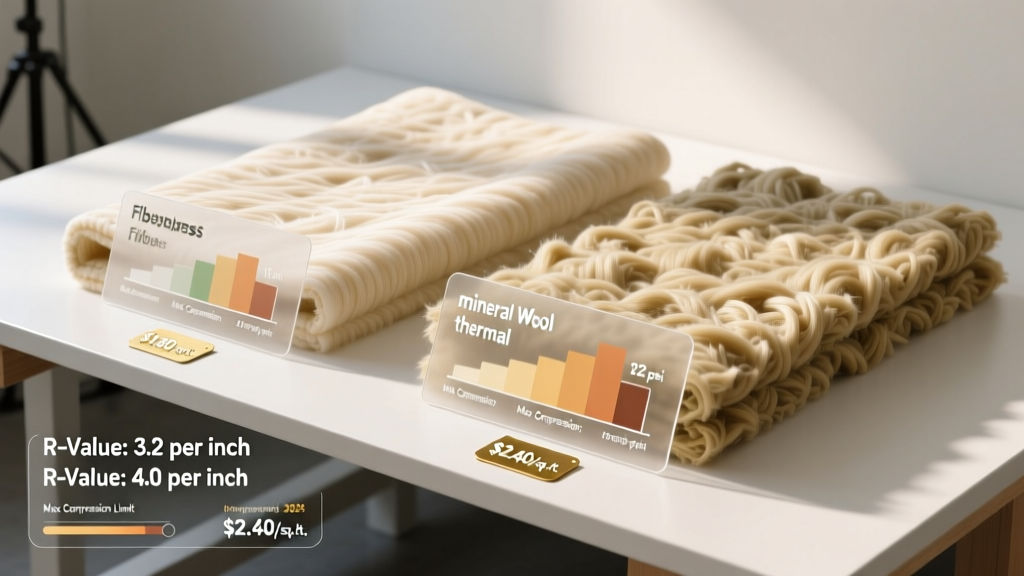
The Physics of Blanket Insulation: Understanding R-Value Degradation
The stated R-value on a package of thermal insulation blanket material is measured under strict laboratory conditions (ASTM C518). In the field, thermal performance is highly dynamic. Blanket insulation—comprising fiberglass and mineral wool batts or rolls—functions by trapping millions of microscopic air pockets within its fibrous matrix. When these pockets are compromised, the R-value degrades through two primary mechanisms: convective looping and compression.
Convective looping occurs when low-density blankets are installed in cavities with extreme temperature differentials. Cold air from the exterior sheathing sinks, while warm interior air rises, creating a micro-convection current inside the batt that transfers heat. According to the Pacific Northwest National Laboratory's Building America Solution Center, standard-density fiberglass batts (0.5 to 0.7 pounds per cubic foot) are highly susceptible to this effect in climate zones with severe winter temperatures, effectively reducing their real-world R-value by 10% to 15% unless paired with a continuous exterior insulation layer.
Never force a thicker batt into a shallower cavity. Compressing an R-19 (6.25-inch) fiberglass batt into a standard 5.5-inch 2x6 wall cavity does not yield R-19. The compressed fibers lose their dead-air spaces, dropping the effective R-value to approximately R-17. Always match the batt thickness to the exact cavity depth.
Material Matrix: Fiberglass vs. Mineral Wool Performance
When selecting a thermal insulation blanket material, the choice overwhelmingly narrows to two dominant categories: fiberglass and mineral (stone) wool. While both are installed similarly, their physical properties dictate vastly different performance profiles under stress, moisture, and fire conditions.
| Performance Metric | High-Density Fiberglass (e.g., Owens Corning PINK Next Gen) | Mineral Wool (e.g., ROCKWOOL Comfortbatt) |
|---|---|---|
| Nominal R-Value per Inch | R-3.7 to R-4.3 | R-4.2 to R-4.3 |
| Material Density | 0.8 to 1.2 pcf | 2.5 to 4.0 pcf |
| Fire Rating (ASTM E84) | Flame Spread ≤ 25 (Non-combustible) | Flame Spread 0 (Non-combustible to 2150°F) |
| Acoustic Damping (NRC) | 0.50 - 0.65 | 0.85 - 1.05 |
| Moisture Retention | Dries quickly; loses R-value when wet | Hydrophobic; maintains R-value when damp |
| Friction Fit Capability | Moderate (requires stapling if sagging) | Excellent (rigid enough to self-support) |
Fiberglass Blankets: The Cost-Effective Baseline
Modern fiberglass blankets have evolved significantly from the low-density, easily compressed batts of the early 2000s. Products like Knauf EcoBatt and Owens Corning PINK Next Gen utilize advanced binder technologies that eliminate formaldehyde and increase the structural memory of the glass fibers. For standard 2x4 framing (3.5-inch cavity), high-density fiberglass delivers a reliable R-15. However, fiberglass requires meticulous cutting and fitting; gaps as small as 1/8th of an inch around electrical boxes can create thermal bypasses that disproportionately reduce whole-wall R-value.
Mineral Wool Blankets: The Premium Performance Tier
Mineral wool, manufactured by spinning molten basalt rock and slag, offers superior dimensional stability. Because it is roughly three times denser than fiberglass, it completely resists convective looping, making it the superior thermal insulation blanket material for extreme climates. Its hydrophobic nature means that if a wall assembly experiences a minor moisture intrusion, mineral wool will not absorb the water, preventing the catastrophic R-value loss and mold growth associated with wet fiberglass.
Real-World R-Value: Installation Variables That Destroy Performance
The U.S. Department of Energy emphasizes that the installed performance of blanket insulation relies heavily on the quality of the installation. The Residential Energy Services Network (RESNET) defines three grades of installation quality. Achieving a RESNET Grade I installation is non-negotiable for maximizing your R-value investment.
Research demonstrates that a mere 4% gap in insulation coverage (missed spots, compressed edges, or unsealed top plates) can reduce the overall thermal resistance of the wall assembly by up to 50%. Even a flawless blanket installation loses approximately 20% of its clear-wall R-value to thermal bridging through the wooden studs themselves. This is why modern building codes increasingly mandate continuous exterior rigid foam to break the thermal bridge.
Cost vs. Performance Analysis (2026 Pricing)
Material costs have stabilized following the supply chain disruptions of the early 2020s. When evaluating the financial impact, it is critical to look beyond the per-square-foot material cost and factor in labor, waste, and the long-term energy savings dictated by the material's effective R-value.
| Cost Factor | High-Density Fiberglass (R-15, 2x4 Wall) | Mineral Wool (R-15, 2x4 Wall) |
|---|---|---|
| Material Cost (per sq. ft.) | $0.65 - $0.85 | $1.15 - $1.45 |
| Professional Installation Labor | $0.40 - $0.60 / sq. ft. | $0.50 - $0.75 / sq. ft. |
| Total Installed Cost | $1.05 - $1.45 / sq. ft. | $1.65 - $2.20 / sq. ft. |
| Estimated Lifespan | 50+ years (if kept dry) | 75+ years (moisture/pest resistant) |
While mineral wool commands a 40% to 50% premium upfront, its acoustic benefits, fire-blocking capabilities, and resistance to convective looping often justify the cost in high-performance builds, particularly in climate zones 5 and above.
Decision Framework: Matching Material to Climate Zone
Selecting the right thermal insulation blanket material requires aligning the product's physical properties with your specific International Energy Conservation Code (IECC) climate zone. The EPA's ENERGY STAR program provides baseline recommendations, but optimizing for real-world performance requires a more nuanced approach.
- IECC Zones 1-3 (Hot/Humid & Hot/Dry): Standard-density fiberglass (R-13 for 2x4 walls) is highly cost-effective here. The primary concern is cooling loads and moisture management. Ensure the blanket is paired with a vapor-permeable housewrap to allow outward drying.
- IECC Zones 4-5 (Mixed Climates): Upgrade to high-density fiberglass (R-15) or standard mineral wool. In these zones, the building experiences both severe heating and cooling seasons. The increased density prevents the convective looping that occurs during freezing winter nights.
- IECC Zones 6-8 (Cold & Very Cold): Mineral wool is the optimal blanket material. Its resistance to wind-washing and convective heat loss is critical. For 2x6 framing, use R-23 mineral wool batts, and supplement with a minimum of R-5 continuous exterior insulation to mitigate stud thermal bridging.
Technical FAQ: Advanced Blanket Insulation Queries
Can I layer two R-11 blankets to achieve R-22 in a 2x4 wall?
No. A standard 2x4 wall cavity is exactly 3.5 inches deep. Two R-11 batts (each 3.5 inches uncompressed) would require 7 inches of space. Forcing 7 inches of material into a 3.5-inch cavity will severely compress the fibers, resulting in an effective R-value closer to R-14, while wasting material and money. To increase R-value beyond the cavity depth, you must add continuous rigid insulation to the exterior or interior surface of the framing.
Does the kraft paper facing on fiberglass batts act as a vapor barrier?
Kraft facing is classified as a Class II vapor retarder (1 to 10 perms), not a true vapor barrier (Class I, ≤ 0.1 perms). It is sufficient for most residential applications in cold climates when installed facing the conditioned interior space. However, in high-humidity environments like bathrooms, or in mixed-humid climates, a dedicated 6-mil polyethylene sheet or a smart vapor retarder (like CertainTeed MemBrain) is required to prevent interstitial condensation.
How do I insulate around electrical boxes and wiring without losing R-value?
The most common failure point in blanket insulation is the粗暴 tearing of batts to fit around wiring. Instead, split the blanket's thickness horizontally. Peel the blanket into two thinner layers, pass the wire between the layers, and press them back together behind and in front of the electrical box. For the box itself, cut precise U-shaped notches in the batt to wrap snugly around the perimeter, sealing any residual gaps with minimal expanding polyurethane foam (specifically formulated for doors and windows to prevent over-expansion and drywall bowing).
Written by
David NakamuraDavid Nakamura is a licensed architect (AIA) and construction technology writer focused on sustainable building methods, mass timber engineering, and high-performance building envelopes. He holds a Master of Architecture from the University of Washington and is a certified Passive House Consultant (CPHC). David spent eight years at the Seattle firm Mithun, where he led the design of three LEED Platinum projects, before founding his own practice specializing in net-zero residential design. He serves on the editorial advisory board of GreenBuilder Magazine and has authored peer-reviewed papers on cross-laminated timber (CLT) connections for the Journal of Structural Engineering. In his spare time, David teaches woodworking at Pratt Fine Arts Center and kayaks the Puget Sound.
More from David Nakamura
View all
Construction Cost
Labor Cost to Build a Deck Per Sq Ft: 2026 Installation Guide
Discover the exact labor cost to build a deck per sq ft in 2026. This installation guide breaks down contractor rates, complexity factors, and hidden fees.
Aug 4, 2026

Construction Cost
How Much Does It Cost to Build a 3 Bedroom House? Financing Guide
Learn exactly how much it costs to build a 3 bedroom house and explore 2026 financing options, construction loan types, and budget frameworks for your build.
Aug 4, 2026

Construction Cost
Cost to Build a Tennis Court: 2026 Guide
How much does it cost to build a tennis court in 2026? Breakdowns for asphalt, concrete, and synthetic surfaces plus fencing and lighting.
Jul 30, 2026