Hard Insulation Material for Soundproofing: A Complete Guide
Discover how to select the right hard insulation material for soundproofing. Compare rigid mineral wool, fiberglass, and foam for acoustic control.

The 'Hard Insulation' Acoustic Misconception
When contractors and DIYers search for a hard insulation material, they typically envision extruded polystyrene (XPS), expanded polystyrene (EPS), or polyisocyanurate (Polyiso) rigid foam boards. While these closed-cell foams are structurally rigid and offer exceptional thermal R-values, they are acoustically disastrous. Closed-cell foams reflect mid-to-high frequency sound waves and readily transmit low-frequency structural vibrations, effectively turning your wall cavities into acoustic resonators.
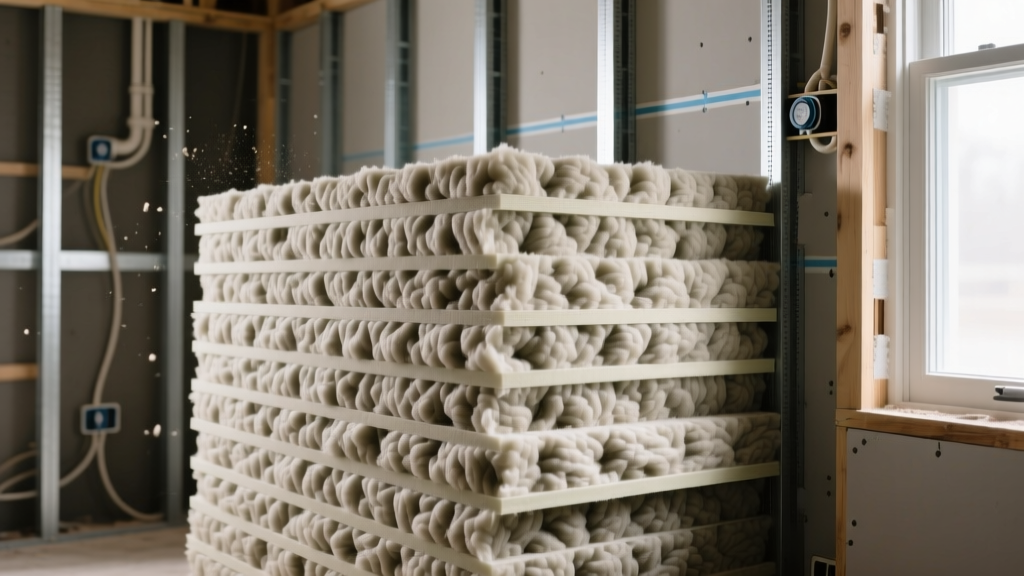
In acoustic engineering, the correct hard insulation material for sound control refers to high-density, semi-rigid, or rigid open-cell mineral wool and fiberglass boards. These materials maintain their structural shape without sagging in vertical wall cavities or when used as the core for fabric-wrapped acoustic panels, while their open-cell matrix provides the necessary flow resistivity to convert sound energy into trace amounts of heat via friction.
Material Breakdown: Rigid Mineral Wool vs. Rigid Fiberglass
To achieve genuine sound transmission loss and broadband absorption, you must specify boards with densities ranging from 2.5 pounds per cubic foot (pcf) to 8.0 pcf. The two dominant categories of rigid acoustic insulation are stone wool (mineral wool) and rigid fiberglass.
1. Rigid Mineral Wool (Stone Wool)
Manufactured by spinning molten basalt rock, rigid mineral wool boards offer superior fire resistance and slightly higher mass than fiberglass. Products like Rockwool AFB (Acoustical Fire Batt) and Thermafiber SAFB are engineered specifically for commercial and high-end residential soundproofing. A standard 2-inch thick Rockwool AFB board features a density of 2.5 pcf and delivers a Noise Reduction Coefficient (NRC) of 0.95. Because of its inherent stiffness, it friction-fits into stud cavities without requiring mechanical fasteners, eliminating flanking paths caused by sagging batts.
2. Rigid Fiberglass Boards
Rigid fiberglass is the gold standard for surface-mounted acoustic treatment and studio construction. Owens Corning 703 (3.0 pcf) and Owens Corning 705 (4.8 pcf) are the industry benchmarks. OC 703 is highly porous, allowing sound waves to penetrate deeply into the core, making it the premier choice for broadband absorption panels. OC 705, being denser and harder, is frequently used for bass traps and outdoor acoustic barriers where impact resistance is required.
Acoustic Performance and Application Matrix
Selecting the right hard insulation material depends entirely on the frequency range you are targeting and the physical application. The table below maps specific rigid board types to their optimal acoustic use cases.
| Material / Model | Density (pcf) | NRC Rating (2") | Optimal Application | Approx. Cost (2x4 Sheet) |
|---|---|---|---|---|
| Owens Corning 703 | 3.0 | 1.10 | Fabric-wrapped wall panels, ceiling clouds | $75 - $90 |
| Owens Corning 705 | 4.8 | 0.85 | Corner bass traps, high-impact zones | $95 - $120 |
| Rockwool AFB | 2.5 | 0.95 | Interior wall cavity fill, floor joists | $65 - $80 |
| Johns Manville SPI | 1.5 | 0.65 | HVAC duct lining, plenum returns | $50 - $65 |
Strategic Application: Surface-Mounted Acoustic Absorbers
One of the most effective uses for rigid fiberglass boards is constructing broadband acoustic absorbers for home theaters, recording studios, and open-plan offices. Unlike fluffy batt insulation, which requires a deep wooden frame to prevent bulging, rigid boards like OC 703 can be beveled, wrapped in fabric, and mounted directly to drywall with a 2-inch air gap to double their low-frequency absorption efficiency.
Step-by-Step: Building a 4x2 Rigid Fiberglass Absorber Panel
- Cut the Core: Using a straight edge and a heavy-duty utility knife, cut a 2-inch thick sheet of Owens Corning 703 to exactly 47 x 23 inches. (Cutting slightly smaller than 48x24 allows room for the wooden frame).
- Construct the Frame: Build a simple frame using 1x3 pine boards. The frame should measure 48 x 24 inches on the outside. Secure corners with wood glue and 1.5-inch brad nails.
- Insert and Secure: Press the rigid fiberglass board into the frame. Because the board is semi-rigid, it will hold itself in place, but apply a light mist of 3M Super 77 spray adhesive to the back to prevent shifting during wrapping.
- Wrap the Fabric: Lay your acoustic fabric (e.g., Guilford of Maine Anchorage, which is acoustically transparent) face down. Place the framed board face down on the fabric. Pull the fabric taut and staple it to the back of the wooden frame using a pneumatic stapler.
- Create the Air Gap: Attach two 2-inch wooden cleats to the top back of the frame. When hung on the wall, this creates a 2-inch air gap behind the panel. According to acoustic principles tested under ASTM E90 standards, this air gap shifts the panel's peak absorption coefficient down into the 250Hz - 500Hz vocal range.
Strategic Application: Decoupled Wall Cavities
When building a room-within-a-room or a staggered-stud wall, the cavity must be filled with a hard insulation material that will not compress or settle over time. Mineral wool boards (like Rockwool AFB) are cut 1-inch wider than the stud bay and friction-fit into place.
"The primary function of cavity insulation in a decoupled wall is not to block sound, but to dampen the resonance of the air spring trapped between the two layers of drywall. High-density mineral wool effectively lowers the resonant frequency of the wall system, improving Sound Transmission Class (STC) ratings by 3 to 5 points in the critical low-mid frequencies."
— Principles of Architectural Acoustics
Common Installation Failures That Destroy Acoustic Performance
Even the most expensive rigid acoustic insulation will fail if installed incorrectly. Avoid these three critical errors:
- Over-Compression: Stuffing a 3-inch thick rigid board into a 2.5-inch cavity increases the material's density but drastically reduces its thickness. This shifts the absorption profile entirely to high frequencies, leaving low-mid frequencies (like male voices and bass guitars) completely untreated. Always match the insulation thickness to the cavity depth.
- Leaving Air Gaps at the Edges: Sound behaves like water; it will exploit the path of least resistance. If a rigid board is cut 1/2-inch too short, the resulting gap creates an acoustic flanking path. Always cut rigid mineral wool 1/2-inch oversized to ensure a tight friction fit against the studs.
- Using Non-Transparent Fabrics: When wrapping rigid fiberglass for acoustic panels, using vinyl, leather, or tightly woven decorative fabrics will reflect high frequencies off the surface, turning your absorber into a diffuser. Always test fabric by holding it up to your mouth and blowing through it; if you cannot feel your breath easily on the other side, it is not acoustically transparent.
Health, Safety, and Handling Protocols
Working with rigid mineral wool and fiberglass boards requires strict adherence to safety protocols. The fibers are mechanical irritants that can cause severe itching, respiratory irritation, and eye discomfort. Always wear an N95 respirator, long sleeves, and nitrile gloves when cutting and handling these materials. For surface-mounted panels in occupied spaces, it is mandatory to encapsulate the rigid core in a breathable, micro-perforated fabric or a specialized acoustic scrim to prevent any microscopic fibers from migrating into the room's air supply over time. For further guidance on material safety and indoor air quality, refer to the Acoustical Society of America's educational resources on architectural treatments.
Written by
Sarah WhitfieldSarah Whitfield is a chartered quantity surveyor (MRICS) and construction cost analyst with 15 years of experience in material pricing, procurement strategy, and project budgeting. She earned her degree in Construction Management from the University of Reading (UK) and has worked on projects ranging from $2M custom homes to $180M mixed-use developments across North America and Europe. Sarah currently leads cost estimating for BuildMat Insight, maintaining a proprietary database of 4,000+ material price points updated quarterly. She is a frequent contributor to RSMeans cost data panels and has presented at the International Cost Engineering Council (ICEC) congress. Based in Denver, CO, Sarah is an avid trail runner and volunteer mentor for Women in Construction.
More from Sarah Whitfield
View all
Wood & Lumber
What Are the Different Types of Wood? A Builder's Guide
Compare structural softwoods, finish hardwoods, and engineered lumber. Analyze Janka ratings, MOE values, and 2026 pricing for construction.
Aug 4, 2026

Walls & Panels
Steel Framing vs Wood Framing: Corrosion and Moisture Defense
Compare steel framing vs wood framing for moisture resistance. Learn about galvanized coatings, condensation risks, and corrosion protection strategies.
Jul 21, 2026

Stone & Masonry
How to Cut Stone Veneer: Wet Saw vs Grinder Comparison
Compare the best tools for cutting stone veneer. We review wet saws, angle grinders, and chop saws to help you achieve clean, chip-free cuts.
Jul 21, 2026