Auto Insulation Material R-Values for Van & Tiny Home Builds
Compare R-values, acoustic performance, and 2026 costs of auto insulation materials like Armaflex, butyl mats, and aerogel for van and tiny home builds.

The R-Value Reality Check: Acoustic Damping vs. Thermal Resistance
When designing mobile architecture—such as sprinter van conversions, skoolies, tiny homes on wheels, or mobile medical units—builders frequently cross over into automotive supply chains. However, a critical misunderstanding plagues the mobile building sector: the conflation of acoustic damping with thermal resistance. Many DIY builders assume that applying heavy, premium auto insulation material to a metal chassis will simultaneously deaden road noise and retain interior heat. From a building science perspective, this is fundamentally incorrect.
Constrained layer dampers (CLDs), like butyl rubber mats, are engineered to alter the resonant frequency of sheet metal, reducing structure-borne noise. They possess virtually zero thermal resistance. Conversely, true thermal insulators rely on trapped gas pockets within a matrix to slow conductive heat transfer. To achieve a high-performance mobile building envelope in 2026, you must decouple acoustic treatment from thermal insulation and layer them strategically.
Core Auto Insulation Materials: Specs, R-Values, and 2026 Costs
Selecting the right auto insulation material requires evaluating the R-value per inch, moisture permeability, and acoustic mass. Below is a technical breakdown of the primary materials used in mobile and high-vibration building envelopes.
1. Closed-Cell Elastomeric Foam (e.g., Armacell Armaflex, HushLiner)
Elastomeric foam is the gold standard for thermal insulation in corrugated metal structures. Unlike open-cell foams, its closed-cell structure makes it inherently waterproof and acts as a Class II vapor retarder. According to building science principles outlined by the Building Science Corporation, controlling vapor diffusion in tight, unvented mobile cavities is critical to preventing interstitial condensation.
- R-Value: R-4.2 to R-4.8 per inch.
- Thickness Available: 1/2-inch (R-2.1), 3/4-inch (R-3.1), 1-inch (R-4.2).
- 2026 Cost: $2.20 – $3.50 per square foot (depending on thickness and adhesive backing).
- Installation Note: Must be cut with a beveled blade and sealed at the seams with proprietary elastomeric tape to maintain the vapor barrier. Do not compress the foam, as crushing the cells reduces the R-value by up to 30%.
2. Butyl Rubber Constrained Layer Dampers (e.g., Kilmat, Dynamat Xtreme)
Butyl mats are applied directly to the bare metal chassis to stop panel resonance. They do not insulate thermally, but they are mandatory for reducing the low-frequency drone of tires and engines, which improves the perceived comfort of the interior space.
- R-Value: ~R-0.16 total (negligible).
- Acoustic Performance: Reduces panel resonance by 10-15 dB depending on coverage area.
- 2026 Cost: $1.50 – $2.80 per square foot.
- Installation Note: Coverage of 25% to 30% of a flat panel is sufficient to shift the resonant frequency; 100% coverage is a waste of weight and money. Always use a hard wooden roller to press the material into the corrugated ribs, ensuring 100% adhesion to prevent delamination under high roof temperatures.
3. Mass Loaded Vinyl (MLV)
MLV is a high-density, limp-mass barrier used to block airborne noise (like highway traffic or generator hum). It is typically sandwiched between the thermal insulation and the interior wall cladding.
- R-Value: R-0 (no thermal benefit).
- Acoustic Performance: Adds 10-12 dB of Sound Transmission Class (STC) per layer (1 lb/sq ft weight).
- 2026 Cost: $1.60 – $2.10 per square foot for 1 lb/sq ft thickness.
- Failure Mode: MLV will sag and tear if mechanically fastened only at the top. It must be supported by furring strips or adhesive-backed velcro strips across the entire cavity.
4. Silica Aerogel Blankets (e.g., Spaceloft)
For ultra-thin wall cavities where maximizing interior square footage is paramount, aerogel blankets offer unparalleled thermal resistance. Originally developed for aerospace, they are now utilized in high-end auto and RV applications.
- R-Value: R-10.3 per inch (the highest of any commercial blanket).
- Thickness: 10mm (approx. R-4.0).
- 2026 Cost: $11.00 – $14.50 per square foot.
- Drawback: Highly hydrophobic but sheds silica dust when cut. Requires sealing in a fabric or poly sleeve before installation in living spaces.
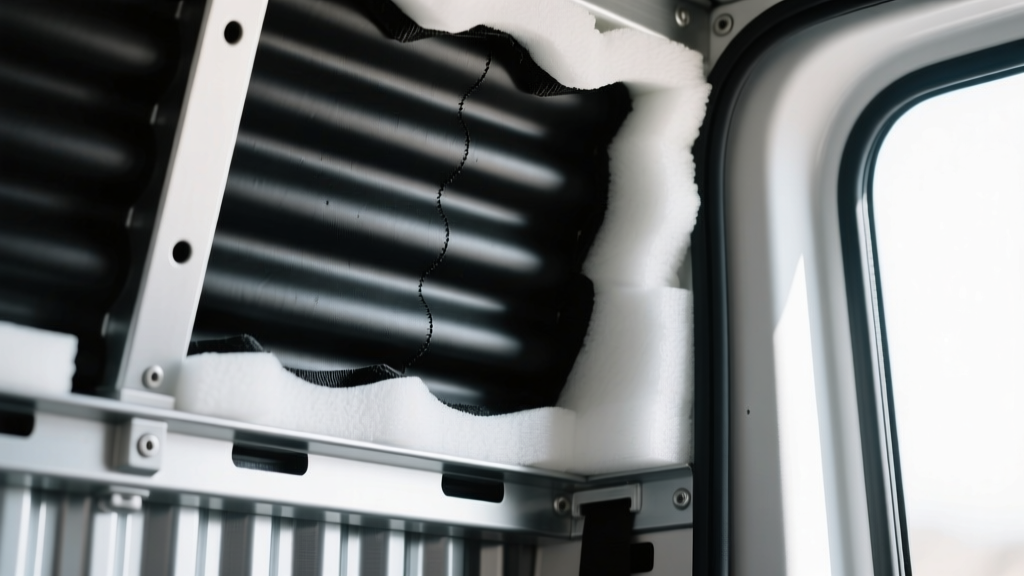
The Thermal Bridging Problem in Corrugated Steel
The U.S. Department of Energy emphasizes that continuous insulation is required to mitigate thermal bridging in structural framing. In a van or steel-framed tiny home, the metal ribs act as massive thermal bridges. Steel conducts heat approximately 400 times faster than wood.
If you only place 1-inch Armaflex (R-4.2) between the metal ribs, the metal itself will drop to near-exterior temperatures in winter, causing condensation to form on the ribs and drip behind your interior walls. To solve this, you must apply a continuous layer of insulation over the ribs. A common 2026 best practice is installing 3/4-inch Armaflex between the ribs, followed by a continuous 1/2-inch layer of Armaflex or cross-linked polyethylene (XPE) foam directly over the ribs before attaching furring strips.
Optimal Layering Sequence for Mobile Architecture
To maximize both STC (Sound Transmission Class) and overall wall R-value, execute the following layering sequence from the exterior metal skin inward:
- Layer 1 (Metal Skin): Clean bare metal with isopropyl alcohol. Apply butyl rubber CLD mats to 30% of the flat recessed panels. Do not apply to the structural ribs.
- Layer 2 (Cavity Fill): Cut closed-cell elastomeric foam to fit tightly between the metal ribs. Seal all perimeter edges with elastomeric seam tape to create a continuous vapor barrier.
- Layer 3 (Thermal Break): Apply a continuous 1/2-inch layer of closed-cell foam or XPE directly over the metal ribs to break the thermal bridge.
- Layer 4 (Acoustic Mass): Hang 1 lb/sq ft Mass Loaded Vinyl using heavy-duty adhesive tape or mechanical battens. Ensure the MLV is decoupled from the final wall panel.
- Layer 5 (Furring & Cladding): Install 1/2-inch wooden or aluminum furring strips through the insulation into the metal ribs, then attach your interior wall paneling (e.g., bamboo plywood or PVC shiplap).
Material Comparison Matrix: Auto Insulation for Mobile Builds
| Material Type | R-Value / Inch | Primary Function | 2026 Cost (per sq ft) | Vapor Permeability |
|---|---|---|---|---|
| Elastomeric Foam (Armaflex) | R-4.2 to R-4.8 | Thermal / Vapor Barrier | $2.20 - $3.50 | Impermeable (Class II) |
| Butyl Rubber Mat (Kilmat) | ~R-0.16 (Total) | Structure-Borne Damping | $1.50 - $2.80 | Impermeable |
| Mass Loaded Vinyl (1 lb) | R-0 | Airborne Noise Blocking | $1.60 - $2.10 | Impermeable |
| Aerogel Blanket (10mm) | R-10.3 / Inch | Ultra-Thin Thermal | $11.00 - $14.50 | Hydrophobic / Breathable |
| XPE Foam (Cross-linked) | R-3.5 to R-4.0 | Thermal Break / Cushion | $0.80 - $1.20 | Impermeable |
Final Procurement Advice
When sourcing auto insulation material for building applications, always request the ASTM C518 thermal conductivity test reports from the manufacturer. Many generic, white-labeled foams sold on e-commerce platforms use lower-density blowing agents that degrade in R-value by up to 20% within the first 18 months due to thermal drift. Stick to ISO 9001-certified manufacturers like Armacell or Zotefoams to ensure the R-values published on the spec sheet hold true over the lifespan of your mobile structure.
Written by
Marcus ChenMarcus Chen is a licensed structural engineer (PE) and building materials analyst with over 12 years of experience across residential, commercial, and industrial construction. He holds a Master of Science in Civil Engineering from UC Berkeley and spent six years at Thornton Tomasetti before transitioning to independent consulting and technical writing. Marcus specializes in material selection for seismic-prone regions, concrete reinforcement strategies, and lifecycle cost analysis. His work has been cited by the American Concrete Institute (ACI) and the Structural Engineers Association of California (SEAOC). When he is not on a job site or at his desk, you will find him hiking the Sierra Nevada or restoring a 1920s craftsman bungalow in Oakland, CA.
More from Marcus Chen
View all
Construction Cost
How Much Did the Eiffel Tower Cost to Build?
How much did the Eiffel Tower cost to build in 1889? We adjust for inflation and compare its budget to modern skyscraper construction.
Aug 4, 2026

Fire Resistance
What Is a Fire Resistant Material? Testing & Certification Guide
Discover what is a fire resistant material through ASTM and UL testing. Learn how fire ratings, certifications, and assemblies work in construction.
Aug 4, 2026

Construction Cost
How Much Did the Burj Khalifa Cost to Build?
How much did the Burj Khalifa cost to build? We break down the $1.5B project and extract 5 money-saving strategies for your next build.
Jul 30, 2026