Evaluating Advanced Insulation Materials for Net-Zero Homes
Compare advanced insulation materials like aerogels, VIPs, and PCMs for net-zero homes. Expert analysis on R-values, costs, and installation limits.

The Shift from Static R-Value to Dynamic Thermal Performance
Achieving a true net-zero energy building envelope requires moving beyond the limitations of traditional cavity fills. Standard fiberglass batts (R-3.2 per inch) and open-cell spray foam (R-3.5 per inch) require 10 to 12 inches of depth to achieve code-mandated R-38 to R-40 wall assemblies. In standard 2x6 framing, this physical constraint forces architects to rely on thick exterior continuous insulation (ci), which complicates window bucking, cladding attachment, and air-barrier continuity. Advanced insulation materials resolve these spatial conflicts while fundamentally altering the thermal dynamics of the building envelope. By leveraging nanotechnology, vacuum physics, and latent heat storage, these next-generation systems allow high-performance builders to meet stringent 2026 IECC and Passive House standards without sacrificing interior floor space or structural simplicity.
Aerogel Blankets: The R-10 Per Inch Standard
Aerogel is a silica-based solid derived from a gel, in which the liquid component has been replaced with gas via supercritical drying. The result is a material that is up to 95% air by volume, yielding an exceptionally low thermal conductivity. Commercial building wraps like Aspen Aerogels’ Spaceloft deliver an R-value of R-10.3 per inch, making it the highest-performing flexible insulation on the market.
Because aerogel blankets are hydrophobic and vapor-permeable, they are highly effective in exterior continuous insulation applications and historic masonry retrofits where interior space loss is unacceptable. A 40mm (1.57-inch) layer of Spaceloft provides R-16, equivalent to nearly 5 inches of rigid polyisocyanurate. However, the material is inherently brittle and possesses low compressive strength, meaning it cannot be used in below-grade applications or beneath concrete slabs.
Cutting aerogel blankets releases fine silica dust. Installers must use N95 or P100 respirators, sealed eye protection, and cut the material using shears rather than high-speed saws to minimize airborne particulates. Always seal cut edges with compatible aerogel tape to prevent continuous dust shedding inside the wall cavity.
Vacuum Insulation Panels (VIPs): Maximum Resistance in Minimal Depth
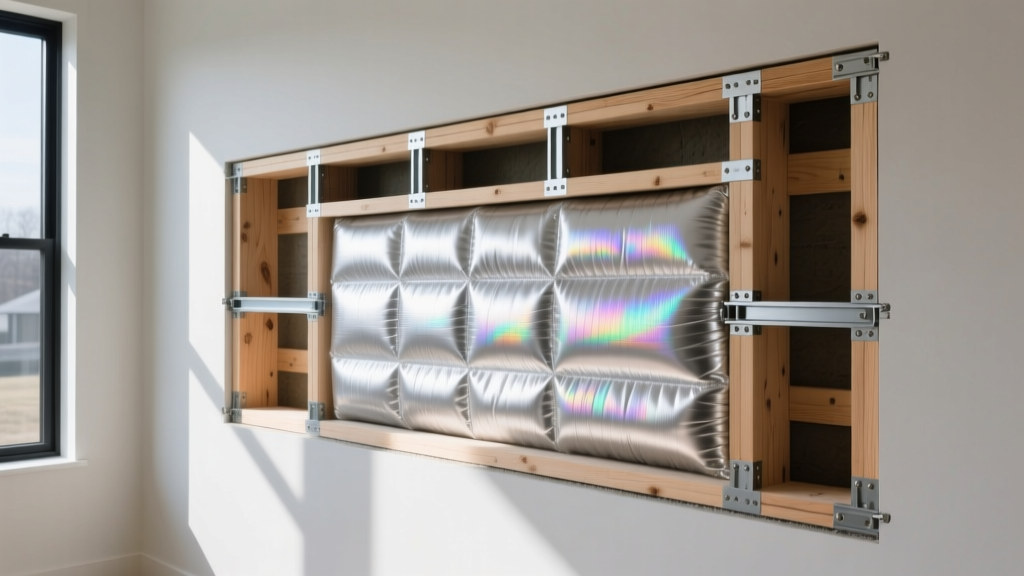
Vacuum Insulation Panels represent the absolute ceiling of steady-state thermal resistance. A VIP consists of a porous core material—typically fumed silica or glass fiber—encased in a gas-tight, metallized polymer barrier film. The panel is evacuated to a pressure of less than 1 millibar, effectively eliminating gaseous thermal conduction. According to the U.S. Department of Energy, VIPs can achieve R-values between R-30 and R-50 per inch.
The Edge Thermal Bridging and Puncture Vulnerability
The primary failure mode of VIPs is envelope compromise. If the barrier film is punctured by a stray nail or sharp framing edge, the panel loses its vacuum, and the R-value instantly plummets to R-4 (the atmospheric R-value of the fumed silica core). Furthermore, the barrier film itself is highly conductive, creating a thermal bridge at the panel edges. To mitigate this, VIPs like Kingspan OPTIM-R must be installed with specialized slip sheets and taped seams, and they can never be cut or trimmed on-site. They must be ordered to exact dimensional specifications from the manufacturer.
Phase Change Materials (PCMs): Managing Thermal Lag and Peak Loads
While aerogels and VIPs improve steady-state R-values, Phase Change Materials (PCMs) address dynamic thermal loads. PCMs are microencapsulated waxes or bio-based salts integrated into drywall or ceiling panels. As interior temperatures rise, the PCM melts, absorbing latent heat and preventing the room temperature from spiking. When the room cools, the PCM solidifies, releasing the stored heat.
Products like PureTemp or Micronal are tuned to melt at specific temperatures, typically 22°C to 25°C (72°F to 77°F). PCMs do not increase the assembly's R-value; instead, they increase the effective thermal mass of a lightweight wood-framed building. For PCMs to function correctly, they must be installed on the interior side of the insulation layer, directly behind the drywall or integrated into the gypsum itself, allowing them to interact with the conditioned space air. Placing them outside the thermal boundary renders them useless for interior load shifting.
Comparative Matrix: Advanced Insulation Materials
The following matrix compares advanced systems against high-performance closed-cell spray foam (ccSPF) to contextualize cost and spatial efficiency for 2026 construction budgets.
| Material | R-Value / Inch | Cost (per sq ft at R-20) | Thickness for R-20 | Primary Failure Mode |
|---|---|---|---|---|
| Aerogel Blanket | R-10.3 | $3.50 - $4.80 | 1.94 inches | Compression / Crush |
| Vacuum Panel (VIP) | R-40.0 | $8.00 - $12.00 | 0.50 inches | Envelope Puncture |
| Phase Change (PCM) | N/A (Latent) | $2.50 - $4.00 | N/A | Incorrect Placement |
| Closed-Cell Foam (Baseline) | R-6.5 | $2.20 - $3.10 | 3.07 inches | Shrinkage / Off-ratio mix |
Strategic Integration: Where to Deploy Advanced Materials
Due to their premium costs, advanced insulation materials should not be used as wholesale replacements for standard cavity fills. Instead, they are best deployed surgically to solve specific geometric and thermal bridging challenges. The DOE Building Technologies Office emphasizes targeting structural thermal bridges to maximize energy ROI.
- Rim Joists and Band Boards: VIPs are ideal for rim joists where depth is severely restricted by floor framing and plumbing/electrical runs. A 1-inch VIP provides R-40, preventing condensation and freezing in these notoriously difficult-to-seal areas.
- Balcony and Parapet Connections: Aerogel strips can be inserted between structural steel connections that penetrate the thermal envelope, breaking the thermal bridge without requiring structural redesigns or cantilevered thermal breaks.
- Cathedral Ceilings: Where roof pitch limits rafter depth, combining a 2-inch layer of interior aerogel with standard dense-pack cellulose in the cavity achieves high R-values without dropping the interior ceiling plane.
- Passive Solar South Walls: Integrating PCM drywall on south-facing interior partitions absorbs excess solar gain during winter afternoons, releasing it at night and reducing the need for active thermal storage systems like concrete floors.
Calculating the Energy Payback and HVAC Downsizing
Evaluating the cost-effectiveness of advanced insulation materials requires looking beyond simple utility bill savings. The most significant financial offset occurs during the mechanical design phase. By utilizing advanced materials to drastically reduce the building's overall heat loss coefficient (UA), mechanical engineers can downsize the HVAC equipment.
A $6,000 premium spent on VIPs and aerogel to eliminate thermal bridging in a 2,500 sq ft net-zero home can reduce the peak heating load by 15%. This frequently allows the builder to drop from a 4-ton to a 3-ton variable-speed heat pump, saving $3,500 to $5,000 in upfront equipment costs and immediately offsetting the insulation premium.
When running Manual J load calculations, ensure your energy model accounts for the reduced thermal bridging factor (psi-values) provided by advanced materials. Standard code-compliance software often defaults to conservative framing factors that underestimate the performance of highly optimized, advanced-material envelopes.
Material Selection Decision Tree
Use the following framework to specify the correct advanced material for your specific assembly constraints:
- If space is constrained to less than 1.5 inches AND the area is protected from fasteners: Specify Vacuum Insulation Panels (VIPs).
- If space is constrained AND the area requires field-cutting or complex routing around pipes: Specify Aerogel Blankets.
- If the assembly has adequate depth but suffers from severe afternoon solar overheating: Specify Phase Change Materials (PCMs) on the interior drywall layer.
- If the application is below-grade or subject to hydrostatic pressure: Reject all advanced materials listed above; specify rigid extruded polystyrene (XPS) or high-density mineral wool.
Written by
James ThorntonJames Thornton is a construction industry veteran with 25 years of hands-on experience in wood framing, lumber grading, and residential building codes. He started as a framing carpenter in rural Oregon, earned his ICC Residential Building Inspector certification, and eventually became a senior plan reviewer for the City of Portland Bureau of Development Services. James holds a B.S. in Wood Science & Technology from Oregon State University and is a certified lumber grader through the West Coast Lumber Inspection Bureau (WCLIB). He has inspected over 3,000 residential construction sites and authored the city's internal guide on advanced framing techniques (2x6 at 24" O.C.). James lives in Bend, OR, where he builds custom timber-frame cabins and competes in lumberjack sports.
More from James Thornton
View all
Insulation
Best Home Insulation Materials: Complete 2026 Guide
Compare top home insulation materials for 2026. Find R-values, installed costs per square foot, and best uses for fiberglass, spray foam, and mineral wool.
Aug 4, 2026

Sustainable Building
Certify Your Green Building Material for LEED and WELL
Step-by-step guide to certifying a green building material for LEED v5 and WELL v2. Master EPDs, HPDs, and VOC limits for 2026 project specifications.
Aug 4, 2026

Stone & Masonry
Veneer Stacked Stone Panels: Interior Design & Style Showcase
Discover how veneer stacked stone panels transform interiors. Explore modern design profiles, material pairings, and technical installation specs.
Aug 4, 2026