Selecting the Right Hood Insulation Material for Sound Control
Learn how to choose the best hood insulation material to reduce range hood noise. Compare MLV, acoustic fiberglass, and foam for optimal sound control.

The Physics of Range Hood Noise
Kitchen range hoods are essential for capturing smoke, grease, and combustion byproducts, but high-CFM blowers often generate 65 to 85 decibels (dB) of noise. When selecting a hood insulation material for sound control, it is critical to understand that range hood noise consists of two distinct acoustic profiles: airborne noise and structure-borne vibration. Airborne noise is the high-frequency hiss and rushing sound of air moving through the ductwork and blower wheel. Structure-borne noise is the low-frequency hum and rattling caused by the blower motor vibrating against the thin stainless steel or copper canopy.
Manufacturers typically rate hood noise in sones. A 400 CFM hood rated at 6 sones produces roughly 55 to 60 dB at the listening position, but the raw acoustic energy inside the unlined canopy can exceed 75 dB. To effectively drop the perceived noise by 50% (a 10 dB reduction), you must use a composite insulation strategy that combines mass to block airborne sound and decoupling to absorb vibration.
Top Hood Insulation Material Options Compared
Not all acoustic materials survive the high-heat, grease-laden environment of a kitchen exhaust system. Below is a comparison of the most effective hood insulation materials used by acoustic engineers and custom fabricators.
| Material Type | STC / NRC Rating | Primary Acoustic Function | Fire Rating (ASTM E84) | Approx. Cost (per sq ft) |
|---|---|---|---|---|
| Mass Loaded Vinyl (1 lb/ft²) | STC 26 | Blocks low-frequency motor hum | Class A (Must be verified) | $2.50 - $3.50 |
| Acoustic Fiberglass (2-inch, 3 pcf) | NRC 0.95 | Absorbs high-frequency airflow hiss | Class A | $1.80 - $2.20 |
| Closed-Cell Elastomeric Foam (1/2-inch) | STC 12 | Thermal barrier and mild dampening | Class 1 (UL 723) | $1.50 - $2.00 |
| Melamine Foam (2-inch) | NRC 0.90 | Broadband absorption, lightweight | Class A | $4.00 - $5.50 |
Material Deep Dive: Why Mass Loaded Vinyl (MLV) is the Baseline
Mass Loaded Vinyl is the industry standard for adding limp mass to thin metal surfaces. When applied to the interior shell of a stainless steel hood canopy, MLV shifts the resonant frequency of the metal, preventing it from acting as a sounding board for the blower motor. However, standard MLV is highly susceptible to melting if exposed to direct heat. You must specify high-temperature rated MLV (often reinforced with a fiberglass scrim) and ensure it is applied only to the exterior of the inner baffle filters, away from direct heat lamp exposure.
The Role of Acoustic Fiberglass and Melamine
While MLV blocks sound, it does not absorb the echoing reverberation inside the canopy. For this, you need a porous absorber. Owens Corning 703 (2-inch thick, 3 lbs per cubic foot) is a rigid acoustic fiberglass board that excels at trapping high-frequency airflow noise. Melamine foam (such as Basotect) is an excellent alternative if weight is a concern, as it is significantly lighter than fiberglass and offers superior thermal resistance, though it comes at a premium price point.
Step-by-Step Canopy Soundproofing Protocol
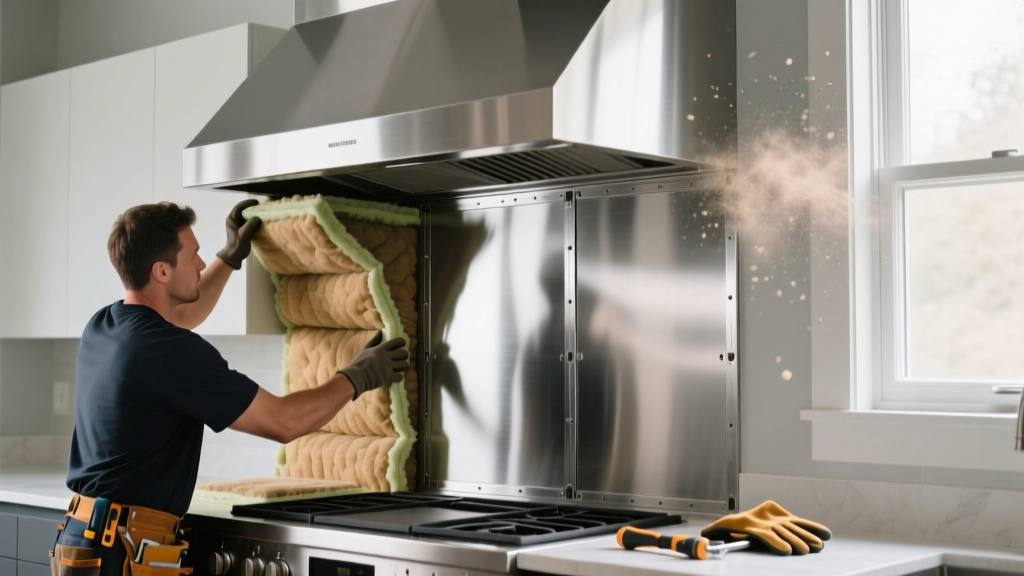
Applying hood insulation material requires meticulous surface preparation and the correct adhesives to prevent delamination under thermal cycling.
- Apply the Mass Layer (MLV): Cut 1 lb/ft² MLV to fit the interior panels of the hood canopy. Apply 3M Hi-Strength 90 Spray Adhesive to both the metal surface and the back of the MLV. Wait 3 minutes for the adhesive to become tacky, then press firmly. Overlap all seams by 2 inches.
- Seal the Seams: Use an acoustic sealant (such as OSI Pro-Series Acoustic Sealant) to seal all MLV overlaps and perimeter edges. Sound behaves like water; even a 1/8-inch gap will compromise the STC rating of the barrier.
- Install the Absorption Layer: Apply 1-inch or 2-inch acoustic fiberglass or melamine foam over the MLV. Use mechanical fasteners (speed clips) in addition to high-temp spray adhesive, as the weight of the fiberglass can cause adhesive creep over time when exposed to the ambient heat of the kitchen.
- Decouple the Blower Motor: If your hood uses an internal blower, ensure the motor housing is mounted on neoprene vibration isolators (minimum 1/4-inch thick, 50 durometer). Never let the metal motor housing directly touch the insulated canopy shell.
Ductwork Insulation: Stopping Airflow Noise
Insulating the canopy is only half the battle. The ductwork itself acts as a massive megaphone, transmitting blower noise directly into the living space. Flexible aluminum ducting is acoustically terrible; it vibrates easily and creates turbulent airflow, increasing the noise floor by up to 12 dB compared to rigid ducting.
For optimal sound control, transition to rigid galvanized steel ducting and line the interior with an acoustic duct liner. Johns Manville Spiracoustic Plus is a 1-inch thick, foil-faced elastomeric duct liner specifically designed for this application. The foil facing prevents fiberglass particles from entering the airstream and provides a smooth surface that resists grease accumulation, keeping the system compliant with NFPA 96 ventilation standards. Wrap the exterior of the rigid duct with an additional layer of MLV if it passes through unconditioned spaces or open ceiling joists.
Common Failure Modes and Edge Cases
When specifying hood insulation material, contractors and DIYers frequently encounter the following failure modes:
- Adhesive Thermal Breakdown: Standard spray adhesives (like 3M Super 77) soften at 120°F. The interior of a hood canopy capturing heat from a commercial-style gas range can easily exceed 140°F near the filters. Always use high-temperature adhesives rated for at least 180°F.
- Grease Saturation of Absorbers: If acoustic fiberglass is left unfaced and exposed to the direct airstream, it will absorb atomized grease, becoming a severe fire hazard and losing its acoustic porosity. Always use foil-faced or mylar-faced acoustic boards inside the hood plenum.
- Motor Overheating: Never insulate the blower motor housing itself. Blower motors rely on the ambient airstream for cooling. Encasing the motor in MLV or foam will cause the thermal overload switch to trip, shutting down the hood mid-cook.
Fire Safety and Code Compliance
Kitchen environments are high-risk zones for grease fires. According to the U.S. Department of Energy Ventilation Guidelines and international building codes, materials used within the exhaust plenum must not contribute to flame spread. Every hood insulation material you purchase must carry an ASTM E84 Class A certification (Flame Spread Index ≤ 25, Smoke Developed Index ≤ 50). Do not rely on generic 'fire retardant' claims from overseas suppliers; demand the actual UL or Intertek test certificates for the specific batch of MLV or foam you are installing.
Frequently Asked Questions
Will adding insulation void my range hood warranty?
Yes, applying aftermarket adhesives and insulation to the interior canopy of a pre-fabricated, mass-market range hood will almost certainly void the manufacturer's structural and electrical warranty. This soundproofing protocol is primarily intended for custom-fabricated hoods, commercial installations, or high-end architectural builds where the canopy is constructed on-site or by a specialized metalworker.
Can I use acoustic spray foam instead of MLV and fiberglass?
No. Closed-cell spray polyurethane foam (SPF) is an excellent thermal insulator but a poor acoustic barrier for the specific frequencies generated by range hoods. Furthermore, SPF is highly flammable unless coated with an approved intumescent paint, which is difficult to apply evenly inside a hood canopy. Stick to the MLV and rigid acoustic board composite method.
How much weight does this insulation add to the hood?
A standard composite layer (1 lb MLV + 1-inch fiberglass) adds approximately 1.5 to 2.0 pounds per square foot. For a large 48-inch custom hood canopy with 15 square feet of interior surface area, expect to add 25 to 30 pounds of dead weight. Ensure your wall blocking or ceiling joist hangers are engineered to support this additional load plus the weight of the steel canopy and blower assembly.
Written by
David NakamuraDavid Nakamura is a licensed architect (AIA) and construction technology writer focused on sustainable building methods, mass timber engineering, and high-performance building envelopes. He holds a Master of Architecture from the University of Washington and is a certified Passive House Consultant (CPHC). David spent eight years at the Seattle firm Mithun, where he led the design of three LEED Platinum projects, before founding his own practice specializing in net-zero residential design. He serves on the editorial advisory board of GreenBuilder Magazine and has authored peer-reviewed papers on cross-laminated timber (CLT) connections for the Journal of Structural Engineering. In his spare time, David teaches woodworking at Pratt Fine Arts Center and kayaks the Puget Sound.
More from David Nakamura
View all
Construction Cost
Labor Cost to Build a Deck Per Sq Ft: 2026 Installation Guide
Discover the exact labor cost to build a deck per sq ft in 2026. This installation guide breaks down contractor rates, complexity factors, and hidden fees.
Aug 4, 2026

Construction Cost
How Much Does It Cost to Build a 3 Bedroom House? Financing Guide
Learn exactly how much it costs to build a 3 bedroom house and explore 2026 financing options, construction loan types, and budget frameworks for your build.
Aug 4, 2026

Construction Cost
Cost to Build a Tennis Court: 2026 Guide
How much does it cost to build a tennis court in 2026? Breakdowns for asphalt, concrete, and synthetic surfaces plus fencing and lighting.
Jul 30, 2026