Core Types of Insulation: Material Taxonomy and Selection
Explore the core types of insulation, from mineral wool to closed-cell spray foam. Compare R-values, costs, and applications for optimal building envelopes.
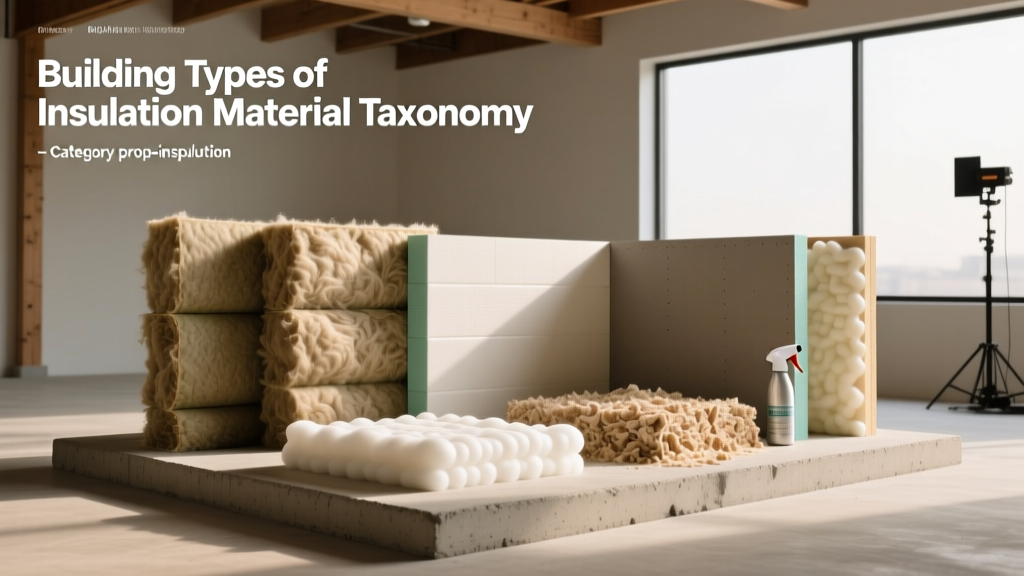
The Thermal Resistance Matrix: Classifying Insulation Types
When evaluating the various types of insulation for a building envelope, architects and builders must look beyond basic R-value charts. Modern building science demands a rigorous taxonomy based on material composition, cellular structure, and moisture dynamics. Selecting the wrong thermal barrier can lead to interstitial condensation, thermal bridging, and catastrophic assembly failure. To make informed decisions, we must categorize insulation into three primary physical forms: flexible fibrous batts, rigid cellular boards, and sprayed/foamed-in-place expansive materials.
Inorganic vs. Organic Base Materials
The foundational split in insulation taxonomy is the base chemistry. Inorganic materials (fiberglass, mineral wool, cellular glass) are derived from melted sand, stone, or glass. They are inherently non-combustible, highly vapor-permeable, and immune to organic decay. Organic materials (expanded polystyrene [EPS], extruded polystyrene [XPS], polyisocyanurate [Polyiso], and spray polyurethane foam [SPF]) are petroleum-derived plastics. They offer higher R-values per inch and can be engineered to resist liquid water, but they require chemical fire retardants and have strict temperature limits during installation and service.
Deep Dive: Performance Profiles by Material Category
1. Fiberglass (The Standard Fibrous Matrix)
Fiberglass remains the most widely installed insulation in North America, manufactured by spinning molten glass into fine fibers. Standard batts offer an R-value of R-3.1 to R-3.4 per inch, while high-density variants (like Owens Corning EcoTouch R-21 for 2x6 walls) push this to R-4.3 per inch. Fiberglass is highly vapor-permeable (Class III vapor retarder) and allows assemblies to dry to the interior or exterior. However, its critical vulnerability is air movement; if not paired with a meticulous air barrier, convective loops will strip up to 40% of its effective thermal resistance.
2. Mineral Wool (The High-Performance Fiber)
Mineral wool (often branded as Rockwool or Thermafiber) is spun from basalt rock and steel slag. It delivers an R-value of R-4.2 to R-5.0 per inch. Its primary advantages over fiberglass are dimensional stability, hydrophobicity (it repels liquid water while remaining vapor open), and acoustic dampening. Mineral wool batts are friction-fit, eliminating the gaps common in fiberglass installations. Furthermore, it is non-combustible up to 2,000°F (1,093°C), making it the mandatory choice for fire-stopping and cavity insulation in commercial shaft walls and multi-family party walls.
3. Polyisocyanurate (The High-R Rigid Board)
Polyiso is a closed-cell rigid foam board faced with aluminum foil, yielding an impressive nominal R-value of R-5.6 to R-6.5 per inch. It is the dominant choice for continuous exterior insulation (ci) in commercial and high-performance residential walls. However, building scientists have documented a phenomenon known as thermal drift. The blowing gases trapped in the closed cells condense at temperatures below 50°F (10°C), causing the effective R-value to drop to approximately R-4.5 per inch in deep winter climates. In cold regions, builders often hybridize Polyiso with a layer of EPS or mineral wool to maintain thermal performance.
4. Extruded Polystyrene (XPS) and EPS
XPS (commonly recognized by its blue or pink rigid boards) offers R-5.0 per inch and exceptional compressive strength (up to 60 psi), making it the undisputed standard for below-grade foundation walls and under-slab applications. Historically, XPS relied on HFC blowing agents with high Global Warming Potential (GWP), but the industry has largely transitioned to low-GWP HFO alternatives as of 2025/2026 code updates. EPS, the more economical white beadboard (R-3.8 to R-4.4 per inch), uses pentane as a blowing agent, making it the most environmentally stable rigid foam over its lifespan, though it lacks the moisture resistance of XPS.
5. Spray Polyurethane Foam (SPF)
SPF is unique among the types of insulation because it serves simultaneously as a thermal barrier, air barrier, and (in closed-cell form) a vapor retarder.
- Open-Cell SPF (0.5 lb density): Yields R-3.5 per inch. It is vapor-permeable, excellent for interior acoustic damping, and allows roof decks to dry inward. It provides zero structural benefit.
- Closed-Cell SPF (2.0 lb density): Yields R-6.0 to R-7.0 per inch. At 1.5 inches thick, it qualifies as a Class II vapor retarder. Crucially, closed-cell foam adheres to framing and increases the structural racking (shear) strength of wall assemblies by up to 300%, a vital metric in high-wind and seismic zones.
Decision Framework: Matching Material to Assembly
Selecting the correct material requires balancing thermal resistance, moisture management, and budget. The following matrix provides a baseline for residential and light-commercial envelope design.
| Material Type | Nominal R-Value / Inch | Vapor Permeability | Optimal Application | Approx. Cost (USD / bd ft) |
|---|---|---|---|---|
| Fiberglass Batts (Standard) | R-3.1 to R-3.4 | Class III (Permeable) | Interior stud cavities (with separate air barrier) | $0.45 - $0.75 |
| Mineral Wool Batts | R-4.2 to R-5.0 | Class III (Permeable) | Fire-rated assemblies, exterior sheathing, acoustics | $1.50 - $2.20 |
| Polyiso (Foil-Faced) | R-5.6 to R-6.5 | Class I (Impermeable) | Exterior continuous insulation (ci), roof decks | $0.65 - $1.10 |
| XPS Rigid Board | R-5.0 | Class II / III (Semi-Permeable) | Below-grade foundations, under-slab, plaza decks | $0.80 - $1.30 |
| Closed-Cell SPF | R-6.0 to R-7.0 | Class II (at 1.5" thick) | Cathedral ceilings, flood zones, structural racking | $2.50 - $3.20 |
Moisture Dynamics and Vapor Permeability
The most common cause of envelope failure is not a lack of insulation, but the mismanagement of moisture drive. According to the Building Science Corporation, vapor retarders are classified by their permeance (perms). A Class I retarder (like foil-faced Polyiso or closed-cell SPF) blocks nearly all vapor diffusion. If installed on the exterior of a wall in a cold climate, it traps moisture inside the cavity, leading to rot. Conversely, in hot-humid climates, exterior vapor-impermeable layers can trap inward-drying moisture.
'The golden rule of envelope design is to ensure that the assembly can dry in at least one direction. Never trap a moisture-sensitive material between two Class I vapor retarders.' — Building Science Digests
To mitigate this, modern builders utilize the Flash-and-Batt technique. This involves spraying 1.5 to 2 inches of closed-cell SPF against the exterior sheathing (providing an air seal, thermal break, and condensation control plane), followed by filling the remainder of the stud cavity with vapor-permeable fiberglass or mineral wool. This hybrid approach optimizes both cost and hygrothermal performance.
Cost Analysis and ROI Timelines
For retrofit projects, dense-pack cellulose (R-3.7 per inch) remains the most cost-effective method for insulating existing enclosed walls, typically costing between $1.80 and $2.50 per square foot installed. For new construction, investing in exterior continuous mineral wool boards (such as Rockwool Comfortboard 80) adds roughly $1.20 per square foot to the envelope but effectively eliminates thermal bridging through wood or steel studs, which can otherwise degrade the whole-wall R-value by up to 25%.
Code Compliance and Fire Ratings
When specifying the types of insulation for commercial or multi-family projects, fire code compliance dictates material selection. The U.S. Department of Energy notes that all foam plastics (EPS, XPS, Polyiso, SPF) must be tested to ASTM E84 for surface burning characteristics. However, in multi-story commercial buildings, wall assemblies containing combustible foam insulation must pass the rigorous NFPA 285 intermediate-scale, multi-story fire propagation test. To pass NFPA 285, architects frequently specify mineral wool as a continuous fire barrier at floor lines, or rely on specific proprietary assemblies that utilize thick gypsum sheathing and specific foil-faced Polyiso products. Always verify the exact UL or Intertek design number with the insulation manufacturer before finalizing the construction documents, as swapping a single brand of rigid foam can invalidate the entire assembly's fire rating.