The Best Insulating Material for High R-Value Wall Assemblies Compared
Compare the best insulating material options for high R-value walls. We analyze closed-cell spray foam, mineral wool, and VIPs for modern builds.

Redefining the Best Insulating Material for Modern Wall Assemblies
When architects and high-performance builders search for the best insulating material, the conversation often stalls at a superficial comparison of R-values per inch. However, selecting the optimal thermal barrier for high-performance wall assemblies requires evaluating a complex matrix of thermal resistance, vapor permeability, acoustic dampening, fire resilience, and long-term dimensional stability. As energy codes tighten globally, the definition of superior insulation has shifted from mere thickness to intelligent moisture management and the elimination of thermal bridging.
In this comprehensive material comparison, we evaluate three dominant high-performance insulation categories: Closed-Cell Spray Polyurethane Foam (ccSPF), High-Density Mineral Wool, and Vacuum Insulation Panels (VIPs). By analyzing specific product formulations, installed costs, and real-world failure modes, this guide provides a definitive decision framework for residential and commercial projects.
The Contenders: ccSPF, Mineral Wool, and VIPs
Each of these materials solves a distinct building science problem. Closed-cell spray foam excels at air sealing and structural racking strength. Mineral wool dominates in fire resistance, acoustic isolation, and vapor-open drying potential. Vacuum Insulation Panels offer unparalleled R-value in ultra-thin profiles, though they come with severe logistical constraints. According to the U.S. Department of Energy, matching the insulation material to the specific hygrothermal control layers of your wall assembly is the single most critical factor in preventing long-term moisture accumulation and structural decay.
A wall framed with 2x6 studs at 16 inches on center loses approximately 20% to 25% of its theoretical cavity R-value due to thermal bridging through the wood framing. The Building Science Corporation strongly advocates for exterior continuous insulation (ci) to break this thermal bridge, making the choice of exterior material just as critical as the cavity fill.
Head-to-Head Comparison Matrix
| Material Type | R-Value per Inch | 2026 Installed Cost (per bd ft) | Vapor Permeability | Fire Rating |
|---|---|---|---|---|
| Closed-Cell SPF (HFO) | R-6.5 to R-7.2 | $1.80 - $2.80 | Class II Retarder (at 1.5') | Class 1 (with intumescent coating) |
| High-Density Mineral Wool | R-4.2 to R-5.0 | $1.20 - $1.70 | Vapor Open (Highly Permeable) | Non-Combustible (Up to 2150°F) |
| Vacuum Insulation Panels | R-30.0 to R-50.0 | $12.00 - $18.00 | Impermeable (Metalized Film) | Depends on Core (Silica is safe) |
Deep Dive: Closed-Cell Polyurethane Spray Foam (ccSPF)
Closed-cell spray foam remains the benchmark for high-R cavity fills and unvented roof assemblies. Modern ccSPF formulations have transitioned to hydrofluoroolefin (HFO) blowing agents, which boast a Global Warming Potential (GWP) of less than 1, resolving the environmental concerns associated with older HFC-based foams. Products like Gaco Western GacoPro and Demilec Heatlok XT deliver an aged R-value of up to R-7.2 per inch while simultaneously acting as an air barrier and a Class II vapor retarder once applied at a minimum thickness of 1.5 inches.
Structural Benefits and Moisture Control
Beyond thermal resistance, ccSPF increases the racking strength of wood-framed walls by up to 300%, according to testing by the North American Insulation Manufacturers Association (NAIMA). This makes it highly desirable in hurricane and seismic zones. Because it is completely impermeable to liquid water and highly resistant to vapor diffusion, it is the premier choice for below-grade foundation walls and interior-side insulation in hot, humid climates where interior vapor drive must be halted.
The most common failure mode of ccSPF is improper substrate temperature during application. If sprayed onto cold lumber (below 60°F), the foam can shrink, pull away from the studs, and create massive air channels. Furthermore, off-ratio mixing due to clogged proportioning pumps can result in uncured foam that continuously off-gasses volatile organic compounds (VOCs) long after installation.
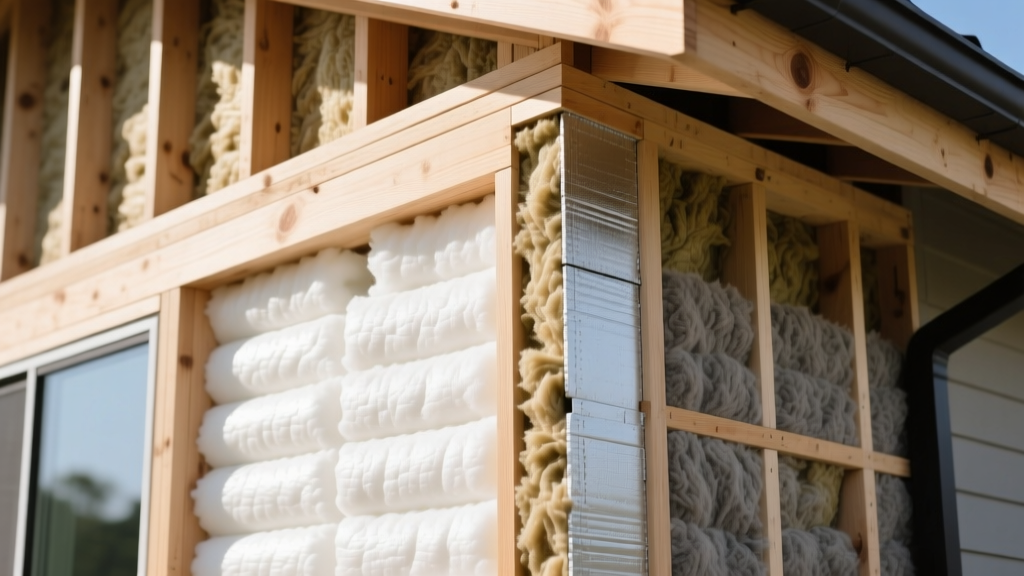
Deep Dive: High-Density Mineral Wool (Stone Wool)
Mineral wool, specifically stone wool manufactured from basalt rock and slag, is the undisputed champion of vapor-open, fire-resistant assemblies. Products like Rockwool Comfortboard 80 (for exterior continuous insulation) and Thermafiber RainBarrier offer R-values between R-4.2 and R-5.0 per inch. While its thermal resistance per inch is lower than spray foam, its ability to manage bulk water and allow vapor diffusion makes it a favorite among Passive House designers and building scientists.
Acoustic Performance and Fire Resilience
Where mineral wool truly separates itself from polyurethane foams is in acoustic dampening and fire containment. The dense, fibrous matrix of stone wool traps sound waves, reducing Sound Transmission Class (STC) ratings in party walls by 5 to 10 points compared to fiberglass. In the event of a fire, mineral wool is inherently non-combustible and can withstand temperatures exceeding 2,150°F without melting, acting as a critical firestop in multi-family and commercial shaft wall assemblies.
Exterior Continuous Insulation (ci) Application
When used as exterior ci, high-density mineral wool boards (minimum 6 lbs/ft³ density) provide sufficient compressive strength to support heavy claddings like brick veneer or fiber cement siding without crushing. Unlike rigid foam boards (XPS or Polyiso), mineral wool does not experience thermal drift; its R-value remains completely stable regardless of seasonal temperature fluctuations, ensuring the wall performs exactly as modeled in energy simulation software.
Deep Dive: Vacuum Insulation Panels (VIPs)
Vacuum Insulation Panels represent the absolute pinnacle of thermal resistance per unit of thickness. Comprising a porous core material (typically fumed silica or fiberglass) encased in a multi-layer metallized polymer film, the air is evacuated to create a near-perfect vacuum. This eliminates gaseous conduction and convection, yielding staggering R-values of R-30 to R-50 per inch. Manufacturers like Kingspan and va-Q-tec produce VIPs specifically for building envelopes.
The Ultimate R-Value (and the Severe Catch)
The primary application for VIPs is in space-constrained environments where maximizing interior square footage or preserving historic architectural details is paramount. A 1-inch VIP can replace 5 inches of polyisocyanurate foam. However, VIPs are incredibly fragile. The metallized barrier film is susceptible to puncture; a single errant nail or screw driven through a panel will instantly compromise the vacuum, causing the R-value to plummet from R-40 down to roughly R-4 (the baseline value of the silica core).
Consequently, VIPs cannot be cut or trimmed on the job site. They must be measured with millimeter precision during the design phase, factory-cut, and shipped in exact sequences. This logistical rigidity, combined with costs exceeding $15 per board foot, restricts VIPs almost exclusively to high-end commercial retrofits, luxury residential projects, and specialized architectural features like balcony thermal breaks.
Decision Framework: Selecting the Right Material
Choosing the best insulating material requires aligning the physical properties of the insulation with the specific hygrothermal demands of your climate zone and project budget. Use the following framework to guide your specification:
- Choose Closed-Cell SPF if: You are insulating unvented cathedral ceilings, below-grade foundation walls, or require maximum air-sealing and structural racking strength in a high-wind zone. It is also the optimal choice for interior-side retrofits in hot-humid climates (IECC Zones 1-3) to prevent interior condensation.
- Choose Mineral Wool if: You are designing a vapor-open wall assembly (such as a double-stud wall or PERSIST wall), require exterior continuous insulation that will not melt or ignite, or need superior acoustic isolation for multi-family residential units and home theaters.
- Choose Vacuum Insulation Panels if: You are executing a high-budget historic retrofit where exterior insulation is prohibited and interior space loss must be minimized to less than two inches, or if you are detailing complex thermal bridges like concrete balcony connections where traditional insulation thickness is physically impossible.
Code Compliance and the Path to Net-Zero
As the International Energy Conservation Code (IECC) continues to mandate higher levels of continuous insulation and stricter whole-building air leakage targets (often requiring blower door results below 1.0 ACH50), the margin for error in wall assembly design shrinks. Relying solely on cavity insulation is no longer sufficient to meet code in Climate Zones 4 and above.
'The transition to net-zero building envelopes is not achieved by simply adding more thickness to a single material. It is achieved by layering complementary materials—using spray foam for air control and mineral wool for thermal and fire control—to create a resilient, redundant hygrothermal defense system.'
Ultimately, the best insulating material is the one that correctly manages heat, air, and moisture for your specific assembly. By moving beyond basic R-value comparisons and evaluating the structural, acoustic, and vapor-diffusion characteristics of ccSPF, mineral wool, and VIPs, builders can construct wall systems that are not only code-compliant but durable for the lifespan of the structure.
Written by
Elena RodriguezElena Rodriguez is a civil engineer and technical writer specializing in concrete technology, masonry systems, and ASTM/ACI compliance. She earned her B.S. in Civil Engineering from Texas A&M University and spent a decade at a materials testing laboratory, performing over 2,000 concrete compressive strength tests and masonry prism evaluations. Elena is an ACI-certified Field Testing Technician (Grade I) and a member of ASTM Committee C12 on Natural Building Stone. She currently consults on forensic engineering cases involving concrete failures and moisture intrusion. Based in San Antonio, TX, Elena is a proud member of the Society of Women Engineers (SWE) and coaches her daughter's FIRST Robotics team.
More from Elena Rodriguez
View all
Walls & Panels
Cost Analysis: Light Gauge Steel Framing Advantages and Disadvantages
Evaluate light gauge steel framing advantages and disadvantages through a strict cost analysis lens, comparing material, labor, and lifecycle expenses.
Aug 4, 2026

Walls & Panels
Gypsum Board Types: Exact Specifications, Thickness & Dimensions
Compare standard, Type X, and moisture-resistant gypsum board types. Get exact specifications, thicknesses, dimensions, and ASTM standards for your project.
Aug 4, 2026

Fire Resistance
Best Fire-Resistant Outdoor Decking Materials: 2026 Buyer Guide
Discover the best fire-resistant outdoor decking materials for 2026. Compare Class A PVC, aluminum, and hardwood options for WUI compliance and safety.
Aug 4, 2026