Cost Analysis: Best Insulating Materials for Homes in 2026
Compare 2026 costs, R-values, and ROI of the best insulating materials. Expert breakdown of fiberglass, spray foam, mineral wool, and polyiso.

The True Cost Paradigm: Upfront vs. Lifecycle ROI
Selecting the best insulating materials for a residential or commercial build requires looking past the initial invoice. In 2026, the insulation market is defined by a widening gap between commodity batts and high-performance continuous insulation (ci) systems. While fiberglass remains the cheapest upfront option, modern energy codes (like the IECC 2024 updates) and rising utility rates are shifting the return-on-investment (ROI) calculus heavily toward air-sealing and moisture-managing materials. According to the U.S. Department of Energy, properly air-sealed and insulated building envelopes can reduce heating and cooling costs by up to 20%, a figure that compounds significantly over a 30-year mortgage.
1. Commodity Builds: Prioritize lowest cost-per-R-value (Fiberglass/Cellulose).
2. High-Performance/Passive Builds: Prioritize air-sealing and vapor control (Closed-Cell Foam/Polyiso).
3. Acoustic/Fire-Rated Builds: Prioritize density and non-combustibility (Mineral Wool).
2026 Material Cost Matrix: Upfront vs. Long-Term Savings
The following matrix breaks down the current market pricing for the most common insulation categories. Costs reflect national averages for materials only, excluding specialized labor or scaffolding.
| Material Type | R-Value per Inch | Cost per Sq. Ft. (Installed) | Air Sealing Capability | 10-Year Energy ROI |
|---|---|---|---|---|
| Fiberglass Batts | R-3.1 to R-4.3 | $1.10 - $1.60 | None (Requires separate WRB) | Moderate |
| Mineral Wool | R-4.2 to R-5.0 | $1.80 - $2.50 | None (Requires separate WRB) | Moderate-High |
| Closed-Cell Spray Foam | R-6.5 to R-7.0 | $2.80 - $3.80 | Excellent (Monolithic seal) | High |
| Rigid Polyiso (ci) | R-6.0 to R-6.5 | $2.10 - $2.90 | High (When taped/sealed) | Very High |
Fiberglass Batts: The Budget Baseline
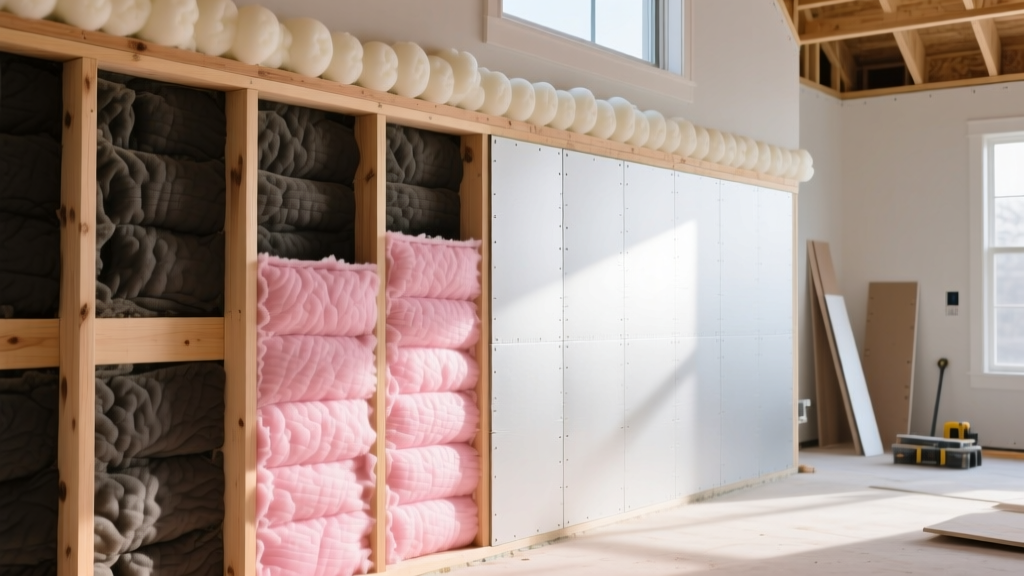
Fiberglass remains the default for production builders due to its low material cost and familiar installation process. In 2026, premium lines like Owens Corning PINK Next Gen offer improved recovery and less itch, but the fundamental physics remain unchanged. For a standard 2x4 wall cavity (3.5 inches), you can achieve R-15. However, fiberglass is highly susceptible to convective heat loss. If the wall cavity is not perfectly air-sealed with a separate membrane or caulked drywall approach, the effective R-value can drop by up to 30% in windy conditions. It is the best insulating material for interior partition walls where acoustic dampening and thermal resistance are secondary to fire-stopping and budget.
Mineral Wool: The Acoustic and Fire Upgrade
Mineral wool (rock wool) has captured significant market share in high-performance builds. Products like ROCKWOOL Comfortbatt provide an R-value of R-15 in a 2x4 cavity and R-23 in a 2x6 cavity. The real cost-value proposition of mineral wool lies in its edge cases: it is completely non-combustible (fire-rated up to 2,150°F), hydrophobic (repels liquid water while remaining vapor-permeable), and dense enough to block sound transmission. The Insulation Institute notes that mineral wool's dimensional stability prevents the sagging and gaps common in aging fiberglass batts, ensuring the long-term thermal envelope remains intact. Expect to pay a 60% premium over fiberglass, justified primarily in fire-prone WUI (Wildland-Urban Interface) zones and multi-family acoustic separations.
Closed-Cell Spray Foam (ccSPF): The Premium Air Barrier
Closed-cell spray foam, such as Demilec Heatlok Sojourn (which utilizes a zero-ODP hydrofluoroolefin blowing agent), is the undisputed leader in R-value per inch (R-7) and structural racking strength. At 1.5 inches thick, ccSPF qualifies as a Class II vapor retarder, eliminating the need for separate poly sheeting in cold climates. The cost is steep—often tripling the insulation line item—but it eliminates the need for separate air-sealing tapes, caulking, and housewrap detailing in complex rooflines. The primary risk with ccSPF is installation error; if the substrate is too cold or damp during application, the foam can delaminate or shrink, creating hidden thermal bridges.
Rigid Polyiso Foam: The Continuous Exterior Solution
Modern energy codes heavily penalize thermal bridging through wood studs. To combat this, builders are moving to continuous exterior insulation (ci). Johns Manville AP Foil-Faced Polyiso offers R-6.5 per inch and features a foil facer that acts as a highly effective weather-resistive barrier (WRB) when seams are taped with compatible acrylic or butyl flashing tapes (e.g., 3M All Weather Flashing Tape). Installing 2 inches of exterior polyiso over OSB sheathing breaks the thermal bridge of the studs, drastically reducing the risk of interstitial condensation inside the wall cavity during winter months.
Regional Climate Cost Multipliers
The 'best' material is entirely dependent on your IECC Climate Zone. Applying the wrong material in the wrong zone leads to catastrophic moisture failure or wasted capital.
- Zones 1-3 (Hot/Humid & Hot/Dry): Prioritize radiant barriers and open-cell foam or unfaced fiberglass. Vapor retarders on the interior side will trap moisture. Cost Strategy: Maximize attic ventilation and radiant reflection over wall R-value.
- Zones 4-5 (Mixed): The transition zone. Requires careful vapor control. Kraft-faced batts or smart vapor retarders (like Membrain) paired with exterior mineral wool or unfaced EPS foam work best. Cost Strategy: Balance cavity insulation with 1 inch of exterior ci.
- Zones 6-8 (Cold/Very Cold): Demands high exterior R-value ratios to keep the sheathing warm. Cost Strategy: Mandatory use of thick exterior Polyiso or closed-cell foam to prevent condensation on the interior side of the sheathing.
Never install interior polyethylene vapor barriers in mixed or hot-humid climates. In the summer, exterior moisture will drive inward, hit the cold poly barrier, and condense inside your wall cavity, leading to rapid mold growth and structural rot. Always consult the DOE's climate-specific vapor retarder guidelines before sealing a wall assembly.
Hidden Installation Costs That Destroy Budgets
When budgeting for the best insulating materials, contractors frequently overlook the ancillary costs required to make the system perform as rated:
- Framing Adjustments: Adding 2 inches of exterior rigid foam requires extending window and door jambs, purchasing longer exterior fasteners, and re-detailing flashing. Add $1.50 to $2.50 per linear foot of opening for these adjustments.
- Air Sealing Prep: Spray foam requires no prep, but fiberglass and mineral wool require meticulous caulking of top plates, bottom plates, and wire penetrations prior to installation. Budget $0.40 per sq. ft. for air-sealing labor and materials (e.g., Tremco acoustical sealant).
- Drywall Fastening: When installing thick exterior foam, standard drywall screws will not reach the studs. You must budget for specialized structural screws or furring strips to attach interior drywall, adding roughly $0.35 per sq. ft. to interior finishing costs.
Navigating 2026 Tax Credits and Rebates
The financial sting of premium insulation is heavily mitigated by federal incentives. Under the Inflation Reduction Act, the 25C Energy Efficient Home Improvement Credit remains fully active in 2026. Homeowners can claim 30% of the cost of insulation materials and air-sealing labor, up to an annual maximum of $1,200. According to Energy Star guidelines, the material must meet the 2021 IECC prescriptive criteria to qualify. This effectively reduces the premium of upgrading from standard fiberglass to mineral wool or spray foam by nearly a third, dramatically shortening the payback period for high-performance envelope upgrades.
Final Decision Matrix: Which Material Maximizes Your Budget?
To finalize your material selection, apply this practical decision tree to your specific project constraints:
- If budget is the absolute primary constraint and you are in Zone 4 or lower: Use R-15 Kraft-faced Fiberglass Batts, but invest heavily in manual air-sealing with caulk and foam at all penetrations.
- If you are building in a Wildfire zone or multi-family dwelling: The premium for ROCKWOOL Mineral Wool is non-negotiable. The fire-stopping and acoustic benefits outweigh the 60% material cost increase.
- If you are designing a complex roofline (dormers, vaulted ceilings): Closed-cell spray foam is the only viable option. Attempting to cut and cobble rigid foam or stuff fiberglass into complex rafter bays guarantees thermal bridging and ice dams.
- If you are targeting Passive House or Net-Zero certification: Combine a dense-pack cellulose or mineral wool cavity with 4+ inches of exterior Polyiso continuous insulation. This hybrid approach offers the highest R-value per dollar while maintaining vapor-open drying potential to the exterior.
Written by
David NakamuraDavid Nakamura is a licensed architect (AIA) and construction technology writer focused on sustainable building methods, mass timber engineering, and high-performance building envelopes. He holds a Master of Architecture from the University of Washington and is a certified Passive House Consultant (CPHC). David spent eight years at the Seattle firm Mithun, where he led the design of three LEED Platinum projects, before founding his own practice specializing in net-zero residential design. He serves on the editorial advisory board of GreenBuilder Magazine and has authored peer-reviewed papers on cross-laminated timber (CLT) connections for the Journal of Structural Engineering. In his spare time, David teaches woodworking at Pratt Fine Arts Center and kayaks the Puget Sound.
More from David Nakamura
View all
Construction Cost
Labor Cost to Build a Deck Per Sq Ft: 2026 Installation Guide
Discover the exact labor cost to build a deck per sq ft in 2026. This installation guide breaks down contractor rates, complexity factors, and hidden fees.
Aug 4, 2026

Construction Cost
How Much Does It Cost to Build a 3 Bedroom House? Financing Guide
Learn exactly how much it costs to build a 3 bedroom house and explore 2026 financing options, construction loan types, and budget frameworks for your build.
Aug 4, 2026

Construction Cost
Cost to Build a Tennis Court: 2026 Guide
How much does it cost to build a tennis court in 2026? Breakdowns for asphalt, concrete, and synthetic surfaces plus fencing and lighting.
Jul 30, 2026