Best Noise Insulation Material: R-Value vs Acoustic STC Performance
Discover the best noise insulation material by comparing R-value thermal metrics with STC acoustic ratings. Expert wall assembly guides and real costs.

The R-Value vs. STC Misconception
When searching for the best noise insulation material, contractors and homeowners frequently make a critical error: conflating thermal resistance with acoustic isolation. R-value and Sound Transmission Class (STC) measure entirely different physical phenomena. According to the U.S. Department of Energy, R-value measures a material's resistance to conductive heat flow. Conversely, STC measures how effectively a building partition attenuates airborne sound, tested under the ASTM E90 standard.
To achieve genuine acoustic isolation, you must address the three principles of soundproofing: mass, decoupling, and damping. The best noise insulation material is rarely a single product; rather, it is a combination of cavity absorbers and structural dampers engineered to work as a unified mass-spring-mass system.
Top Contenders for the Best Noise Insulation Material
Mineral Wool (Stone Wool) Batts
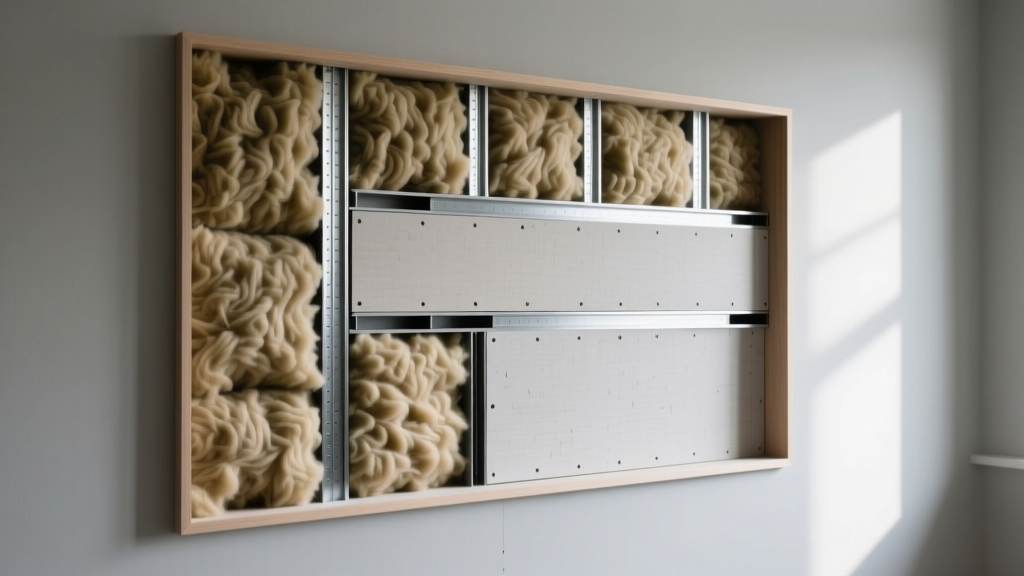
Mineral wool, specifically products like Rockwool Safe'n'Sound, is widely considered the best noise insulation material for standard wood-framed cavities. Manufactured from spun basalt rock and slag, it achieves a density of roughly 2.5 lbs/ft³—significantly heavier than standard fiberglass. While it possesses an inherent thermal resistance of about R-4.2 per inch, it is typically sold unfaced and is designed primarily for interior acoustic partitions rather than exterior thermal envelopes.
- Acoustic Mechanism: The dense, fibrous matrix creates high internal friction, converting mid-to-high frequency sound energy into trace amounts of heat.
- STC Impact: Upgrades a standard 2x4 drywall wall (STC 33) to approximately STC 45 when combined with proper sealing.
- Cost: $1.10 to $1.30 per square foot.
High-Density Fiberglass Acoustic Boards
Rigid fiberglass boards, such as Owens Corning 703 or 705, are engineered for acoustic absorption. With densities ranging from 3.0 to 6.0 lbs/ft³, these panels are exceptional at trapping reverberant sound. However, they are rarely used inside standard wall cavities due to their rigidity and cost. Instead, they are the premier choice for surface-mounted acoustic treatments in home theaters and recording studios. Inside a wall cavity, standard unfaced fiberglass batts (R-3.1 per inch) perform adequately for high frequencies but fail to block low-frequency structural vibrations.
Spray Polyurethane Foam (The Acoustic Trap)
Spray foam is a thermal powerhouse but an acoustic liability if chosen incorrectly. Closed-cell spray foam (R-6.5 per inch) cures into a rigid, structural plastic. Because it bonds the drywall directly to the framing, it creates a mechanical bridge that transmits low-frequency impact noise and structural vibrations. Open-cell spray foam (R-3.5 per inch) is softer and absorbs some mid-range airborne noise, but it lacks the mass to improve STC ratings significantly. For soundproofing, spray foam should be avoided in favor of decoupled mineral wool.
Mass-Loaded Vinyl (MLV) and Damping Compounds
Neither MLV nor viscoelastic damping compounds (like Green Glue) provide any meaningful R-value. However, they are indispensable for high-performance acoustic assemblies. MLV (typically 1 lb or 2 lb per square foot) adds limp mass to a wall, blocking sound transmission without adding structural rigidity. Damping compounds are applied between two layers of drywall, shearing as sound waves hit the wall and converting acoustic energy into low-grade thermal energy.
Material Performance & Cost Comparison Matrix
| Material | Primary Metric | R-Value / Inch | Cavity STC Bump | Est. Cost (per sq ft) |
|---|---|---|---|---|
| Mineral Wool Batts | Absorption / Thermal | ~4.2 | +8 to +12 | $1.15 |
| Standard Fiberglass | Thermal | ~3.1 | +3 to +5 | $0.45 |
| Open-Cell Spray Foam | Thermal / Air Seal | ~3.5 | +4 to +6 | $1.60 |
| Mass-Loaded Vinyl (1lb) | Mass / Blocking | 0.0 | +5 to +8 | $1.85 |
| Viscoelastic Damping Glue | Damping / Shearing | 0.0 | +10 to +15 | $1.50 |
Engineering a High-STC Wall Assembly
Selecting the best noise insulation material is only 25% of the battle. The remaining 75% relies on the physical assembly of the wall. According to the Gypsum Association Fire Resistance and Sound Control Design Manual, achieving an STC 55 or higher requires strict adherence to decoupling and sealing protocols.
- Decouple the Framing: Use staggered-stud construction on a double 2x4 bottom plate, or install 25-gauge resilient channels horizontally across standard 2x4 studs spaced 24 inches on center. This breaks the direct mechanical path for vibration.
- Fill the Cavity: Friction-fit 2.5-inch thick mineral wool batts into the stud bays. Do not compress the batts; compression reduces the air pockets necessary for sound absorption.
- Apply the First Drywall Layer: Install 5/8-inch Type X gypsum board. Use acoustic sealant along the bottom plate and all perimeter edges before screwing the board to the framing or channels.
- Apply Damping Compound: Run viscoelastic damping glue in continuous zigzag patterns across the first layer of drywall. Use exactly two tubes per 4x8 sheet to ensure proper shearing action.
- Install the Second Drywall Layer: Apply a second layer of 5/8-inch Type X drywall, staggering the seams so they do not align with the first layer. Screw only into the first layer of drywall, ensuring the screws do not penetrate the resilient channel or studs beneath.
The Flanking Path Failure
The most common reason a high-end soundproofing project fails is flanking noise. If you build an STC 60 wall but install a hollow-core interior door with a 1-inch bottom gap, the wall's effective STC drops to match the door (typically STC 25). Always pair high-performance wall insulation with solid-core doors, automatic door bottoms, and acoustic putty pads over all electrical outlets on the partition.
Understanding the STC Scale: What the Numbers Actually Mean
Normal speech is easily understood through the wall. Typical of older homes with hollow doors and single-layer 1/2-inch drywall.
Loud speech is audible but not easily understood. Standard code-minimum new construction interior walls (R-13 fiberglass, 1/2-inch drywall).
Loud speech is reduced to a faint murmur. Music is audible but muffled. Achieved with mineral wool and double drywall.
Loud speech and high-volume music are virtually inaudible. Theater-grade isolation requiring decoupled framing, damping compounds, and mass.
Final Material Selection Framework
Identifying the best noise insulation material requires aligning your budget with your acoustic targets. If your goal is simply to reduce echo and absorb high-frequency noise in a home office, standard mineral wool batts combined with a single layer of 5/8-inch drywall will provide an adequate STC 45 at roughly $1.50 per square foot of wall area.
However, if you are isolating a home theater, a bedroom adjacent to a noisy street, or a mechanical room housing a vibrating HVAC unit, cavity absorption alone will fail. You must prioritize mass and decoupling. In these scenarios, mineral wool serves only as the cavity filler; the true acoustic heavy lifting is done by resilient channels, double layers of 5/8-inch drywall, and viscoelastic damping compounds. Do not let thermal R-value ratings distract you from the mass and decoupling metrics that actually govern acoustic performance.
Written by
Priya KapoorPriya Kapoor is a real estate market analyst and construction economics researcher with expertise in housing affordability, development feasibility, and infrastructure investment. She holds a Master of Regional Planning from Cornell University and previously worked as a senior analyst at CBRE's Investment Properties group, where she modeled returns for $4B in mixed-use development pipelines. Priya now runs an independent research practice advising developers, municipalities, and REITs on construction cost forecasting and market timing. She publishes the quarterly "BuildMat Market Pulse" report tracking material price indices across 12 commodity categories. Based in Austin, TX, Priya serves on the board of Habitat for Humanity Austin and is a marathon runner.
More from Priya Kapoor
View all
Construction Cost
Cost to Build a 1600 Sq Ft Home in 2026: Full Breakdown
Accurate 2026 cost to build a 1600 sq ft home—material, labor, and regional pricing breakdowns included. Plan your budget with real-time estimates.
Aug 11, 2026

Wood & Lumber
Name the Types of Wood for Pressure Treatment and Preservation
Learn how to name the types of wood best suited for pressure treatment. Compare species treatability, chemical retention levels, and 2026 preservation costs.
Aug 4, 2026

Stone & Masonry
Stone Veneer Suppliers Lindenhurst: 2026 Cost Analysis
Analyze 2026 stone veneer costs in Lindenhurst, NY. Compare local supplier pricing, delivery fees, and Suffolk County installation labor rates.
Aug 4, 2026