DIY Spray Foam Insulation Kit Review: Touch 'n Seal vs Tiger Foam
Compare top DIY spray foam insulation kits for 2026. We analyze Touch 'n Seal vs Tiger Foam yields, costs, and failure modes to help you choose.
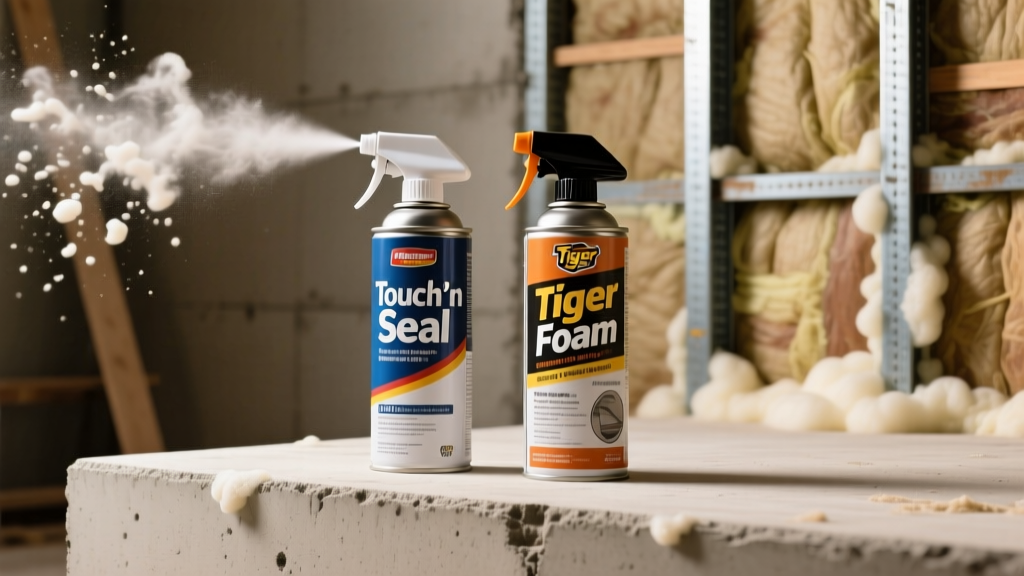
The Reality of DIY Spray Foam Yields and Chemistry
Purchasing a DIY spray foam insulation kit is an exercise in applied chemistry. Unlike fiberglass batts or rigid foam boards, two-component polyurethane spray foam requires precise environmental conditions to achieve the advertised R-value and board-foot yield. Most DIY kits on the market dispense 2 lb density closed-cell foam, which provides an R-value of roughly R-6.5 per inch and acts as both an air barrier and a Class II vapor retarder.
According to the U.S. Department of Energy, closed-cell spray foam is uniquely suited for tight cavities and rim joists where air sealing is critical. However, the primary point of failure for DIYers is not the application technique, but a fundamental misunderstanding of the thermodynamics governing the A-side (isocyanate) and B-side (polyol resin) tanks.
Brand Deep-Dive: Touch 'n Seal Product Line
Touch 'n Seal, a subsidiary of BASF, dominates the large-format DIY and prosumer market. Their systems are characterized by high-yield tanks and proprietary anti-clog nozzle technology. For whole-home retrofits, attic knee walls, or extensive basement rim joist sealing, Touch 'n Seal is the default choice.
Fire Block 600 (Model 30-600)
The Fire Block 600 is the flagship kit, yielding up to 600 board feet at a 1-inch thickness. It is formulated with a fire retardant that grants it a Class A fire rating (ASTM E84), meaning it can be left exposed in certain unoccupied spaces like crawlspaces without an additional thermal or ignition barrier. The kit includes 15-foot hoses and a specialized dispensing gun that allows you to pause and resume application without immediately purging the nozzle.
- Pros: Highest yield per dollar; Class A fire rating reduces the need for drywalling over exposed foam; includes a reusable dispensing gun for large projects.
- Cons: Heavy (approx. 65 lbs total); requires significant physical strength to maneuver the tanks and hoses in tight attic spaces; high upfront cost.
Strataseal 250 (Model 30-250)
For mid-sized projects like sealing a single basement sill plate or insulating a small shed, the Strataseal 250 offers 250 board feet of yield. It uses the same closed-cell chemistry but is packaged in lighter, more manageable 12-inch tall cylinders. It lacks the reusable gun of the 600 model, relying instead on single-use flow nozzles.
Brand Deep-Dive: Tiger Foam Product Line
Tiger Foam targets the agile, small-to-medium project market. Their kits are generally lighter, easier to ship, and utilize a simpler valve-and-hose system. While they do not offer a 600-board-foot mega-kit, their smaller increments reduce the risk of wasting unused product.
Fastfoam 200 (Model TF-200)
The Fastfoam 200 yields 200 board feet of 2 lb closed-cell foam. Tiger Foam's primary advantage here is their proprietary flow nozzle design, which features a slightly wider spray pattern than Touch 'n Seal's standard nozzles. This makes it easier to fill wide stud bays (2x6 construction) in a single pass. According to building science principles outlined by Building Science Corporation, achieving a continuous air seal in deep cavities requires a spray pattern that can bridge the gap without trapping voids.
- Pros: Excellent wide-pattern nozzles for 2x6 framing; lighter tanks (approx. 30 lbs); highly maneuverable for solo DIYers in cramped crawlspaces.
- Cons: Higher cost per board foot compared to Touch 'n Seal; lacks a Class A fire rating (requires a 15-minute thermal barrier like drywall if used in living spaces).
E-84 Specialty Kit
Yielding just 84 board feet, the E-84 is designed strictly for micro-repairs: sealing around HVAC penetrations, plumbing stacks, and small electrical chases. It is the most cost-effective entry point if you only need to air-seal a few specific leaks identified by a blower door test.
2026 Specification & Cost Matrix
Pricing for DIY spray foam fluctuates with raw material costs, but the relative cost-per-board-foot remains a reliable metric for comparing value. Professional installation typically costs between $2.50 and $3.50 per board foot. The kits below represent the DIY savings margin.
| Brand / Model | Yield (bd ft) | Est. Price (2026) | Cost / bd ft | Fire Rating | Best Application |
|---|---|---|---|---|---|
| Touch 'n Seal 600 | 600 | $720 | $1.20 | Class A | Whole attics, large basements |
| Touch 'n Seal 250 | 250 | $340 | $1.36 | Class 1 | Knee walls, shed insulation |
| Tiger Foam 200 | 200 | $310 | $1.55 | Class 1 | 2x6 stud bays, rim joists |
| Tiger Foam E-84 | 84 | $145 | $1.72 | Class 1 | Penetrations, small drafts |
Troubleshooting the 'Off-Ratio' Catastrophe
The most common and expensive mistake made with DIY spray foam kits is an off-ratio mix. Polyurethane foam requires a strict 1:1 volumetric ratio of isocyanate to resin. When the ratio skews, the chemical reaction fails to complete.
Symptoms of Off-Ratio Foam
- Tacky / Uncured Surface: The foam remains sticky days after application. This indicates excess resin (B-side) or insufficient isocyanate (A-side).
- Brittle / Crumbly Texture: The foam shatters when pressed. This indicates excess isocyanate (A-side).
- Shrinkage: The foam pulls away from the wood framing after curing, breaking the air seal.
The 30-Second Nozzle Rule
Once the A and B components meet in the mixing chamber of the nozzle, the polymerization process begins immediately. You have approximately 30 to 45 seconds of flow time before the foam cures inside the plastic nozzle. If you pause your work for longer than 20 seconds, you must trigger the gun into a waste bucket to clear the chamber, or unscrew and replace the nozzle entirely. Forcing a clogged nozzle will blow out the O-rings in the dispensing gun, ruining the kit.
Respiratory Protection and Safety Standards
Spray foam chemistry relies heavily on methylene diphenyl diisocyanate (MDI). The Occupational Safety and Health Administration (OSHA) strictly regulates isocyanate exposure due to its potential to cause severe respiratory sensitization and asthma. A standard N95 dust mask provides zero protection against isocyanate vapors or aerosolized particulates.
When operating any DIY spray foam kit, you must wear a half-face or full-face elastomeric respirator equipped with Organic Vapor (OV) cartridges combined with P100 particulate filters (such as the 3M 60926 multi-gas cartridges). Furthermore, because the exothermic reaction of curing foam releases volatile organic compounds (VOCs) and blowing agents, you must establish active cross-ventilation. Set up a box fan in a window to create negative pressure in the workspace, exhausting fumes directly to the exterior. Keep all occupants and pets out of the home for a minimum of 24 hours post-application to allow for complete off-gassing and thermal stabilization.