Cost of Insulation Materials for Cryogenic Vessels in 2026
Analyze 2026 costs for cryogenic vessel insulation materials. Compare perlite, PIR foam, cellular glass, and aerogel CAPEX versus boil-off gas OPEX.

The Financial Reality of Cryogenic Thermal Management
Designing and maintaining cryogenic vessels—whether for Liquid Natural Gas (LNG), liquid nitrogen, liquid oxygen, or aerospace propellants—requires managing extreme temperature differentials, typically ranging from -150°C to -269°C (-238°F to -452°F). In this environment, insulation is not merely a thermal barrier; it is a critical financial asset. The selection of insulation materials for cryogenic vessels directly dictates both upfront capital expenditure (CAPEX) and long-term operational expenditure (OPEX), primarily through the mitigation of Boil-Off Gas (BOG).
As of 2026, supply chain stabilization and advancements in aerogel and polyisocyanurate (PIR) manufacturing have shifted the cost-benefit analysis for cryogenic engineers. This analysis breaks down the exact material costs, installation variables, and lifecycle financial impacts of the primary insulation systems used in modern cryogenic storage.
Primary Cryogenic Insulation Materials & 2026 Unit Costs
The choice of material depends heavily on the vessel's operating temperature, structural movement, and spatial constraints. Below is the current market pricing for industrial-grade cryogenic insulation materials.
| Material Type | Specific Product / Grade | Thermal Conductivity (mW/m·K at -160°C) | 2026 Material Cost (USD) | Primary Application |
|---|---|---|---|---|
| Expanded Perlite (Loose Fill) | ASTM C549 Grade | 22 - 26 | $3.50 - $5.00 / cu. ft. | Large annular spaces in double-wall LNG tanks |
| Cellular Glass | FOAMGLAS T4+ (Owens Corning) | 32 - 36 | $14.00 - $18.50 / sq. ft. (2" thick) | Pipe supports, vessel heads, high-load areas |
| Polyisocyanurate (PIR) Foam | Trymer PIR (Johns Manville) | 18 - 22 | $11.00 - $15.00 / sq. ft. (2" thick) | Cylindrical vessel walls, large diameter piping |
| Elastomeric Foam | Armaflex AF/HT (Armacell) | 28 - 32 | $9.00 - $13.00 / sq. ft. (1.5" thick) | Secondary containment, complex geometries |
| Silica Aerogel Blanket | Cryogel Z (Aspen Aerogels) | 12 - 14 | $45.00 - $65.00 / sq. ft. (10mm) | Space-constrained vessels, aerospace, LNG marine |
Lifecycle Cost Analysis: The Boil-Off Gas (BOG) Penalty
Evaluating cryogenic insulation strictly on CAPEX is a critical engineering error. The true cost driver is Boil-Off Gas (BOG)—the vapor generated when ambient heat leaks through the insulation matrix, vaporizing the cryogenic liquid. According to data from the NIST Cryogenic Technologies Group, managing heat leak is the primary determinant of cryogenic system viability.
Calculating the Financial Impact of Heat Leak
Consider a standard 50,000-gallon (approx. 95 metric tons) LNG storage vessel operating at -162°C. The latent heat of vaporization for LNG is roughly 510 kJ/kg.
- Scenario A (Standard PIR System): Achieves a BOG rate of 0.15% per day. This results in 142.5 kg of LNG lost daily. At an industrial LNG valuation of $10/MMBtu, this equates to an annualized product loss of approximately $38,500.
- Scenario B (Premium Aerogel/Cellular Glass Composite): Achieves a BOG rate of 0.08% per day. This results in 76 kg lost daily, reducing the annualized loss to $20,500.
While Scenario B may require an additional $45,000 in upfront insulation CAPEX, the OPEX savings yield a payback period of just 2.5 years. Over a 20-year vessel lifecycle, the premium insulation system generates over $300,000 in net savings.
Installation & Labor Cost Variables
Material costs represent only 35% to 45% of the total installed insulation budget. Cryogenic applications demand rigorous installation protocols to prevent catastrophic failure modes like moisture ingress and ice-jacking.
'In cryogenic systems, the vapor barrier is the insulation system. If the vapor barrier fails, ambient moisture will migrate into the insulation matrix, freeze, and expand, destroying the cellular structure of foams and drastically increasing thermal conductivity.' — Industrial Insulation Contractors Association (IICA) Best Practices.
Labor Cost Breakdown (2026 Rates)
- Certified Cryogenic Applicators: $85 - $125 per hour. Standard pipefitters cannot be substituted; joints must be sealed with specialized cryogenic mastic (e.g., Foster 85-60 or Zeston).
- Expansion Joints & Contraction Allowances: Adding 15% to labor time. Carbon steel shrinks ~0.2% at -160°C, while stainless steel shrinks ~0.3%. Insulation layers must be staggered and offset to accommodate this thermal contraction without tearing the vapor barrier.
- Nitrogen Purging (Perlite Systems): Loose-fill perlite requires a continuous or intermittent nitrogen purge to prevent oxygen from condensing within the insulation matrix, which poses a severe explosion hazard. Purge system installation adds $12,000 - $18,000 to the project CAPEX.
Comparative Case Study: 50,000 Gallon LNG Tank Refurbishment
To illustrate the decision-making framework, we analyze a recent 2026 refurbishment of an outdoor, single-wall 50,000-gallon stainless steel LNG tank. The engineering team evaluated two systems:
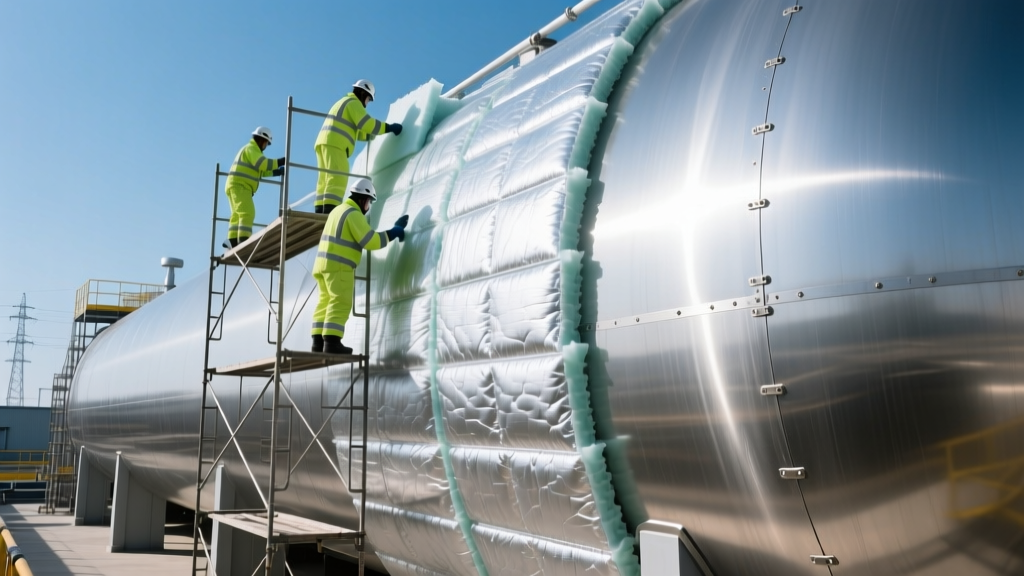
System 1: 4-inch Polyisocyanurate (PIR) with Aluminum Jacketing
- Material Cost: $28,000
- Labor & Jacketing: $42,000
- Total CAPEX: $70,000
- Estimated Annual BOG Loss: $31,000
- Vulnerability: High risk of joint-degradation if the aluminum jacketing is breached by mechanical impact or severe weather.
System 2: 2-inch Cellular Glass (Inner) + 10mm Aerogel (Outer)
- Material Cost: $58,000
- Labor & Jacketing: $35,000 (Reduced labor due to thinner profile and less scaffolding)
- Total CAPEX: $93,000
- Estimated Annual BOG Loss: $18,000
- Vulnerability: Extremely low. Cellular glass is 100% vapor impermeable (ASTM C552), and aerogel is hydrophobic. Even if the outer jacket is breached, the insulation matrix will not absorb water or lose R-value.
Hidden Costs & Failure Modes in Cryogenic Systems
When budgeting for cryogenic insulation, project managers must account for secondary costs associated with specific material limitations. Failure to do so results in severe OPEX spikes within the first three years of operation.
1. The Perlite Settlement Factor
Expanded perlite is highly cost-effective for double-wall tanks but suffers from mechanical settlement over time due to thermal cycling and vibration. Engineers must overfill the annular space by 15% to 20% during initial installation and budget for periodic top-up maintenance every 5 to 7 years. Failing to account for settlement leaves the upper dished head of the vessel uninsulated, creating a massive localized heat leak.
2. Vapor Barrier Redundancy
For closed-cell foams like PIR and Elastomeric (such as those detailed in Armacell's Armaflex cryogenic systems), the material itself acts as a vapor retarder. However, the joints do not. Budgeting must include high-grade cryogenic adhesives and secondary vapor barrier wraps (e.g., 3M Scotchrap or Zeston PVC) applied in a shingled, weather-shedding pattern. Skimping on joint sealants accounts for over 70% of cryogenic ice-formation claims.
3. Structural Support Thermal Bridging
Vessel saddle supports and pipe shoes penetrate the insulation layer, creating thermal bridges. Standard carbon steel supports will freeze and crack the concrete foundation. Budgets must include high-density, high-compression-strength insulation blocks (like FOAMGLAS High Load or specialized PUF cored saddles) at all support points, which cost 3x to 5x more per cubic foot than standard wall insulation.
Strategic Procurement Framework for 2026
To optimize the balance between CAPEX and OPEX, utilize the following decision matrix when specifying insulation materials for cryogenic vessels:
- Choose Expanded Perlite if: You are constructing a massive, double-walled flat-bottom tank with a wide annular space, and the budget strictly limits upfront CAPEX. (Requires nitrogen purge infrastructure).
- Choose PIR Foam if: You are insulating standard cylindrical vessel walls and large-diameter transfer lines where spatial constraints are minimal, and a balance of cost and thermal performance is required.
- Choose Cellular Glass if: The application involves high compressive loads (vessel supports), high fire-risk environments (cellular glass is non-combustible per ASTM E84), or areas highly susceptible to mechanical abuse.
- Choose Aerogel Blankets if: You are retrofitting existing facilities with severe spatial constraints, insulating complex valve manifolds, or designing marine LNG vessels where reducing the overall footprint and weight of the insulation system directly impacts vessel payload capacity.
By aligning the specific thermodynamic and structural demands of the cryogenic vessel with the precise material properties outlined above, facility owners can eliminate hidden maintenance costs and secure long-term thermal efficiency.
Written by
Sarah WhitfieldSarah Whitfield is a chartered quantity surveyor (MRICS) and construction cost analyst with 15 years of experience in material pricing, procurement strategy, and project budgeting. She earned her degree in Construction Management from the University of Reading (UK) and has worked on projects ranging from $2M custom homes to $180M mixed-use developments across North America and Europe. Sarah currently leads cost estimating for BuildMat Insight, maintaining a proprietary database of 4,000+ material price points updated quarterly. She is a frequent contributor to RSMeans cost data panels and has presented at the International Cost Engineering Council (ICEC) congress. Based in Denver, CO, Sarah is an avid trail runner and volunteer mentor for Women in Construction.
More from Sarah Whitfield
View all
Wood & Lumber
What Are the Different Types of Wood? A Builder's Guide
Compare structural softwoods, finish hardwoods, and engineered lumber. Analyze Janka ratings, MOE values, and 2026 pricing for construction.
Aug 4, 2026

Walls & Panels
Steel Framing vs Wood Framing: Corrosion and Moisture Defense
Compare steel framing vs wood framing for moisture resistance. Learn about galvanized coatings, condensation risks, and corrosion protection strategies.
Jul 21, 2026

Stone & Masonry
How to Cut Stone Veneer: Wet Saw vs Grinder Comparison
Compare the best tools for cutting stone veneer. We review wet saws, angle grinders, and chop saws to help you achieve clean, chip-free cuts.
Jul 21, 2026