Duct Insulation Cost Calculator & Estimation Guide 2026
Calculate your 2026 duct insulation costs accurately. Learn material pricing per square foot, R-value requirements, and labor estimates for HVAC systems.
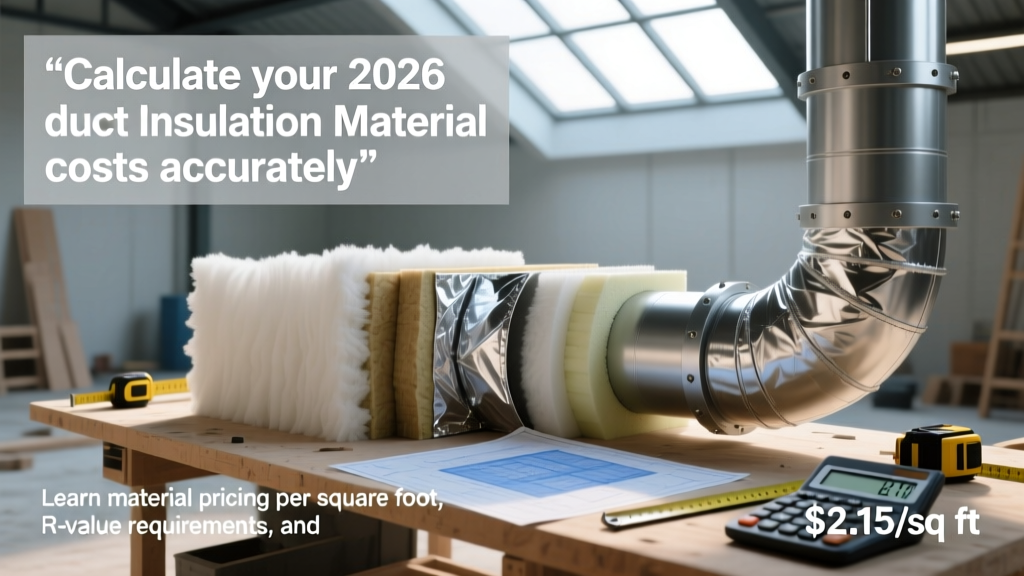
The True Cost of Duct Insulation in 2026
Uninsulated or poorly insulated HVAC ductwork located in unconditioned spaces—such as attics, crawlspaces, and unheated basements—can lose up to 30% of the conditioned air traveling through it. According to the U.S. Department of Energy, sealing and insulating ducts is one of the most cost-effective energy upgrades a building owner can undertake. However, accurately estimating the cost of a duct insulation project requires moving beyond simple square-footage guesses. In 2026, material costs have stabilized, but labor rates and code-mandated R-value requirements continue to drive total project budgets. A standard residential retrofit typically costs between $1.50 and $4.50 per square foot of duct surface area, fully installed. For commercial applications requiring specialized vapor retarders or higher thermal resistance, costs can exceed $6.00 per square foot. This guide provides a precise framework for calculating material quantities, understanding labor variables, and identifying the hidden costs that frequently derail HVAC insulation budgets.
Material Cost Breakdown by Insulation Type
Selecting the right material is not just about thermal resistance; it is about moisture management and physical durability. Below is a comparative matrix of the primary duct insulation materials used in 2026, including current market pricing and specific application profiles.
| Material Type | Standard R-Value | Cost per Sq. Ft. (Material Only) | Best Application & Notes |
|---|---|---|---|
| Foil-Faced Fiberglass Wrap | R-8 to R-12 | $0.75 - $1.40 | Standard residential attics. Requires careful handling to avoid compressing the glass fibers, which reduces the R-value. |
| Closed-Cell Elastomeric Rubber (e.g., ArmaFlex) | R-6 to R-9 | $1.80 - $3.20 | High-humidity climates. Built-in vapor barrier prevents condensation sweating on cold supply lines. |
| Rigid Phenolic Foam Board | R-6 per inch | $2.10 - $3.50 | Commercial rectangular ductwork. Excellent fire resistance and structural rigidity, but requires specialized mastic sealing. |
| Double-Bubble Reflective Foil | R-4 to R-6 | $0.50 - $0.90 | Radiant heat barriers in hot climates. Must be installed with an air gap to achieve rated reflectivity; poor for conductive heat loss. |
| Duct Board (Internal/External) | R-4 to R-6 | $1.90 - $2.80 | Acoustic dampening and thermal control. Often used to fabricate the duct itself rather than wrapping existing sheet metal. |
Expert Insight: When purchasing foil-faced fiberglass wraps (such as Johns Manville Micro-Lok HP), pay close attention to the stated thickness versus the recovered thickness. A wrap labeled as 3 inches thick may compress to 2 inches when wrapped tightly around a duct corner, dropping its effective R-value from R-12 to R-8. Always calculate your required R-value based on the compressed thickness at the corners.
The Duct Insulation Quantity Calculator: Step-by-Step
Ordering insulation by linear foot is a common estimation error that leads to massive material shortages. Duct insulation is sold by the square foot of surface area, and the surface area changes drastically depending on the duct's geometry. Use the following formulas to calculate your exact material requirements.
1. Rectangular Duct Surface Area Formula
For standard rectangular sheet metal ducts, calculate the perimeter and multiply by the length:
- Formula: Surface Area = 2 × (Width + Height) × Length
- Example: A 14-inch by 8-inch duct that runs for 50 linear feet.
- Calculation: Convert inches to feet (14" = 1.16 ft, 8" = 0.66 ft). Perimeter = 2 × (1.16 + 0.66) = 3.64 ft. Surface Area = 3.64 ft × 50 ft = 182 square feet.
2. Round Duct Surface Area Formula
For flexible or rigid round ducts, use the circumference:
- Formula: Surface Area = π × Diameter × Length
- Example: A 10-inch round duct running for 40 linear feet.
- Calculation: Diameter = 0.83 ft. Surface Area = 3.1416 × 0.83 × 40 = 104.3 square feet.
Labor Estimates and Professional Installation Rates
Labor costs for duct insulation are highly dependent on the accessibility of the workspace. An HVAC technician working in a spacious, unconditioned basement will move significantly faster than one crawling through a low-clearance crawlspace or navigating around blown-in attic insulation.
In 2026, professional installation labor typically ranges from $1.50 to $3.50 per square foot of duct surface area. However, many contractors bid by the linear foot for simplicity. If a contractor quotes you $4.00 per linear foot for a massive 24x12 commercial duct, they are likely underbidding and will issue a change order later. Always verify whether a quote is based on linear footage or surface square footage.
Factors That Increase Labor Costs
- Pre-Insulation Sealing: Insulation cannot hide leaky ducts. Joints must be sealed with mastic or UL 181 tape before wrapping. This adds $0.50 to $1.00 per linear foot in labor.
- Pin Fastening: On the bottom of rectangular ducts wider than 12 inches, insulation must be mechanically fastened using welded stick pins and speed clip washers to prevent sagging. This adds roughly 15% to the labor time.
- Workspace Remediation: If an attic requires the installation of catwalks or the relocation of existing blown-in cellulose to access the duct runs, expect a premium hourly rate of $85 to $125 per hour for the preparatory work.
Hidden Cost Traps: Sealants, Fasteners, and Vapor Barriers
The insulation blanket is only one component of a complete duct insulation system. Budgeting exclusively for the wrap will leave you short on the critical accessories required for a code-compliant, functional installation.
| Accessory Component | Estimated Cost | Purpose and Code Requirement |
|---|---|---|
| UL 181B-FX Tape (Foil-Scrim-Kraft) | $12 - $18 per 150ft roll | Required to seal the longitudinal and circumferential seams of the vapor retarder. Standard HVAC duct tape will degrade and fail within 24 months. |
| Insulation Stick Pins (10-gauge) | $35 per box of 100 | Mechanical fastening for the bottom of horizontal rectangular ducts to prevent gravity-induced compression of the fiberglass. |
| Hardcast 1402 Mastic Sealant | $45 per 2-gallon pail | Used to seal sheet metal joints prior to insulation. Brush-on mastic is vastly superior to tape for irregular joints and branch takeoffs. |
| Vapor Dam Collars | $4 - $8 each | Prevents condensation from migrating through the insulation at the exact point where a branch duct intersects the main trunk line. |
In humid climates, the foil facing on fiberglass duct wrap acts as a Class I vapor retarder. If installers use standard wire ties to secure the insulation and puncture the foil without sealing the puncture, warm, moisture-laden attic air will infiltrate the insulation. When this air hits the cold sheet metal of the AC supply duct, it condenses, soaking the fiberglass and causing water to drip onto your ceiling drywall. Every puncture, staple, and cut must be sealed with UL 181B-FX tape or mastic.
Code Compliance and R-Value Requirements
Estimating costs accurately requires knowing exactly how much insulation the law demands. The International Energy Conservation Code (IECC) dictates minimum R-values based on your specific climate zone and whether the duct is a supply or return line.
According to the Sheet Metal and Air Conditioning Contractors' National Association (SMACNA) guidelines, which align with modern IECC standards, supply ducts located entirely in unconditioned spaces generally require a minimum of R-8 in Climate Zones 1 through 3, and R-11 in Climate Zones 4 through 8. Return ducts in unconditioned spaces typically require R-6 across most zones. Upgrading from an R-8 to an R-11 fiberglass wrap increases material costs by approximately 35%, but the energy savings in northern climates (Zones 5 and above) yield a payback period of under four years. For a comprehensive breakdown of climate-specific sealing and insulation protocols, refer to the ENERGY STAR Seal and Insulate guidelines.
Final Estimation Checklist
Before finalizing your 2026 duct insulation budget, ensure you have accounted for the following sequence:
- Duct Sealing: Mastic and UL 181 tape for all sheet metal joints.
- Surface Area Math: Calculated via perimeter formulas, plus 15% waste.
- Primary Insulation: Priced per square foot based on required climate-zone R-value.
- Mechanical Fasteners: Stick pins and washers for wide rectangular ducts.
- Vapor Retarder Sealing: Foil tape for all insulation seams and punctures.
- Labor Premiums: Factored in for tight crawlspaces or attic clearance issues.
By treating duct insulation as a multi-component system rather than a simple wrap-and-tape job, you will eliminate budget overruns and ensure an HVAC system that performs efficiently for decades.