Top Sound Insulation Materials Compared: STC Ratings & Costs
Compare top sound insulation materials by STC ratings, cost per square foot, and installation methods to find the best acoustic solution for your project.

Decoding Acoustic Metrics: STC vs. NRC
When specifying sound insulation materials, contractors and homeowners frequently conflate sound blocking with sound absorption. Understanding the distinction between Sound Transmission Class (STC) and Noise Reduction Coefficient (NRC) is the foundational step in acoustic design. According to the Institute of Noise Control Engineering (INCE-USA), STC measures a partition's ability to block airborne sound from passing through it, while NRC measures a material's ability to absorb sound energy within a room to reduce reverberation.
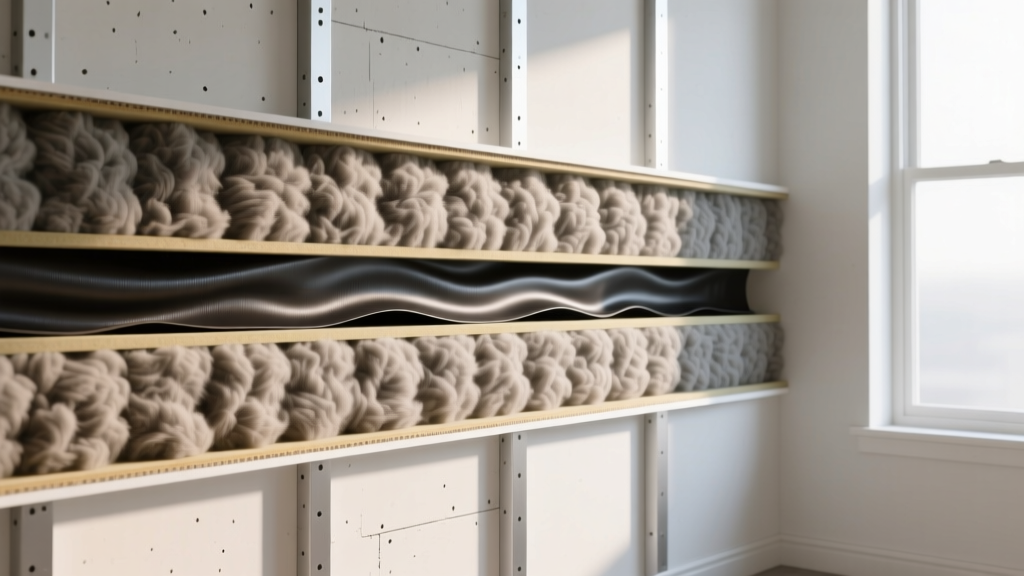
A material with a high NRC (like acoustic foam) will do almost nothing to stop a neighbor's dog from barking through a shared wall. Conversely, a dense material with a high STC contribution might leave a home theater sounding echoey. Effective soundproofing requires a hybrid assembly that utilizes mass, damping, decoupling, and absorption. The Whole Building Design Guide (WBDG) emphasizes that addressing structural flanking paths and selecting the correct combination of these materials is critical for achieving target STC ratings of 50 or higher in multi-family residential construction.
Comprehensive Sound Insulation Materials Matrix
The following matrix compares the primary acoustic materials used in modern construction, evaluating their specific acoustic roles, physical properties, and current market pricing.
| Material Type | Specific Product Example | Primary Acoustic Role | Density / Weight | Avg. Cost (per sq. ft.) |
|---|---|---|---|---|
| Mineral Wool Batts | Rockwool Safe'n'Sound | Cavity Absorption (NRC) | 2.5 lb/cu ft | $0.95 - $1.15 |
| Rigid Fiberglass | Owens Corning 703 | Surface Absorption / Traps | 3.0 lb/cu ft | $2.80 - $3.50 |
| Mass Loaded Vinyl | Soundproofing MLV (1lb) | Mass / Sound Blocking (STC) | 1.0 lb/sq ft | $1.60 - $2.10 |
| Damping Compound | Green Glue Noiseproofing | Viscoelastic Damping | N/A (Paste) | $0.75 - $0.90 (applied) |
| Decoupling Clips | Kinetics IsoMax / GenieClip | Mechanical Decoupling | N/A (Hardware) | $3.50 - $4.50 (per clip) |
| Acoustic Sealant | OSI SC-175 / Tremco | Air Gap Sealing | N/A (Caulk) | $8.00 - $12.00 (per tube) |
Material Deep Dive: Performance and Edge Cases
Mineral Wool Batts (Rockwool Safe'n'Sound)
Mineral wool remains the industry standard for cavity insulation in interior partition walls. Unlike standard thermal fiberglass (which typically ranges from 0.5 to 0.8 lb/cu ft), acoustic mineral wool like Rockwool Safe'n'Sound is manufactured to a higher density of approximately 2.5 lb/cu ft. This increased density and the random orientation of the stone fibers create high flow resistivity, which effectively traps mid-to-high frequency airborne noise (voices, television) inside the wall cavity, preventing it from resonating. Edge Case: Mineral wool does not add significant mass to the wall assembly itself, meaning its standalone STC contribution is limited. It must be paired with heavy facing materials (like 5/8-inch Type X drywall) to achieve high STC ratings. Furthermore, it offers minimal resistance to low-frequency impact noise (bass, footsteps).
Rigid Fiberglass (Owens Corning 703)
Owens Corning 703 is a semi-rigid fiberglass board primarily used for acoustic treatment rather than hidden wall cavity insulation. With an NRC rating of 0.85 to 1.10 (depending on thickness and mounting), it is the premier choice for constructing broadband acoustic panels and bass traps in recording studios and home theaters. Installation Note: It is not designed to be stuffed into stud bays. Instead, it is wrapped in acoustically transparent fabric and mounted on the surface of the room to control reverberation time (RT60). It requires mechanical fastening with impaling clips or Z-clips to prevent sagging over time.
Mass Loaded Vinyl (MLV)
MLV is a limp-mass material composed of vinyl loaded with barium sulfate or calcium silicate. Its primary function is to add mass to an assembly without adding significant thickness. A standard 1 lb/sq ft MLV adds roughly 5 to 7 STC points when integrated into a wall or ceiling assembly. Failure Mode: The most common installation error with MLV is fastening it too rigidly or allowing it to bridge across structural framing. MLV must be installed with slight overlaps and sealed with acoustic caulk, but it must remain 'limp' to effectively convert sound wave energy. If it is stretched tight like a drum between studs, it will transmit vibrations directly into the framing.
Viscoelastic Damping Compounds (Green Glue)
Green Glue is not an adhesive; it is a viscoelastic damping compound designed to be sandwiched between two rigid layers of drywall or plywood. As sound waves vibrate the wall, the compound undergoes shear strain, converting acoustic kinetic energy into negligible amounts of heat. Application Specifics: To achieve the advertised STC gains (often 8-12 points over a non-damped double-drywall assembly), you must use the correct coverage rate. The manufacturer specifies two standard 29 oz tubes per 4x8 sheet of drywall. Using less than the recommended amount drastically reduces the damping effect, while using more yields diminishing returns and can cause the drywall to slip before the compound cures.
Critical Warning: The Flanking Path Effect
You can build an STC 65 wall using double studs, MLV, and Green Glue, but if you leave a 1/4-inch gap at the top plate, or if the HVAC ductwork connects both rooms without an acoustic baffle, your effective STC will plummet to 35. Sound behaves like water; it will exploit the path of least resistance. Always specify acoustic putty pads behind all electrical outlets on partition walls, and use flexible duct connections to isolate mechanical noise.
2026 Cost Breakdown: Soundproofing a 12x12 Room
To provide actionable budgeting data, below is a material-only cost estimate for upgrading a standard 12x12 bedroom (assuming 8-foot ceilings, yielding roughly 384 sq. ft. of wall area and 144 sq. ft. of ceiling area) from a basic STC 33 to a high-performance STC 55+ assembly. This assumes a decoupled ceiling and a damped double-drywall wall assembly.
- Cavity Insulation: Rockwool Safe'n'Sound for walls and ceiling (528 sq. ft.) = $550.00
- Decoupling Hardware: GenieClip RST with hat channel for ceiling (144 sq. ft. requires ~30 clips and 4 channels) = $210.00
- Mass & Damping (Walls): Two layers of 5/8-inch drywall with Green Glue (768 sq. ft. total drywall, 38 tubes of Green Glue) = $1,150.00
- Mass & Damping (Ceiling): Two layers of 5/8-inch drywall with Green Glue (288 sq. ft. total drywall, 15 tubes of Green Glue) = $480.00
- Sealants & Putty: 12 tubes of acoustic sealant, 8 electrical putty pads = $180.00
- Total Material Cost: ~$2,570.00 (Approximately $4.86 per sq. ft. of treated surface area)
Note: This excludes labor, demolition of existing drywall, and finishing (taping/mudding/painting). Professional installation typically adds $3.50 to $6.00 per square foot depending on regional labor rates and site accessibility.
Decision Framework: Selecting the Right Assembly
Choosing the correct sound insulation materials depends entirely on the specific acoustic problem you are trying to solve. Use this framework to guide your specification:
Scenario A: Stopping Airborne Voice Noise Between Rooms (Interior Partitions)
Focus on cavity absorption and mass. Standard wood studs filled with Rockwool Safe'n'Sound, faced with a single layer of 5/8-inch Type X drywall on each side, will yield an STC of roughly 45-48. This is sufficient for most residential bedrooms and bathrooms. If higher privacy is required (STC 50+), add a second layer of drywall with Green Glue.
Scenario B: Mitigating Impact Noise (Footsteps from Above)
Ceiling treatments alone are rarely sufficient for impact noise because the structure transmits the vibration. The primary fix must occur at the source (the floor above) using an acoustic underlayment like cork or recycled rubber. If access is only available from below, you must use a fully decoupled suspended ceiling with resilient isolation clips, deep mineral wool batts, and double drywall. Expect to lose at least 3 to 4 inches of ceiling height.
Scenario C: Controlling Echo in a Home Theater or Studio
Stop looking at STC and focus on NRC. You do not need to tear open the walls. Purchase or build acoustic panels using Owens Corning 703 or Rockwool Rockboard 60, wrap them in breathable fabric, and mount them at primary reflection points on the walls and ceiling. Target covering 15% to 25% of the room's total surface area to achieve a balanced reverberation time without making the room sound 'dead'.
Written by
David NakamuraDavid Nakamura is a licensed architect (AIA) and construction technology writer focused on sustainable building methods, mass timber engineering, and high-performance building envelopes. He holds a Master of Architecture from the University of Washington and is a certified Passive House Consultant (CPHC). David spent eight years at the Seattle firm Mithun, where he led the design of three LEED Platinum projects, before founding his own practice specializing in net-zero residential design. He serves on the editorial advisory board of GreenBuilder Magazine and has authored peer-reviewed papers on cross-laminated timber (CLT) connections for the Journal of Structural Engineering. In his spare time, David teaches woodworking at Pratt Fine Arts Center and kayaks the Puget Sound.
More from David Nakamura
View all
Construction Cost
Labor Cost to Build a Deck Per Sq Ft: 2026 Installation Guide
Discover the exact labor cost to build a deck per sq ft in 2026. This installation guide breaks down contractor rates, complexity factors, and hidden fees.
Aug 4, 2026

Construction Cost
How Much Does It Cost to Build a 3 Bedroom House? Financing Guide
Learn exactly how much it costs to build a 3 bedroom house and explore 2026 financing options, construction loan types, and budget frameworks for your build.
Aug 4, 2026

Construction Cost
Cost to Build a Tennis Court: 2026 Guide
How much does it cost to build a tennis court in 2026? Breakdowns for asphalt, concrete, and synthetic surfaces plus fencing and lighting.
Jul 30, 2026