Dual-Purpose Materials for Sound Insulation and Energy Efficiency
Discover the best dual-purpose materials for sound insulation that also maximize thermal R-value. Compare mineral wool, cellulose, and fiberglass costs.
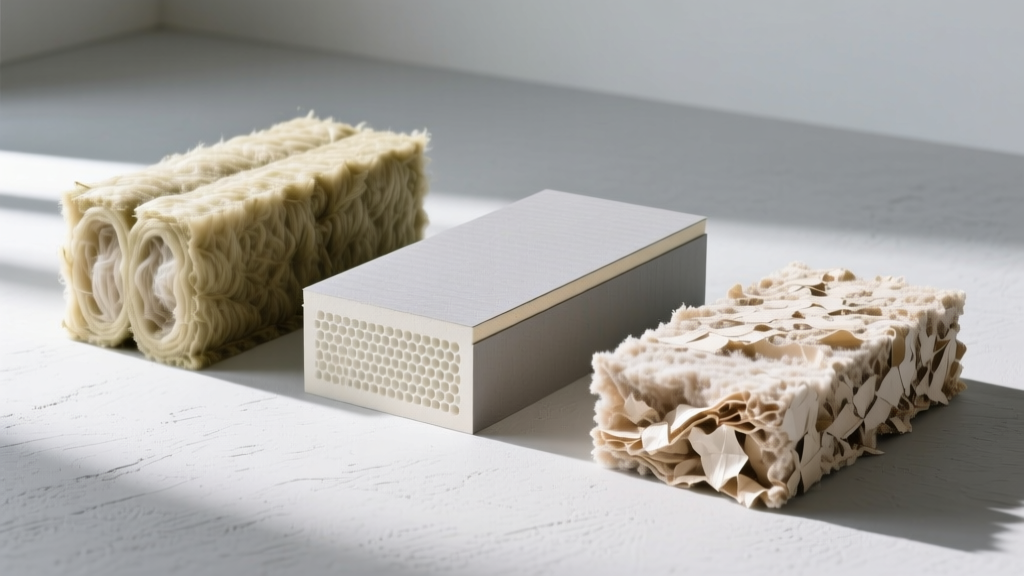
The Physics of Thermal-Acoustic Synergy
Designing a high-performance building envelope requires balancing two distinct physical mandates: thermal retention and acoustic isolation. While thermal insulation relies on trapping pockets of still air to reduce conductive heat transfer, acoustic insulation depends on mass, damping, and decoupling to disrupt mechanical sound waves. Historically, builders treated these as separate scopes of work, installing lightweight thermal batts in exterior walls and heavy acoustic treatments in interior partitions. However, modern building science recognizes that specific fibrous and dense-pack materials can fulfill both roles simultaneously, optimizing both energy efficiency and Sound Transmission Class (STC) ratings.
When selecting materials for sound insulation that also deliver high R-values, the goal is to find products with a high Noise Reduction Coefficient (NRC) for internal echo damping, combined with sufficient density to impede airborne noise transmission. According to the U.S. Department of Energy, optimizing insulation density not only improves thermal resistance but inherently adds the mass required to block mid-to-high frequency airborne noise, provided the assembly is properly decoupled and sealed.
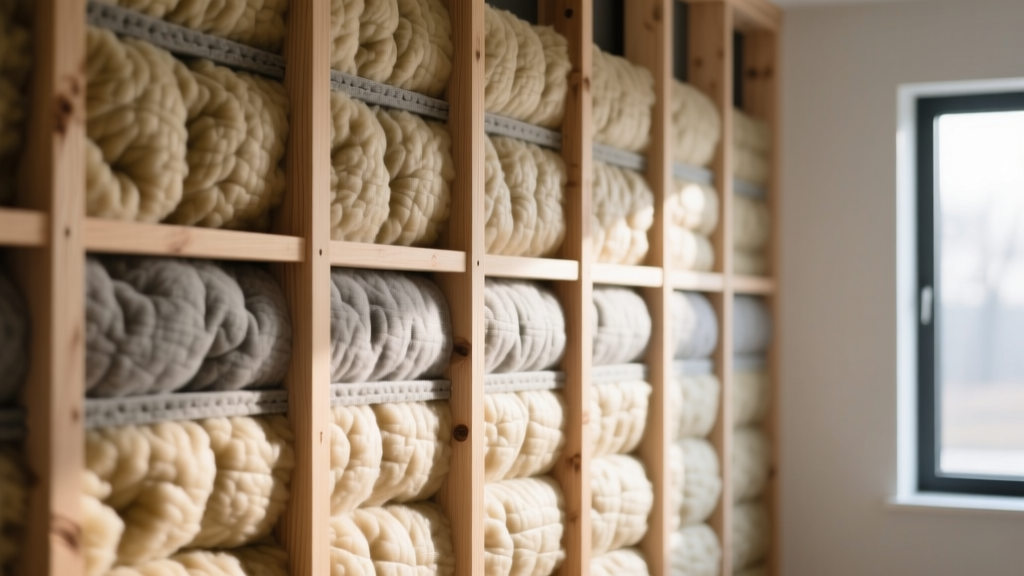
Top Materials for Sound Insulation with High R-Values
Not all insulation is created equal. Standard lightweight fiberglass excels at thermal resistance but lacks the mass to stop low-frequency sound. Conversely, rigid foam boards offer high R-values per inch but are acoustically transparent, often amplifying impact noise. The following materials represent the optimal intersection of acoustic damping and thermal resistance.
Mineral Wool (Stone Wool)
Mineral wool remains the gold standard for dual-purpose performance. Manufactured by spinning molten basalt rock and slag into a dense fibrous matrix, mineral wool offers superior acoustic damping compared to fiberglass. A standard 3.5-inch batt of Rockwool Comfortbatt 80 yields an R-15 thermal rating while significantly outperforming equivalent fiberglass in STC tests. In a standard 2x4 wood-framed wall with 5/8-inch drywall on both sides, mineral wool can achieve an STC of 45 to 50, effectively blocking loud speech and television noise. Furthermore, mineral wool is hydrophobic and non-combustible (withstanding temperatures exceeding 2,150°F), adding fire-resistance and moisture resilience to the energy-efficient assembly. As of 2026, material costs range from $1.15 to $1.45 per square foot.
Dense-Pack Cellulose
For retrofit applications and exterior walls where thermal bridging and airborne exterior noise are primary concerns, blown-in dense-pack cellulose is highly effective. Products like Greenfiber Sanctuary are treated with borates for fire and pest resistance. The critical factor is installation density: to achieve both optimal thermal resistance (R-3.7 to R-3.8 per inch) and acoustic mass, the cellulose must be pneumatically installed at a minimum density of 3.5 lbs/ft³. At this density, the material acts as a semi-solid mass that severely restricts the movement of sound waves through wall cavities while eliminating the convective air loops that degrade the performance of poorly installed batts. Installed costs typically range from $1.30 to $1.70 per square foot.
High-Density Fiberglass Batts
While standard fiberglass is acoustically inadequate, specialized high-density acoustic batts bridge the gap. Owens Corning QuietZone acoustic batts are engineered with a tighter fiber matrix than standard thermal batts. While they do not match the low-frequency blocking power of mineral wool, they provide excellent absorption of mid-to-high frequency airborne noise (such as voices and office equipment) while maintaining an R-13 to R-15 thermal rating in 2x4 and 2x6 cavities. They are also significantly more cost-effective, averaging $0.65 to $0.85 per square foot, making them ideal for budget-conscious interior partition walls where extreme thermal performance is secondary to basic energy code compliance.
Performance Matrix: STC vs. R-Value Comparison
The following matrix compares standard 2x4 wall assemblies (5/8-inch gypsum board on both sides, no resilient channels) to illustrate the dual-purpose capabilities of these materials.
| Material Type | Thickness | Thermal R-Value | Assembly STC Rating | Avg. Cost / Sq. Ft. (2026) |
|---|---|---|---|---|
| Standard Fiberglass | 3.5" | R-11 to R-13 | 35 - 38 | $0.45 - $0.60 |
| High-Density Fiberglass | 3.5" | R-13 to R-15 | 39 - 42 | $0.65 - $0.85 |
| Dense-Pack Cellulose | 3.5" | R-13 (3.8/in) | 44 - 47 | $1.30 - $1.70 (Installed) |
| Mineral Wool (Stone) | 3.5" | R-15 | 45 - 50 | $1.15 - $1.45 |
| Closed-Cell Spray Foam | 3.5" | R-21 to R-24 | 36 - 39 | $2.50 - $3.20 (Installed) |
Note: Closed-cell spray foam is included as a baseline. Despite its exceptional thermal R-value, its rigid, high-density cellular structure couples directly to the framing, transmitting low-frequency impact noise and resulting in a surprisingly poor STC rating compared to fibrous materials.
Air Sealing: The Missing Link in Acoustic-Thermal Performance
Even the most advanced materials for sound insulation will fail if the building envelope is not hermetically sealed. Sound behaves like water; it will exploit the smallest available pathway. According to research published by the Building Science Corporation, a mere 1/8-inch gap running the perimeter of a standard 10x10 foot room can reduce the assembly's overall R-value by up to 20% due to convective thermal bypass, while simultaneously dropping the STC rating by 5 to 8 points.
Strategic Assembly Techniques for Maximum Isolation
Selecting the right batt or blown-in material is only 50% of the equation. To maximize both thermal efficiency and acoustic isolation, the physical framing assembly must be designed to prevent thermal bridging and mechanical sound transmission.
- Decoupling via Resilient Channels: Installing RC-1 resilient channels horizontally across the studs before hanging drywall creates a mechanical break. This prevents sound vibrations from traveling directly through the wooden studs into the drywall. When combined with mineral wool, this technique can push a standard 2x4 wall's STC into the low 50s.
- Staggered Stud Construction: For exterior walls where both high thermal resistance and exterior noise blocking are required, staggered stud walls on a common 2x6 plate ensure that the interior drywall and exterior sheathing never share the same continuous wooden stud, eliminating direct acoustic flanking paths while allowing for a thicker insulation cavity.
- Electrical Box Isolation: Back-to-back electrical outlets on interior partition walls are notorious acoustic weak points. Use putty pads (like TENMAT Putty Pads) wrapped around the rear and sides of the electrical boxes to restore the mass and fire-rating of the drywall, preventing sound from leaking through the wall cavity.
A common failure mode in high-performance builds is ignoring flanking paths. If you install premium mineral wool in a partition wall but leave a continuous, uninsulated drop-ceiling plenum above it, sound will simply travel up into the ceiling, across the partition, and down into the adjacent room. Always extend acoustic insulation at least 3 feet beyond the partition wall into the adjacent ceiling cavities, or use acoustic baffling in the plenum space.
Expert Decision Framework
Use this conditional framework to specify the correct dual-purpose material for your specific project parameters:
- IF you are framing new interior partition walls (e.g., bedrooms, home theaters, home offices) AND require maximum speech privacy on a moderate budget, THEN specify 3.5-inch Mineral Wool batts with resilient channels and acoustic sealant.
- IF you are retrofitting an existing exterior wall to improve both energy efficiency and block street/traffic noise AND cannot remove the interior drywall, THEN specify dense-pack cellulose blown in through 2-inch exterior or interior access holes.
- IF you are building a multi-family dwelling requiring strict fire-code compliance (e.g., 1-hour or 2-hour fire-rated assemblies) alongside acoustic separation, THEN mineral wool is mandatory, as it is inherently non-combustible and holds the fire-rating of the drywall assembly intact.
- IF you are insulating an interior basement ceiling to prevent impact noise from the floor above while retaining heat in the basement, THEN use high-density fiberglass or mineral wool held in place with wire mesh, ensuring all HVAC duct penetrations are sealed with mastic to prevent airborne noise leakage.
By aligning the physical properties of the insulation material with the specific acoustic and thermal demands of the assembly, builders can eliminate redundant material costs and deliver a highly efficient, acoustically comfortable living environment.
Written by
James ThorntonJames Thornton is a construction industry veteran with 25 years of hands-on experience in wood framing, lumber grading, and residential building codes. He started as a framing carpenter in rural Oregon, earned his ICC Residential Building Inspector certification, and eventually became a senior plan reviewer for the City of Portland Bureau of Development Services. James holds a B.S. in Wood Science & Technology from Oregon State University and is a certified lumber grader through the West Coast Lumber Inspection Bureau (WCLIB). He has inspected over 3,000 residential construction sites and authored the city's internal guide on advanced framing techniques (2x6 at 24" O.C.). James lives in Bend, OR, where he builds custom timber-frame cabins and competes in lumberjack sports.
More from James Thornton
View all
Insulation
Best Home Insulation Materials: Complete 2026 Guide
Compare top home insulation materials for 2026. Find R-values, installed costs per square foot, and best uses for fiberglass, spray foam, and mineral wool.
Aug 4, 2026

Sustainable Building
Certify Your Green Building Material for LEED and WELL
Step-by-step guide to certifying a green building material for LEED v5 and WELL v2. Master EPDs, HPDs, and VOC limits for 2026 project specifications.
Aug 4, 2026

Stone & Masonry
Veneer Stacked Stone Panels: Interior Design & Style Showcase
Discover how veneer stacked stone panels transform interiors. Explore modern design profiles, material pairings, and technical installation specs.
Aug 4, 2026