Good Insulation Materials: The Ultimate Energy Efficiency Guide
Discover the best good insulation materials for maximum energy efficiency. Compare R-values, costs, and climate zone specifications for modern builds.

Selecting good insulation materials is no longer just about stuffing fiberglass batts into a wall cavity and hoping for the best. Modern building science demands a rigorous approach to thermal resistance, air sealing, and moisture management. With the continuous evolution of the International Energy Conservation Code (IECC), architects and builders must specify materials that deliver high R-values per inch while mitigating thermal bridging and vapor drive.
The Thermodynamics of Enclosure Design
When evaluating good insulation materials, professionals must look beyond the center-of-cavity R-value. The U.S. Department of Energy emphasizes that the effective thermal performance of an assembly depends on the insulation's resistance to conductive heat flow, its ability to limit convective loops, and its emissivity properties.
Furthermore, the Global Warming Potential (GWP) of blowing agents used in foam plastics has shifted material specifications. Hydrofluorocarbon (HFC) blowing agents are being rapidly phased out in favor of hydrofluoroolefin (HFO) alternatives, which offer a GWP of less than 10 without sacrificing the closed-cell structure's thermal performance.
Material Matrix: Matching Materials to Climate Zones
Not all good insulation materials perform equally across different hygrothermal regions. The following matrix aligns specific material classes with IECC climate zones to optimize energy efficiency and prevent condensation within the wall assembly.
| IECC Climate Zone | Primary Cavity Material | Continuous Exterior (ci) Requirement | Vapor Retarder Class Needed |
|---|---|---|---|
| Zones 1-2 (Hot/Humid) | Open-Cell Spray Foam / Mineral Wool | None to R-5 (for dew point control) | Class III (or none) |
| Zones 3-4 (Mixed) | Dense-Pack Cellulose / Fiberglass | R-5 to R-10 ci | Class II (Smart Membrane) |
| Zones 5-6 (Cold) | Closed-Cell Foam / Mineral Wool | R-10 to R-15 ci | Class I or II (Interior side) |
| Zones 7-8 (Very Cold) | Closed-Cell Foam + Mineral Wool | R-15 to R-20+ ci | Class I (Interior side) |
Deep Dive: High-Performance Material Profiles
Closed-Cell Spray Polyurethane Foam (ccSPF)
Closed-cell foam remains the gold standard for high-R-value applications where space is constrained. Modern formulations, such as Gaco Western's HFO-blown foams, deliver an aged R-value of R-7.0 to R-7.3 per inch. At a standard 2-inch application, ccSPF acts as a Class II vapor retarder and provides an exceptional air barrier, effectively eliminating convective heat loss.
- Cost: $1.60 to $2.80 per board foot installed.
- Best Application: Rooflines, rim joists, and unvented cathedral ceilings.
- Limitation: High embodied carbon and requires professional installation with strict temperature and humidity tolerances during application.
High-Density Mineral Wool Boards
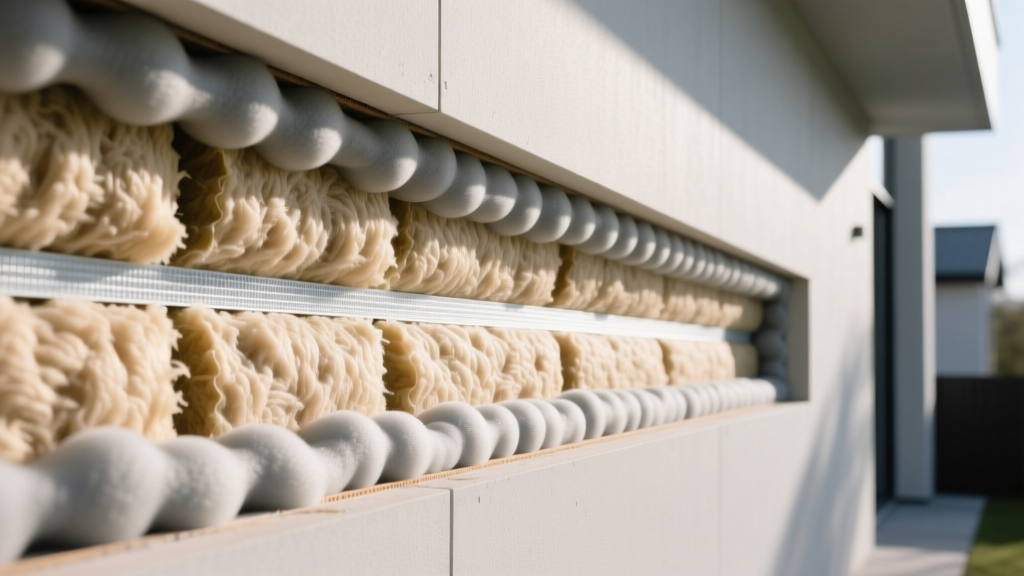
For continuous exterior insulation (ci), mineral wool boards like ROCKWOOL Comfortboard 80 are superior to rigid foams in fire resistance and vapor permeability. Offering R-4.3 per inch, mineral wool does not off-gas and maintains its dimensional stability and R-value in extreme temperature fluctuations, unlike polyiso which suffers from thermal drift in freezing temperatures.
- Cost: $1.20 to $1.75 per square foot (material only).
- Best Application: Exterior continuous insulation, commercial shaft walls, and acoustic buffering.
- Limitation: Lower R-value per inch requires thicker wall assemblies; requires specialized fasteners with thermal breaks to prevent compression.
Polyisocyanurate (Polyiso) Rigid Foam
Polyiso offers the highest initial R-value of standard rigid foams (up to R-6.5 per inch). However, the PNNL Building America Solution Center notes that the blowing agents in polyiso condense at low temperatures, causing the R-value to drop significantly in sub-freezing climates. To counter this, specify foil-faced polyiso for interior applications where temperatures remain stable, or use it in hybrid assemblies where it is kept above the dew point.
The Air Barrier Imperative: Why R-Value Isn't Enough
The Environmental Protection Agency estimates that up to 25% of a building's heat loss is driven by air leakage, not conductive transfer through the insulation itself. Good insulation materials must be paired with a continuous air barrier.
Warning: Installing R-30 batts in a leaky wall assembly will not yield a high-performance building. A blower door test target of 2.0 ACH50 (Air Changes per Hour at 50 Pascals) or lower is the benchmark for modern energy-efficient enclosures. Without fluid-applied membranes or taped sheathing, convective loops will bypass the insulation entirely.
Financial Modeling: Life-Cycle Cost Analysis (LCCA)
When specifying good insulation materials, builders must calculate the payback period based on local utility rates. Consider a 2,500 sq. ft. home in Climate Zone 5 upgrading from code-minimum R-13 cavity insulation to a hybrid assembly (R-15 closed-cell flash + R-15 fiberglass batt).
Upgrade Economics (Zone 5 Example)
Premium for Hybrid Assembly: ~$4,200 over code-minimum.
Annual HVAC Energy Savings: ~$480/year (based on $0.16/kWh and 1,200 heating degree days).
Simple Payback Period: 8.7 years.
HVAC Downsizing Savings: $1,500 (smaller heat pump required due to reduced load).
Adjusted Payback: 5.6 years.
Expert Decision Framework: Which Material Should You Specify?
Use this logic flow to select the optimal material for your specific project constraints:
- Is the cavity depth severely restricted (e.g., historic masonry retrofit)?
- Yes: Specify Vacuum Insulation Panels (VIPs) or Aerogel blankets (R-10 to R-14 per inch). Expect costs exceeding $12/sq. ft.
- No: Proceed to step 2.
- Is the assembly exposed to bulk water risk or high humidity (e.g., below-grade, coastal)?
- Yes: Use Extruded Polystyrene (XPS) or closed-cell spray foam. Avoid fiberglass or cellulose.
- No: Proceed to step 3.
- Is fire-stopping and acoustic isolation a primary code requirement (e.g., multi-family party walls)?
- Yes: Specify high-density mineral wool (ROCKWOOL Safe'n'Sound or Comfortbatt).
- No: Proceed to step 4.
- Is minimizing embodied carbon the primary project goal?
- Yes: Use dense-pack cellulose or wood fiber boards (e.g., Gutex). These store carbon and offer excellent vapor-open hygrothermal performance.
- No: Standard fiberglass or HFO-blown spray foam remains the most cost-effective baseline.
Specifying the right insulation requires balancing thermodynamics, building physics, and project economics. By matching the material's specific hygrothermal properties to the climate zone and pairing it with rigorous air-sealing protocols, you ensure the building enclosure performs at peak efficiency for its entire lifecycle.
Written by
Marcus ChenMarcus Chen is a licensed structural engineer (PE) and building materials analyst with over 12 years of experience across residential, commercial, and industrial construction. He holds a Master of Science in Civil Engineering from UC Berkeley and spent six years at Thornton Tomasetti before transitioning to independent consulting and technical writing. Marcus specializes in material selection for seismic-prone regions, concrete reinforcement strategies, and lifecycle cost analysis. His work has been cited by the American Concrete Institute (ACI) and the Structural Engineers Association of California (SEAOC). When he is not on a job site or at his desk, you will find him hiking the Sierra Nevada or restoring a 1920s craftsman bungalow in Oakland, CA.
More from Marcus Chen
View all
Construction Cost
How Much Did the Eiffel Tower Cost to Build?
How much did the Eiffel Tower cost to build in 1889? We adjust for inflation and compare its budget to modern skyscraper construction.
Aug 4, 2026

Fire Resistance
What Is a Fire Resistant Material? Testing & Certification Guide
Discover what is a fire resistant material through ASTM and UL testing. Learn how fire ratings, certifications, and assemblies work in construction.
Aug 4, 2026

Construction Cost
How Much Did the Burj Khalifa Cost to Build?
How much did the Burj Khalifa cost to build? We break down the $1.5B project and extract 5 money-saving strategies for your next build.
Jul 30, 2026