Choosing the Right Type of Insulation Material for Maximum R-Value
Compare the R-value performance of every major type of insulation material. Learn how temperature, moisture, and installation impact thermal resistance.

Beyond the Label: Center-of-Cavity vs. Whole-Wall R-Value
When evaluating which type of insulation material will deliver the best thermal resistance for your building envelope, relying solely on the manufacturer's printed R-value is a critical error. The R-value printed on a batt or foam board represents the center-of-cavity measurement—tested under ideal, steady-state laboratory conditions (typically at a mean temperature of 75°F) according to ASTM C518 standards. It completely ignores the wooden or steel studs, corners, headers, and rim joists that create thermal bridges.
To make accurate performance predictions, building scientists use the whole-wall R-value. This metric accounts for the structural framing (which typically has an R-value of only R-1.25 per inch for softwood lumber) and the inevitable installation imperfections. For example, a standard 2x6 wall framed at 16 inches on-center and filled with R-21 fiberglass batts does not yield an R-21 wall. The whole-wall R-value drops to approximately R-13.7 due to thermal bridging through the studs and minor compression at the edges. Understanding this distinction is the first step in selecting the correct material for your specific climate zone and framing geometry.
R-Value Performance Matrix by Type of Insulation Material
The following matrix breaks down the real-world thermal performance, cost parameters, and physical limitations of the primary insulation categories available on the market. Costs reflect average 2026 material pricing for residential applications, excluding professional installation labor.
| Material Type | R-Value per Inch (at 75°F) | Cost per Sq. Ft. (R-13 equiv.) | Moisture Permeability | Primary Limitation |
|---|---|---|---|---|
| Fiberglass Batts | R-2.9 to R-3.8 | $0.45 - $0.75 | High (Vapor permeable) | Severe R-value loss if compressed or exposed to convective air loops. |
| Mineral Wool | R-4.2 to R-4.3 | $1.10 - $1.50 | High (Vapor permeable) | Higher material cost; requires specialized cutting tools. |
| Open-Cell SPF | R-3.5 to R-3.8 | $1.20 - $1.60 | High (Vapor permeable) | Does not block liquid water; requires an interior vapor retarder in cold climates. |
| Closed-Cell SPF | R-6.0 to R-7.0 | $2.80 - $3.50 | Low (Class II Vapor Retarder) | High cost; traps moisture if a leak occurs inside the wall cavity. |
| Polyiso (Foil-faced) | R-6.0 to R-6.5 | $1.30 - $1.80 | Very Low (Class I Vapor Retarder) | R-value degrades significantly in freezing temperatures (thermal drift). |
| XPS (Extruded Polystyrene) | R-5.0 | $1.40 - $1.90 | Low (Class II/III Vapor Retarder) | Long-term thermal resistance (LTTR) drops as blowing agents diffuse out. |
| EPS (Expanded Polystyrene) | R-3.6 to R-4.4 | $0.80 - $1.20 | Moderate (Vapor semi-permeable) | Lower R-value per inch; vulnerable to solvent-based adhesives and melting. |
The Polyiso Cold-Weather Penalty
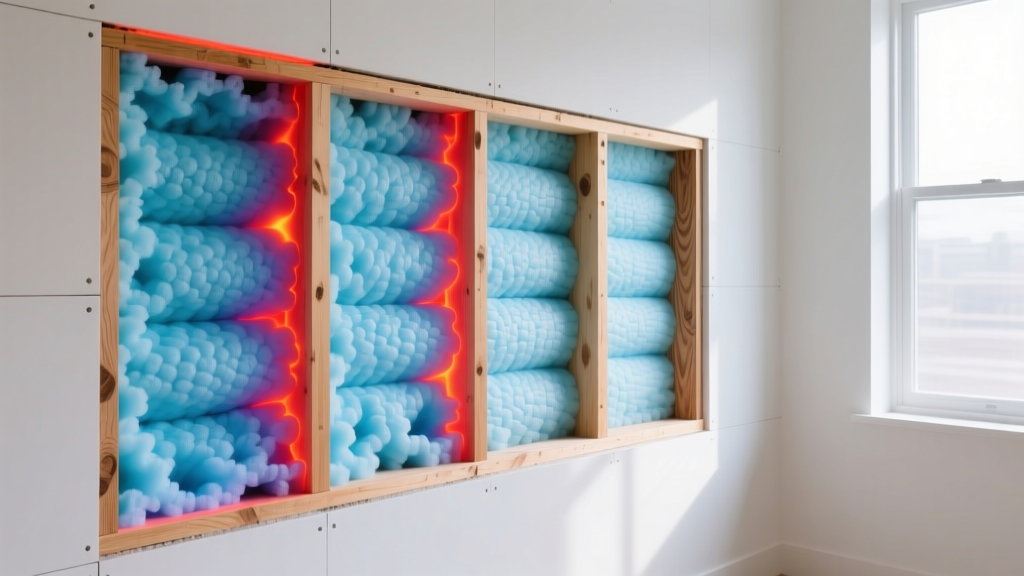
Polyisocyanurate (Polyiso) is frequently specified for continuous exterior insulation because it boasts the highest rated R-value per inch (up to R-6.5) among rigid foams at room temperature. However, this high performance is driven by low-conductivity hydrocarbon blowing agents trapped in the foam's cellular structure. When the exterior temperature drops below freezing, these gases begin to condense, losing their insulating properties and allowing air to take over the cellular spaces.
According to research published by the U.S. Department of Energy, the effective R-value of Polyiso can drop by 20% to 25% when the mean temperature falls to 25°F. If you are building in Climate Zones 6 through 8, you must derate Polyiso in your energy modeling calculations. In contrast, Expanded Polystyrene (EPS) uses pentane as a blowing agent, which diffuses out quickly and is replaced by air. While EPS has a lower initial R-value, its thermal resistance remains entirely stable regardless of how cold the winter gets.
XPS and Long-Term Thermal Resistance (LTTR)
Extruded Polystyrene (XPS), recognizable by its pink, blue, or green coloring, is manufactured using HFC or HCFC blowing agents that yield an initial R-value of R-5.0 per inch. However, XPS suffers from Long-Term Thermal Resistance (LTTR) degradation. Over a 15- to 50-year lifespan, the high-performance blowing agents slowly diffuse out of the foam and are replaced by ambient air. The FTC mandates that manufacturers report the 15-year aged R-value, which typically settles around R-4.5 to R-4.7 per inch. Furthermore, due to environmental regulations phasing out high-GWP (Global Warming Potential) HFCs, the industry is shifting toward HFO blowing agents, which alters the long-term degradation curve of modern XPS boards.
Installation Flaws That Decimate Thermal Performance
Selecting the highest performing type of insulation material is irrelevant if the installation methodology compromises the assembly. The Environmental Protection Agency (EPA) notes that improper installation can reduce effective thermal resistance by up to 30%. Here are the specific failure modes to audit on your job site:
- Fiberglass Compression: Fiberglass relies on trapped, stationary air for its thermal resistance. Stuffing an R-19 batt (designed for a 6.25-inch 2x6 cavity) into a 3.5-inch 2x4 wall does not yield R-19. The compression increases the material's density and thermal conductivity, dropping the effective R-value to roughly R-13 or lower.
- Convective Wind-Washing: If fiberglass or mineral wool batts are not perfectly flush against the interior drywall and exterior sheathing, air can circulate behind the insulation. This convective loop acts as a thermal bypass, stripping heat from the wall cavity. Wind-washing in unsealed attic eaves can reduce ceiling insulation performance by 40%.
- Missing Air Sealing: Insulation stops conductive heat transfer; it does not stop convective heat transfer. Without a continuous air barrier (such as caulk, spray foam, or specialized membranes like Intello Plus), warm, moist interior air will bypass the insulation entirely, rendering the R-value meaningless and causing interstitial condensation.
Climate-Specific Decision Framework
Use this decision matrix to align your material choice with your specific hygrothermal region. Always verify local amendments to the IECC (International Energy Conservation Code) before finalizing your assembly.
- Hot-Humid Climates (Zones 1-3): Prioritize moisture management over maximum R-value. Use open-cell spray foam or unfaced fiberglass batts to allow the wall cavity to dry inward. Avoid interior polyethylene vapor barriers and interior foil-faced Polyiso, which can trap moisture and cause mold growth on the interior side of the sheathing.
- Mixed Climates (Zone 4): Utilize a 'flash and batt' hybrid approach. Apply 1.5 inches of closed-cell spray foam against the interior sheathing to raise the temperature of the condensing surface above the dew point, then fill the remainder of the cavity with cost-effective mineral wool or fiberglass.
- Cold Climates (Zones 5-8): Maximize continuous exterior insulation to prevent thermal bridging and keep the structural sheathing warm. Use EPS or mineral wool boards on the exterior. If using Polyiso, increase the thickness by 25% to account for the cold-weather R-value drop, and ensure the exterior R-value meets the code-required ratio to prevent interior condensation.
'The pursuit of higher R-values is futile if the building envelope is not airtight. Air leakage accounts for up to 40% of a building's heat loss. Insulation and air sealing must be treated as a single, interdependent system.' — Building Science Corporation Guidelines on Enclosure Design.
Final Verification
When specifying your materials, demand the manufacturer's technical data sheets (TDS) and verify the ASTM test standards cited. For rigid foams, ensure you are looking at the LTTR (Long-Term Thermal Resistance) values rather than the initial day-one values. By matching the physical properties of the material to the specific thermal and moisture dynamics of your climate zone, you will achieve an enclosure that performs as efficiently in year twenty as it did on day one.
Written by
Priya KapoorPriya Kapoor is a real estate market analyst and construction economics researcher with expertise in housing affordability, development feasibility, and infrastructure investment. She holds a Master of Regional Planning from Cornell University and previously worked as a senior analyst at CBRE's Investment Properties group, where she modeled returns for $4B in mixed-use development pipelines. Priya now runs an independent research practice advising developers, municipalities, and REITs on construction cost forecasting and market timing. She publishes the quarterly "BuildMat Market Pulse" report tracking material price indices across 12 commodity categories. Based in Austin, TX, Priya serves on the board of Habitat for Humanity Austin and is a marathon runner.
More from Priya Kapoor
View all
Construction Cost
Cost to Build a 1600 Sq Ft Home in 2026: Full Breakdown
Accurate 2026 cost to build a 1600 sq ft home—material, labor, and regional pricing breakdowns included. Plan your budget with real-time estimates.
Aug 11, 2026

Wood & Lumber
Name the Types of Wood for Pressure Treatment and Preservation
Learn how to name the types of wood best suited for pressure treatment. Compare species treatability, chemical retention levels, and 2026 preservation costs.
Aug 4, 2026

Stone & Masonry
Stone Veneer Suppliers Lindenhurst: 2026 Cost Analysis
Analyze 2026 stone veneer costs in Lindenhurst, NY. Compare local supplier pricing, delivery fees, and Suffolk County installation labor rates.
Aug 4, 2026