Best Insulated Curtain Material for Thermal Window Efficiency
Compare the best insulated curtain material types, R-values, and sealing techniques to maximize window thermal efficiency and reduce HVAC costs.

The Physics of Window Heat Loss and the Role of Drapery
Windows represent the most vulnerable thermal breach in a residential building envelope. While modern double-pane argon-filled units achieve an R-value of R-3 to R-4, older single-pane windows languish at R-1. Upgrading entire window assemblies costs between $800 and $1,500 per unit in 2026. For homeowners and facility managers seeking a high-ROI alternative, deploying the correct insulated curtain material can add an effective R-1 to R-5 to the existing fenestration, drastically reducing convective heat transfer and radiant heat loss.
According to the U.S. Department of Energy, properly sealed window treatments can reduce heat loss through windows by up to 25% in winter and heat gain by up to 33% in summer. However, the thermal performance of insulated curtain material is entirely dependent on two factors: the intrinsic density and backing of the fabric, and the airtightness of the perimeter seal. A curtain that allows air to circulate behind it will fail to deliver its rated R-value due to convective looping.
Core Insulated Curtain Material Types Compared
The market offers three primary categories of thermal drapery fabrics. Each utilizes a different mechanism to resist heat flow, ranging from high-density mass to reflective barriers. The Efficient Windows Collaborative notes that the addition of a sealed air space between the glass and the treatment is what ultimately generates the insulating value.
| Material Type | Base Fabric Weight | Added R-Value (Unsealed) | Added R-Value (Sealed) | Light Blockage | Avg. Cost (52x84 in.) |
|---|---|---|---|---|---|
| Triple-Weave Polyester | 280 - 320 GSM | + 0.5 | + 2.0 to 2.5 | 85% - 95% | $35 - $50 |
| Acrylic Foam-Backed | 220 GSM + 3-Pass Foam | + 1.0 | + 3.0 to 3.5 | 100% | $45 - $65 |
| Mylar/Foil Interlined | Multi-layer Composite | + 1.5 | + 4.0 to 5.0 | 100% | $80 - $120 |
| Cellular Honeycomb Liner | Spunlace Polyester | + 1.2 | + 3.5 to 4.5 | 70% - 99% | $60 - $90 |
Decoding Fabric Weight and Thermal Backing Technologies
Triple-Weave Technology
Triple-weave insulated curtain material is constructed by weaving a dense black yarn core between two outer layers of colored or white polyester. Brands like Nicetown and Deconovo utilize this method to achieve fabric weights exceeding 300 Grams per Square Meter (GSM). The primary advantage of triple-weave is its drapeability; it hangs like a traditional textile without the stiffness associated with chemical backings. However, because it relies purely on fabric density rather than a closed-cell barrier, its maximum thermal resistance caps at approximately R-2.5, even with perfect perimeter sealing.
Acrylic Foam-Backed (Thermaback)
Foam-backed curtains, such as those utilizing Eclipse's patented Thermaback technology, apply multiple passes of white acrylic foam directly to the rear of a woven polyester face cloth. This creates a closed-cell barrier that significantly restricts air infiltration. The foam layer reflects radiant heat and provides superior acoustic dampening. The drawback is structural rigidity; foam-backed curtains do not drape elegantly and are prone to micro-cracking in the foam layer if machine-washed in warm water or tumble-dried on high heat.
Mylar and Reflective Interlinings
For extreme climate zones (IECC Zones 6 through 8), Mylar-interlined curtains offer the highest thermal resistance. These feature a thin, vapor-deposited aluminum layer sandwiched between cotton or polyester batting. The Mylar reflects up to 85% of long-wave infrared radiation back into the room. While highly effective for thermal retention, the metallic crinkle sound and stiff hand-feel make them best suited for use as hidden interlinings behind a decorative face fabric.
Warning: The Convective Loop Problem
If an insulated curtain is mounted flush to the wall with gaps at the top, bottom, or sides, it creates a thermal siphon. Cold air from the window surface cools the air trapped behind the curtain. This dense, cold air sinks to the floor, drawing warm room air over the top of the curtain to replace it. This continuous convective loop can actually increase the rate of heat loss compared to having no curtain at all. Perimeter sealing is not optional; it is the defining factor in thermal performance.
Step-by-Step Installation for Maximum R-Value
To achieve the sealed R-values listed in the comparison matrix above, you must eliminate air infiltration around the curtain perimeter. Follow this exact specification for retrofit applications:
- Ceiling or Recess Mounting: Never mount the curtain rod below the window casing on the wall. Mount the track directly to the ceiling or inside the window recess to eliminate the top gap. If a rod must be used, install a rigid MDF pelmet (valance box) over the top to cap the convective loop.
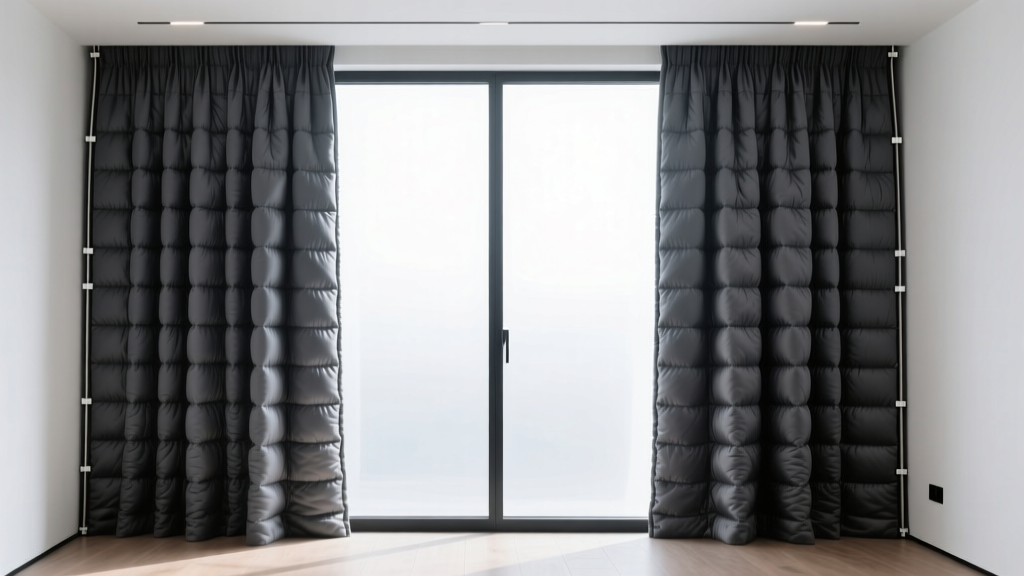
- Magnetic Side Seals: Apply 1/2-inch flexible magnetic tape (such as 3M Magnetic Tape 7924MP) to the vertical side hems of the curtain panels. Apply the corresponding steel tape or magnetic receiver strip directly to the drywall or window casing. When drawn, the curtains will snap to the wall, creating an airtight lateral seal.
- Weighted Bottom Hems: Insert weighted drapery tape (minimum 1 lb per linear yard) into the bottom hem pocket. This ensures the curtain rests heavily against the floor or windowsill, preventing cold air from spilling out at the bottom edge.
- Center Overlap: For double-panel setups, sew overlapping magnetic strips into the center vertical hems so the panels seal tightly to one another when closed.
Acoustic Insulation: STC Ratings and Mass Law
While thermal insulation relies on trapped dead air and radiant barriers, acoustic insulation is governed by the Mass Law—simply put, heavier materials block more sound. Insulated curtain material can improve a window's Sound Transmission Class (STC) rating, but the material choice dictates the acoustic outcome.
Triple-weave polyester (300+ GSM) provides marginal acoustic improvement, typically raising the window assembly's STC by 1 to 2 points, mostly dampening high-frequency noise like wind or light traffic. Conversely, acrylic foam-backed materials act as a decoupled mass-spring-mass system. The dense face fabric combined with the spongy, closed-cell foam backing absorbs mid-to-low frequency sound waves. Testing indicates that heavy foam-backed thermal curtains can improve a window's STC rating by 3 to 5 points, making them the superior choice for urban environments facing street-level noise pollution.
Edge Case: Condensation and Moisture Risks
A critical, often overlooked failure mode of highly sealed insulated curtain material is interstitial condensation. When you seal a heavy thermal curtain tightly against a single-pane or poorly insulated double-pane window in sub-freezing weather, the interior surface of the glass drops significantly in temperature. If the interior relative humidity exceeds 35%, moisture from the room can diffuse through the fabric and freeze on the glass, or pool on the windowsill, leading to mold growth and wood rot.
The Fix: In climate zones with sustained winter temperatures below 20°F (-6°C), do not use vapor-impermeable Mylar or heavy acrylic foam backings on single-pane glass. Instead, use breathable triple-weave polyester and integrate a small, passive desiccant strip on the windowsill behind the curtain. Alternatively, leave a 1-inch intentional gap at the bottom hem to allow minimal air exchange, preventing moisture trapping while retaining 80% of the thermal benefit.
2026 Cost vs. Energy Savings: ROI Breakdown
Calculating the return on investment for insulated curtain material requires factoring in local energy rates and window surface area. Consider a standard 2,400 sq. ft. home in Climate Zone 5 (e.g., Chicago, IL) with 15 standard-sized double-pane windows (15 sq. ft. each, total 225 sq. ft. of glazing).
- Material Cost: 15 pairs of foam-backed curtains ($55/pair) + magnetic sealing kits ($20/window) = $1,125 total investment.
- Energy Savings: Upgrading the effective window R-value from R-3 to R-6 reduces winter conductive and convective heat loss through the glazing by approximately 45%. Based on 2026 natural gas and electricity averages, this yields an estimated annual heating savings of $180 to $240.
- Payback Period: 4.6 to 6.2 years for thermal savings alone. However, when factoring in the extended lifespan of HVAC components, improved acoustic comfort, and UV protection for interior furnishings, the functional payback period compresses to under 3 years.
Insulated curtains are not a replacement for structurally failing windows, but they are the most cost-effective, non-destructive thermal upgrade available for functional glazing. The material you choose must align with your specific climate zone and acoustic requirements.
Maintenance and Longevity Constraints
The longevity of insulated curtain material is directly tied to laundering protocols. The acrylic foam backing on thermal curtains will degrade, peel, or fuse to the dryer drum if exposed to high heat. Always wash foam-backed and triple-weave curtains in cold water (below 85°F) on a delicate cycle, and hang them to dry. Mylar-interlined curtains should never be machine washed; the agitation will fracture the metallic layer, destroying the radiant barrier properties. Dry clean or spot-clean Mylar composites only. With proper maintenance, high-grade insulated drapery will maintain its thermal and acoustic integrity for 7 to 10 years before the face fabric experiences UV degradation.
Written by
Marcus ChenMarcus Chen is a licensed structural engineer (PE) and building materials analyst with over 12 years of experience across residential, commercial, and industrial construction. He holds a Master of Science in Civil Engineering from UC Berkeley and spent six years at Thornton Tomasetti before transitioning to independent consulting and technical writing. Marcus specializes in material selection for seismic-prone regions, concrete reinforcement strategies, and lifecycle cost analysis. His work has been cited by the American Concrete Institute (ACI) and the Structural Engineers Association of California (SEAOC). When he is not on a job site or at his desk, you will find him hiking the Sierra Nevada or restoring a 1920s craftsman bungalow in Oakland, CA.
More from Marcus Chen
View all
Construction Cost
How Much Did the Eiffel Tower Cost to Build?
How much did the Eiffel Tower cost to build in 1889? We adjust for inflation and compare its budget to modern skyscraper construction.
Aug 4, 2026

Fire Resistance
What Is a Fire Resistant Material? Testing & Certification Guide
Discover what is a fire resistant material through ASTM and UL testing. Learn how fire ratings, certifications, and assemblies work in construction.
Aug 4, 2026

Construction Cost
How Much Did the Burj Khalifa Cost to Build?
How much did the Burj Khalifa cost to build? We break down the $1.5B project and extract 5 money-saving strategies for your next build.
Jul 30, 2026