How to Install the Best Building Insulation Material: Foam vs. Wool
Master installation techniques for the best building insulation material. Compare closed-cell spray foam and mineral wool methods for maximum R-value.

The Reality of Material Performance vs. Installation Precision
The debate over the best building insulation material typically narrows down to two high-performance contenders: closed-cell spray polyurethane foam (ccSPF) for maximum thermal resistance and air sealing, and high-density mineral wool for fire resistance, acoustic dampening, and vapor permeability. However, material specifications are meaningless without exact installation precision. A misapplied R-30 mineral wool batt will underperform a perfectly installed R-19 system due to thermal bridging, convective loops, and compression voids. This guide details the exact field techniques, thermal thresholds, and cut tolerances required to extract maximum performance from both materials.
Closed-Cell Spray Foam (ccSPF): Precision Application Techniques
Closed-cell spray foam (typically 2.0 lb/ft³ density) delivers an R-value of 7.0 per inch and acts as a Class II vapor retarder at 1.5 inches thick. Achieving these metrics requires strict adherence to chemical reaction parameters during application.
Substrate Preparation and Thermal Thresholds
The B-side (resin) of ccSPF crystallizes if applied to cold surfaces, leading to severe shrinkage, delamination, and compromised R-values. The substrate temperature—not the ambient air temperature—must be between 60°F and 80°F. Installers must use infrared surface thermometers to verify wood or concrete temperatures immediately before spraying. If the substrate is below 60°F, it must be heated using indirect-fired heaters (direct-fired heaters introduce moisture that ruins the foam's cellular structure).
The 2-Inch Pass Rule and Scorch Prevention
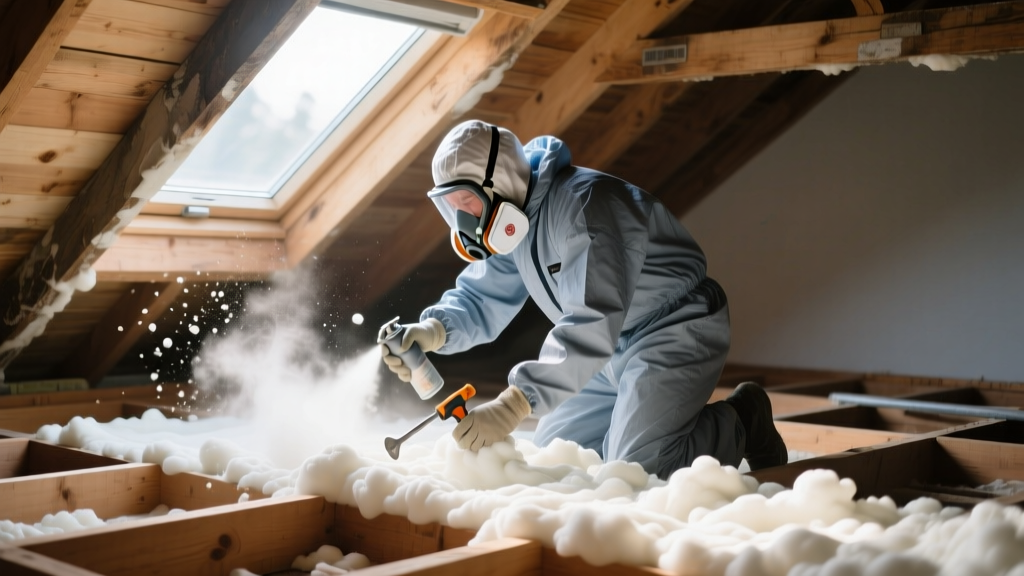
Never apply ccSPF in lifts exceeding 2 inches. The exothermic curing reaction generates internal temperatures up to 300°F. Exceeding the 2-inch limit traps this heat, causing the core of the foam to 'scorch' or char. Scorched foam loses structural rigidity, off-gasses toxic isocyanates, and creates brittle pockets that fail under structural movement. Wait a minimum of 5 to 10 minutes between passes to allow the foam's internal temperature to dissipate.
Per the Spray Polyurethane Foam Alliance (SPFA), installers must wear a supplied-air respirator (SAR) or a Powered Air-Purifying Respirator (PAPR) with an Assigned Protection Factor (APF) of at least 50. Standard N95 masks are entirely ineffective against aerosolized isocyanates during the active spraying and 24-hour off-gassing cure phase.
High-Density Mineral Wool: Friction-Fit Mastery
High-density mineral wool (e.g., Rockwool Comfortbatt yielding R-15 at 3.5 inches for 2x4 framing) is inorganic, non-combustible (meeting ASTM E136), and vapor-open. Its performance relies entirely on eliminating edge gaps through precise friction-fitting.
The 1/2-Inch Overcut Technique
The most common failure in mineral wool installation is cutting batts exactly to the cavity width, which leaves 1/8-inch edge gaps that facilitate convective heat loss. You must cut mineral wool batts exactly 1/2 inch wider and 1/2 inch taller than the stud cavity. Use a specialized insulation knife with a serrated edge and a straight-edge guide. Compress the 1/2-inch excess into the cavity; the material's high density will push outward against the studs, creating a continuous, gap-free thermal barrier.
Managing Obstacles and Vapor Permeability
When encountering plumbing or electrical boxes, do not simply stuff the batt behind the obstacle, which compresses the material and destroys its R-value. Instead, split the batt laterally: tuck the back half behind the pipe and wrap the front half over it. Because mineral wool is vapor-permeable, assemblies in cold climates (IECC Zones 5 and higher) require a Class I or II vapor retarder (such as CertainTeed MemBrain) on the interior warm-in-winter side, as outlined in Rockwool's technical installation guides.
Installation Parameter Matrix: Foam vs. Wool
| Parameter | Closed-Cell Spray Foam (2lb) | High-Density Mineral Wool |
|---|---|---|
| R-Value per Inch | R-7.0 | R-4.2 to R-4.3 |
| Substrate Temp Requirement | 60°F - 80°F (Critical) | Ambient (Keep dry) |
| Max Pass / Cut Tolerance | 2-inch max lift per pass | 1/2-inch overcut for friction fit |
| Vapor Permeability | Vapor semi-impermeable at >1.5" | Vapor open (Requires separate retarder in cold zones) |
| Primary PPE Requirement | APF 50 PAPR or SAR, Tyvek suit | P100 respirator, safety goggles, long sleeves |
Critical Air Sealing Pre-Insulation Protocol
Except for ccSPF, insulation materials do not stop air leakage. Before installing mineral wool or any other fiber-based insulation, you must execute a comprehensive air sealing protocol. The Department of Energy (DOE) emphasizes that air leakage accounts for up to 30% of a building's heating and cooling costs.
- Top and Bottom Plates: Apply a continuous bead of elastomeric sealant or 2-part canned polyurethane foam between the bottom plate and the subfloor, and at the top plate-to-stud joints.
- Electrical and Plumbing Penetrations: Seal all wire and pipe penetrations through framing members. For gaps larger than 1/4 inch, use fire-rated expanding foam rather than caulk.
- Window and Door Bucks: Inject low-expansion closed-cell canned foam between the rough framing and the window/door flanges. High-expansion foam will bow the frames and prevent proper operation.
- Recessed Lighting: Ensure all recessed canisters are IC-AT (Insulation Contact, Air Tight) rated. If they are not, build a drywall dam around the fixture to maintain the air barrier and prevent mineral wool contact with hot housings.
Troubleshooting Common Installation Failures
When insulation underperforms, the root cause is almost always a field installation error. Use this diagnostic framework to identify and correct failures.
Symptom: Frost or Condensation on Interior Drywall in Winter
- Cause: Missing air seal at the top plate or window headers, allowing warm, moisture-laden indoor air to bypass the insulation and hit the cold drywall surface.
- Fix: Remove a 4-inch strip of drywall at the ceiling line. Apply closed-cell spray foam directly to the top plate-to-stud joint to establish a continuous air barrier, then patch the drywall.
Symptom: Spray Foam Pulling Away from Studs (Delamination)
- Cause: The substrate was below 60°F, or the wood surface was covered in sawdust or frost during application, preventing chemical adhesion.
- Fix: Scrape off all delaminated foam using a putty knife. Clean the substrate aggressively with a wire brush. Reapply the foam in 1-inch lifts, ensuring the substrate is heated to at least 65°F prior to spraying.
Symptom: Mineral Wool Batts Sagging in Wall Cavities
- Cause: The friction fit failed due to undersized cuts, or the batts were exposed to high humidity before the drywall was hung, causing slight dimensional relaxation.
- Fix: For walls exceeding 10 feet in height, friction fit alone is insufficient. Install metal insulation hangers or horizontal wire supports every 24 inches vertically to provide mechanical support against gravity.
Written by
Marcus ChenMarcus Chen is a licensed structural engineer (PE) and building materials analyst with over 12 years of experience across residential, commercial, and industrial construction. He holds a Master of Science in Civil Engineering from UC Berkeley and spent six years at Thornton Tomasetti before transitioning to independent consulting and technical writing. Marcus specializes in material selection for seismic-prone regions, concrete reinforcement strategies, and lifecycle cost analysis. His work has been cited by the American Concrete Institute (ACI) and the Structural Engineers Association of California (SEAOC). When he is not on a job site or at his desk, you will find him hiking the Sierra Nevada or restoring a 1920s craftsman bungalow in Oakland, CA.
More from Marcus Chen
View all
Construction Cost
How Much Did the Eiffel Tower Cost to Build?
How much did the Eiffel Tower cost to build in 1889? We adjust for inflation and compare its budget to modern skyscraper construction.
Aug 4, 2026

Fire Resistance
What Is a Fire Resistant Material? Testing & Certification Guide
Discover what is a fire resistant material through ASTM and UL testing. Learn how fire ratings, certifications, and assemblies work in construction.
Aug 4, 2026

Construction Cost
How Much Did the Burj Khalifa Cost to Build?
How much did the Burj Khalifa cost to build? We break down the $1.5B project and extract 5 money-saving strategies for your next build.
Jul 30, 2026