Insulated Garage Doors: Matching R-Values to Climate and Usage
Match insulated garage doors to your climate and usage. Compare polyurethane vs polystyrene cores, R-values, and 2026 costs for optimal thermal fit.
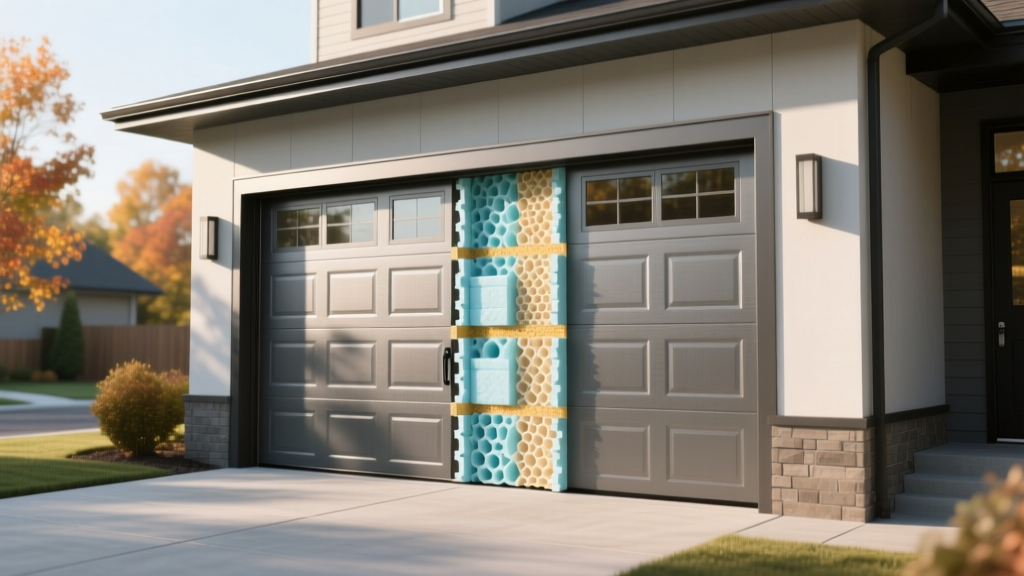
The garage door is frequently the largest unbroken surface on a home's facade, yet it is often treated as a secondary thermal barrier. Selecting the right insulated garage doors requires moving beyond basic marketing claims and applying a rigorous application-fit methodology. A door that performs flawlessly in a mild coastal climate will fail to protect a heated workshop in a freezing continental zone. Proper specification hinges on matching the door's core material, panel R-value, and perimeter sealing system to the specific physical and functional demands of the space.
The R-Value Decision Matrix for Garage Doors
R-value measures thermal resistance, but higher is not universally better if the budget and climate do not justify the premium. The Department of Energy recommends evaluating the garage's relationship to the primary living envelope before selecting an R-value tier.
| R-Value Tier | Core Material | Ideal Application Scenario | Expected Winter Temp Delta |
|---|---|---|---|
| R-6 to R-8 | Single-layer EPS | Detached storage, mild climates (Zone 1-3) | 5°F - 10°F above exterior |
| R-12 to R-14 | Dual-layer EPS / Thin PU | Attached unconditioned garages, mixed climates | 12°F - 18°F above exterior |
| R-16 to R-18 | Thick Polyurethane (PU) | Attached garages with living space above (Zone 4-6) | 20°F - 25°F above exterior |
| R-19+ | High-Density PU + Thermal Breaks | Conditioned workshops, extreme cold (Zone 7-8) | 30°F+ above exterior |
Core Insulation Materials: Polystyrene vs. Polyurethane
The thermal performance of insulated garage doors is dictated by the core chemistry. Manufacturers primarily use two distinct foam families, each with unique structural and thermal properties.
Expanded and Extruded Polystyrene (EPS/XPS)
Polystyrene is applied as rigid, pre-cut boards inserted into the cavities of steel or aluminum door pans. EPS typically yields an R-value of R-3.8 to R-4.4 per inch, while XPS pushes closer to R-5 per inch. Because these are rigid boards, they do not expand to fill the cavity. This leaves micro-gaps along the steel rails and stiles, creating convective loops that degrade the real-world thermal performance below the laboratory-tested center-of-panel R-value. Polystyrene doors are lighter and less expensive, making them the standard for R-8 to R-12 applications.
Injected Polyurethane (PU)
Polyurethane is injected as a liquid that expands and cures in place, bonding directly to the inner and outer steel skins. This yields an R-value of R-6.5 to R-7.2 per inch. According to testing standards monitored by the Door and Access Systems Manufacturers Association (DASMA), the structural bonding of PU increases the door's deflection resistance, allowing it to withstand higher wind loads without bowing. For any application requiring R-16 or higher, injected polyurethane is the mandatory choice.
Scenario Matching: Which Door Fits Your Garage?
Scenario A: The Attached Garage with Living Space Above
The Challenge: Heat rises, and the floor joists separating the garage ceiling from the living space above are highly susceptible to thermal bridging and cold-air infiltration. If the garage drops below 40°F in winter, the floor above will feel drafty and heating costs will spike.
The Specification: Require a minimum R-16 polyurethane door. Crucially, the door panels must feature a thermal break—a non-conductive polyurethane or rubber spacer separating the inner and outer steel skins at the panel edges. Without a thermal break, the steel edges will conduct freezing exterior temperatures directly to the interior garage air, rendering the center-panel R-value moot.
Scenario B: The Detached Conditioned Workshop in Extreme Climates
The Challenge: Maintaining a 65°F working environment when exterior temperatures plunge to 0°F requires minimizing both conductive heat loss and air infiltration.
The Specification: Specify an R-18+ high-density polyurethane door. Pair this with a heavy-duty bottom astragal (seal) and kerf-in perimeter weatherstripping. In high-wind regions, ensure the door is rated for the local wind-load requirements (e.g., 110+ mph), as the PU core will provide the necessary rigidity to prevent the panels from pulling away from the track seals during storms.
Scenario C: The Mild Climate Storage Garage
The Challenge: Protecting stored vehicles, paints, and batteries from freezing or extreme heat degradation without overspending on unnecessary thermal resistance.
The Specification: An R-8 to R-10 dual-layer polystyrene door is the optimal ROI choice. The primary goal here is radiant heat blocking in the summer and basic freeze protection in the winter. Ensure the exterior skin is painted with a high-albedo reflective coating to reject solar heat gain.
Hidden Thermal Weak Points: Weatherstripping and Track Seals
A common mistake in specifying insulated garage doors is fixating on the panel R-value while ignoring the whole-assembly U-factor. The DOE Insulation Materials Guide emphasizes that air leakage can negate up to 40% of an insulation system's effectiveness. To achieve true application-fit, you must specify the sealing hardware:
- Bottom Astragal: Standard vinyl bottom seals harden and crack in sub-freezing temperatures. Specify a dual-durometer EPDM rubber bottom seal with an aluminum retainer. EPDM remains flexible down to -40°F, maintaining a positive seal against uneven concrete driveways.
- Perimeter Kerf-in Seals: Avoid nail-on weatherstripping, which creates gaps at the corners. Specify PVC kerf-in weatherseals with a flexible vinyl bulb. The kerf (slot) is cut directly into the door frame, allowing the seal to compress uniformly when the door closes.
- Inter-panel Seals: Ensure the door features a shiplap or tongue-and-groove joint between panels, backed by a continuous foam compression seal, to prevent wind-driven rain and cold air from penetrating the horizontal hinges.
2026 Cost Breakdown and ROI for Insulated Upgrades
Pricing for insulated garage doors has stabilized following the supply chain fluctuations of the early 2020s. Below is the current market pricing for a standard 16x7 foot sectional door, including professional installation and standard track hardware.
| Door Specification | Material Cost (16x7) | Installed Cost (2026) | Estimated Payback Period |
|---|---|---|---|
| R-8 Polystyrene (Non-insulated frame) | $650 - $850 | $1,100 - $1,400 | N/A (Comfort upgrade) |
| R-12 Polystyrene (Thermal break frame) | $900 - $1,200 | $1,500 - $1,900 | 7 - 10 Years |
| R-16 Polyurethane (Full thermal break) | $1,300 - $1,700 | $2,100 - $2,700 | 4 - 6 Years |
| R-18+ Polyurethane (High-wind rated) | $1,800 - $2,400 | $2,800 - $3,600 | 3 - 5 Years |
Expert Troubleshooting: Condensation on the Inner Pan
If you observe water droplets forming on the interior steel skin of your insulated garage door during winter, the door lacks a proper thermal break at the panel edges, or the interior humidity is uncontrolled. The steel skin is dropping below the dew point. To fix this in an existing door, apply a continuous bead of closed-cell spray foam along the interior perimeter rails where the steel folds, or install a smart exhaust fan to vent combustion moisture and wet vehicle runoff to the exterior.
Matching insulated garage doors to your specific application requires a holistic view of the building envelope. By aligning the core chemistry, R-value tier, and perimeter sealing hardware with your exact climate zone and usage scenario, you transform the garage from a thermal liability into a highly efficient, comfortable buffer space.