High Temperature Insulating Materials: An Energy Efficiency Guide
Discover how to select high temperature insulating materials for industrial systems. Compare ceramic fiber, calcium silicate, and microporous boards.

Industrial and commercial facilities operating boilers, kilns, and high-pressure steam lines lose millions of BTUs annually through poorly specified thermal barriers. When process temperatures exceed 1,000°F (538°C), standard fiberglass and foam plastics fail catastrophically, melting or off-gassing toxic compounds. Selecting the correct high temperature insulating materials is not just about fire safety; it is a critical energy efficiency lever that directly impacts operational expenditure (OPEX) and system longevity.
Defining the High-Temperature Spectrum
In industrial insulation engineering, "high temperature" strictly refers to continuous operating environments between 1,000°F and 2,300°F (538°C to 1,260°C). Materials in this category must maintain structural integrity, resist thermal shock, and exhibit minimal linear shrinkage under sustained heat load. The selection process requires balancing thermal conductivity (k-value), mechanical strength, moisture resistance, and installed cost per square foot.
Comparative Matrix of High Temperature Insulating Materials
The following matrix compares the four primary material families used in high-heat applications. Pricing reflects 2026 market averages for 2-inch thick industrial-grade products, excluding labor and jacketing.
| Material Type | Max Temp Limit (°F) | k-value @ 400°F (BTU·in/hr·ft²·°F) | Approx. Cost (per sq ft, 2" thick) | Primary Use Case |
|---|---|---|---|---|
| Ceramic Fiber Blanket | 2,300 | 0.65 | $4.50 - $6.00 | Kilns, irregular surfaces, expansion joints |
| Calcium Silicate | 1,200 | 0.41 | $8.00 - $11.00 | Steam piping, high-traffic areas, structural support |
| Microporous Boards | 2,000 | 0.14 | $25.00 - $35.00 | Space-constrained aerospace, tight-clearance valves |
| High-Temp Mineral Wool | 1,200 | 0.50 | $3.00 - $4.50 | Exhaust ducts, commercial HVAC, outer layer backup |
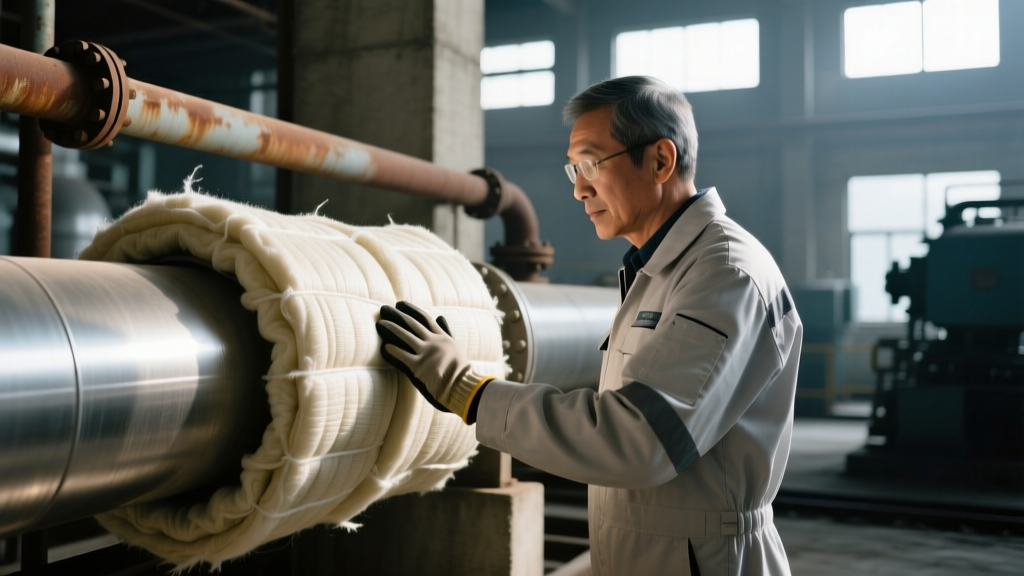
Engineering Deep Dive: Top High Temperature Insulating Materials
Ceramic Fiber Blankets (Alumina-Silica)
Ceramic fiber blankets, such as Unifrax Cerablanket or Morgan Thermal Ceramics Superwool, are the standard for extreme heat. They are manufactured by spinning or blowing molten alumina-silica into interlocking fibers. For continuous operation at 2,000°F, you must specify a "High-Purity" or Zirconia-enhanced grade. Standard grades will experience linear shrinkage exceeding 2% at these temperatures, leading to joint separation and massive heat leaks. When installing blankets in furnaces, use Alloy 310 or Inconel anchors; standard 304 stainless steel anchors will yield and fail under cyclic thermal expansion.
Calcium Silicate Pipe Insulation (ASTM C533 / C547)
Calcium silicate, like Johns Manville Thermo-1200, is a rigid, pre-formed pipe and block insulation. Its primary advantage is high compressive strength (often exceeding 100 psi), allowing it to support the weight of personnel and metal jacketing without crushing. However, it is inherently hydrophilic. If the outer aluminum jacket is breached, calcium silicate will absorb water like a sponge, leading to severe Corrosion Under Insulation (CUI). Always specify hydrophobic-treated grades or ensure flawless jacketing with weatherproof sealants at all longitudinal seams.
Microporous Silica Boards
Microporous insulation (e.g., Min-K) utilizes pyrogenic silica mixed with infrared opacifiers and reinforcing fibers. The pore structure is smaller than the mean free path of air molecules, effectively eliminating convective heat transfer. With a k-value of 0.14 at 400°F, it provides up to four times the thermal resistance of calcium silicate at the same thickness. It is highly brittle and must be handled carefully, but it is the only viable high temperature insulating material for tight-clearance applications where adding 3 inches of standard insulation is physically impossible.
Most high-temperature blankets and rigid boards use organic acrylic or latex binders to maintain shape during shipping and installation. When these materials are first fired above 400°F, the binders combust, releasing volatile organic compounds (VOCs), smoke, and odors. Always specify "binder-free" or "pre-fired" high temperature insulating materials for indoor applications, cleanrooms, or environments with sensitive air quality sensors.
Quantifying Energy Loss and ROI
To justify the capital expenditure of premium high temperature insulating materials, facility managers must calculate the exact heat loss differential. Consider a 10-inch nominal steel steam pipe operating at 800°F in a 70°F ambient indoor environment.
- Uninsulated Heat Loss: ~4,500 BTU/hr per linear foot.
- Insulated (3" Calcium Silicate + Al Jacket): ~120 BTU/hr per linear foot.
- Energy Saved: 4,380 BTU/hr per linear foot.
Assuming a natural gas cost of $8.50 per MMBtu and 8,000 operating hours per year, the energy savings equate to roughly $297 per linear foot, per year. With a fully installed cost of $45 per linear foot for 3-inch calcium silicate with aluminum jacketing, the simple payback period is under two months. According to the U.S. Department of Energy's Advanced Manufacturing Office, uninsulated or under-insulated steam distribution systems routinely account for up to 10% of total boiler fuel consumption, making this one of the highest-ROI upgrades in industrial energy efficiency.
Mitigating Corrosion Under Insulation (CUI) in Cyclic Systems
High temperature insulating materials often operate in cyclic environments—shutting down on weekends or during maintenance. When the system cools, moisture condenses on the pipe surface. If the insulation holds this moisture against the steel, CUI initiates rapidly, particularly in carbon steel operating between 150°F and 350°F during cool-down phases.
The Dual-Layer Solution: For critical cyclic piping, engineers are increasingly specifying a dual-layer system. The inner layer (1 to 1.5 inches) consists of closed-cell cellular glass (e.g., FOAMGLAS), which is 100% impermeable to moisture and operates safely up to 900°F. The outer layer consists of high-temp mineral wool or calcium silicate to handle the remaining thermal gradient and provide structural bulk. This prevents moisture migration to the pipe wall while maintaining overall thermal efficiency. The National Insulation Association (NIA) strongly advocates for rigorous material selection and jacketing protocols to mitigate CUI in mid- and high-temperature applications.
Installation Tolerances and Expansion Joints
Even the most expensive high temperature insulating materials will fail if installed without accounting for thermal expansion. A 100-foot run of carbon steel pipe heated from 70°F to 800°F will expand by approximately 6 inches. If rigid calcium silicate is installed tightly end-to-end without expansion joints, the insulation will buckle, crush, and crack.
- Install rigid insulation with 1/4-inch to 1/2-inch gaps at longitudinal and circumferential joints.
- Place dedicated expansion joints (filled with compressible ceramic fiber rope) every 15 to 20 feet along straight horizontal runs.
- Ensure metal jacketing bands are spaced no more than 18 inches apart to prevent wind-induced vibration from degrading the underlying brittle insulation.
By matching the specific thermal, mechanical, and environmental demands of your system to the correct high temperature insulating materials, you eliminate hidden energy waste, prevent catastrophic pipe degradation, and ensure long-term operational stability.
Written by
Elena RodriguezElena Rodriguez is a civil engineer and technical writer specializing in concrete technology, masonry systems, and ASTM/ACI compliance. She earned her B.S. in Civil Engineering from Texas A&M University and spent a decade at a materials testing laboratory, performing over 2,000 concrete compressive strength tests and masonry prism evaluations. Elena is an ACI-certified Field Testing Technician (Grade I) and a member of ASTM Committee C12 on Natural Building Stone. She currently consults on forensic engineering cases involving concrete failures and moisture intrusion. Based in San Antonio, TX, Elena is a proud member of the Society of Women Engineers (SWE) and coaches her daughter's FIRST Robotics team.
More from Elena Rodriguez
View all
Walls & Panels
Cost Analysis: Light Gauge Steel Framing Advantages and Disadvantages
Evaluate light gauge steel framing advantages and disadvantages through a strict cost analysis lens, comparing material, labor, and lifecycle expenses.
Aug 4, 2026

Walls & Panels
Gypsum Board Types: Exact Specifications, Thickness & Dimensions
Compare standard, Type X, and moisture-resistant gypsum board types. Get exact specifications, thicknesses, dimensions, and ASTM standards for your project.
Aug 4, 2026

Fire Resistance
Best Fire-Resistant Outdoor Decking Materials: 2026 Buyer Guide
Discover the best fire-resistant outdoor decking materials for 2026. Compare Class A PVC, aluminum, and hardwood options for WUI compliance and safety.
Aug 4, 2026