Choosing the Best Insulation Material for Walls: A Deep Comparison
Compare the best insulation material for walls in 2026. Deep dive into R-values, installed costs, moisture dynamics, and failure modes.

The Physics of Wall Assemblies: Beyond Basic R-Value
Selecting the right insulation material for walls requires moving past the simplistic metric of R-value. While thermal resistance is critical, modern building science dictates that a wall assembly must simultaneously manage heat flow, air leakage, and moisture diffusion. According to the Department of Energy, air leakage can account for 25% to 40% of a building's heat loss, rendering a high-R-value cavity useless if the insulation is air-permeable and lacks a dedicated air barrier.
When evaluating cavity and continuous insulation options, contractors and architects must weigh the material's vapor permeance, its ability to act as an air barrier, and its performance under extreme temperature differentials. The following breakdown analyzes the four dominant wall insulation materials based on 2026 material science, installed economics, and real-world failure modes.
Quick Decision Matrix: Which Material Fits Your Assembly?
- Maximum Air Sealing & High R-Value per Inch: Closed-Cell Spray Foam (ccSPF)
- Fire Resistance, Soundproofing & Vapor-Open Design: Mineral Wool Batts
- Strict Budget Constraints & Standard Code Compliance: High-Density Fiberglass + Smart Membrane
- Exterior Continuous Insulation (ci) to Break Thermal Bridges: Polyisocyanurate (Polyiso) or EPS
Material Breakdown: Performance, Cost, and Edge Cases
1. Closed-Cell Spray Foam (ccSPF): The Air Barrier Champion
Closed-cell spray polyurethane foam (typically 2.0 lb/ft³ density) provides an R-value of R-6.5 to R-7.0 per inch. Its primary advantage is its dual function: at 1.5 inches thick, it qualifies as a Class II vapor retarder, and at full cavity depth, it creates a monolithic, code-compliant air barrier.
Modern formulations have shifted away from high-GWP (Global Warming Potential) HFC blowing agents to next-generation HFOs (Hydrofluoroolefins), such as Demilec's Heatlok XT or Icynene's ProSeal Eco, which boast a GWP of less than 2.
- 2026 Installed Cost: $2.40 to $3.50 per board foot.
- Best Application: Complex framing, cathedral ceilings, and high-performance envelopes where interior space is at a premium.
- Edge Case: ccSPF is rigid. In areas with significant foundation settling or timber frame shrinkage, the foam can delaminate from the studs if not properly primed or if applied to dusty substrates.
2. Mineral Wool (Stone Wool): The Fire & Sound Specialist
Mineral wool, such as Rockwool Comfortbatt or Thermafiber, offers an R-value of R-4.22 per inch. While its thermal resistance is slightly lower than fiberglass, its physical properties solve major assembly challenges. It is hydrophobic (repels liquid water) while remaining highly vapor-permeable, allowing walls to dry to the exterior or interior.
Furthermore, mineral wool is non-combustible (passing ASTM E136) and provides superior acoustic dampening (STC ratings 5-10 points higher than equivalent fiberglass).
- 2026 Installed Cost: $1.30 to $1.80 per square foot.
- Best Application: Exterior walls in fire-prone zones, party walls requiring sound attenuation, and assemblies utilizing exterior vapor-permeable weather barriers.
- Edge Case: Mineral wool is dense and difficult to cut. Installers must use specialized serrated knives; compressing the batt to force it into a cavity destroys its R-value by reducing the trapped air pockets.
3. High-Density Fiberglass: The Budget Baseline
High-density fiberglass batts (e.g., Owens Corning EcoTouch R-15 for 2x4 walls or R-21 for 2x6 walls) remain the most common insulation material for walls due to cost. They offer R-4.28 per inch. However, fiberglass is entirely air-permeable. The North American Insulation Manufacturers Association explicitly states that fiberglass must be installed in a cavity that is fully sealed on all six sides to achieve its rated performance.
- 2026 Installed Cost: $0.85 to $1.20 per square foot.
- Best Application: Standard production housing, budget-conscious retrofits, and walls utilizing an exterior continuous air barrier (like ZIP sheathing).
- Edge Case: Electrical boxes and plumbing penetrations destroy the air seal in fiberglass cavities. Without meticulous detailing or an interior smart membrane (like Intello Plus), convective looping will severely degrade the wall's effective R-value.
4. Rigid Polyisocyanurate (Polyiso): The Continuous Insulation Solution
Polyiso boards offer an impressive R-6.0 to R-6.5 per inch at 75°F. They are primarily used as exterior continuous insulation (ci) to cover wooden studs, thereby eliminating thermal bridging—a phenomenon where heat bypasses cavity insulation through the more conductive wood framing.
- 2026 Installed Cost: $1.10 to $1.60 per square foot (material only).
- Best Application: Exterior sheathing applications in Climate Zones 4 and higher to meet IECC continuous insulation mandates.
- Edge Case: Polyiso suffers from "thermal drift." As temperatures drop below 40°F, the blowing gases inside the foam cells condense, and the R-value can drop to R-5.2 per inch. In extreme cold climates (Zones 7+), EPS or XPS is often preferred for exterior applications.
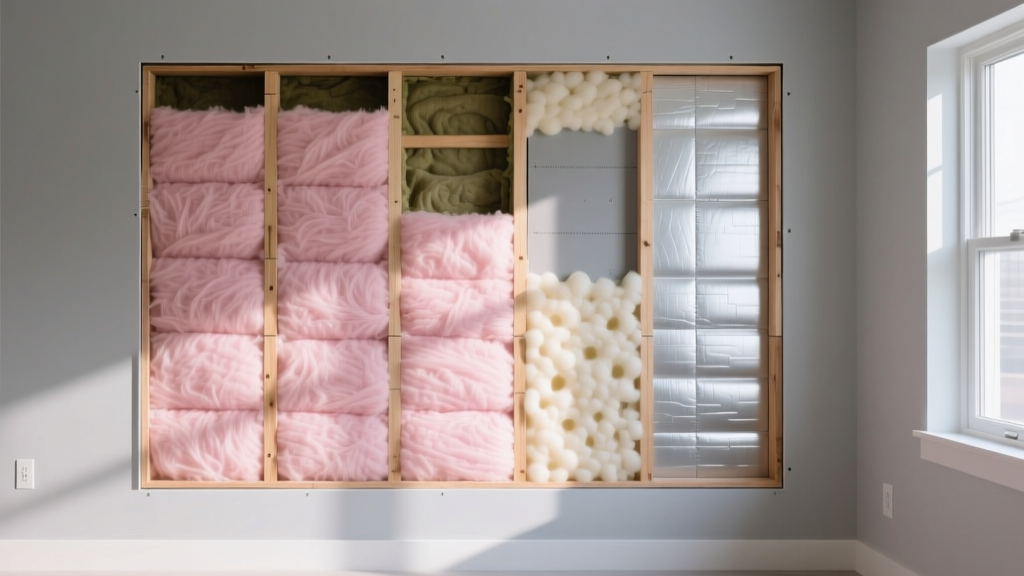
Comprehensive Comparison Matrix
| Material | Nominal R-Value / Inch | 2026 Installed Cost (per sq ft) | Vapor Permeance | Air Barrier Capable? | Primary Weakness |
|---|---|---|---|---|---|
| Closed-Cell Spray Foam | R-6.5 - R-7.0 | $2.40 - $3.50 | Class II Retarder (at 1.5") | Yes (Monolithic) | High cost; requires certified installer |
| Mineral Wool Batts | R-4.22 | $1.30 - $1.80 | High (Vapor Open) | No | Difficult to cut; heavy |
| High-Density Fiberglass | R-4.28 | $0.85 - $1.20 | High (Vapor Open) | No | Useless without perfect air sealing |
| Polyiso Rigid Board | R-6.0 - R-6.5 | $1.10 - $1.60 (Material) | Class II/III (Foil faced) | Yes (Taped seams) | Thermal drift in freezing temps |
Real-World Failure Modes and How to Avoid Them
Theoretical R-values rarely match field performance. Understanding how these materials fail in the real world is critical for long-term building durability.
- The Convective Loop (Fiberglass & Mineral Wool): If warm interior air enters a wall cavity, it rises, transfers heat to the cold exterior sheathing, cools, and sinks, creating a continuous loop. This convective action can reduce the effective R-value of a fiberglass wall by up to 50%. Fix: Use an interior air-tight drywall approach (ADA) or a variable-permeance membrane to stop air ingress.
- Polyiso Condensation Risk: Because foil-faced polyiso is a vapor retarder, placing it on the exterior of a wall in a hot, humid climate (like Florida) can cause exterior moisture to condense on the back of the foam when interior air conditioning cools the sheathing. Fix: Use unfaced, vapor-permeable polyiso or mineral wool boards for exterior continuous insulation in cooling-dominated climates.
- Spray Foam Shrinkage: If ccSPF is applied to cold wood (below 60°F) or in high humidity without adjusting the spray rig's temperature and pressure settings, the foam can shrink away from the studs over time, breaking the air seal. Fix: Ensure the substrate is at least 65°F and clean prior to application.
Code Compliance and Climate Zone Mapping
The International Energy Conservation Code (IECC) and local adoptions increasingly mandate continuous insulation (ci) to combat thermal bridging. As detailed by the Building Science Corporation, a standard 2x6 wood-framed wall only has a whole-wall R-value of about R-14 to R-15, despite the cavity insulation being rated at R-21, because the wood studs act as thermal bridges.
Expert Insight: In Climate Zones 5 and above, relying solely on cavity insulation is a structural liability. You must pair your interior cavity material (like mineral wool or fiberglass) with a minimum of R-5 to R-10 exterior rigid insulation to keep the sheathing above the dew point, preventing interstitial condensation and wood rot.
Final Verdict: Matching Material to Your Wall Assembly
There is no single "best" insulation material for walls; there is only the right material for a specific hygrothermal assembly. If you are building a high-performance, net-zero-ready home where wall thickness is constrained, closed-cell spray foam provides the highest R-value and air sealing in one step. If you are designing a vapor-open, durable wall in a mixed climate that prioritizes fire safety and acoustics, mineral wool is unmatched. For production builders operating on tight margins, high-density fiberglass remains viable, but only if paired with a rigorous, tested exterior or interior air-barrier system. Finally, regardless of your cavity choice, integrating rigid exterior insulation is no longer optional in northern climates—it is a mandatory defense against thermal bridging and condensation.
Written by
James ThorntonJames Thornton is a construction industry veteran with 25 years of hands-on experience in wood framing, lumber grading, and residential building codes. He started as a framing carpenter in rural Oregon, earned his ICC Residential Building Inspector certification, and eventually became a senior plan reviewer for the City of Portland Bureau of Development Services. James holds a B.S. in Wood Science & Technology from Oregon State University and is a certified lumber grader through the West Coast Lumber Inspection Bureau (WCLIB). He has inspected over 3,000 residential construction sites and authored the city's internal guide on advanced framing techniques (2x6 at 24" O.C.). James lives in Bend, OR, where he builds custom timber-frame cabins and competes in lumberjack sports.
More from James Thornton
View all
Insulation
Best Home Insulation Materials: Complete 2026 Guide
Compare top home insulation materials for 2026. Find R-values, installed costs per square foot, and best uses for fiberglass, spray foam, and mineral wool.
Aug 4, 2026

Sustainable Building
Certify Your Green Building Material for LEED and WELL
Step-by-step guide to certifying a green building material for LEED v5 and WELL v2. Master EPDs, HPDs, and VOC limits for 2026 project specifications.
Aug 4, 2026

Stone & Masonry
Veneer Stacked Stone Panels: Interior Design & Style Showcase
Discover how veneer stacked stone panels transform interiors. Explore modern design profiles, material pairings, and technical installation specs.
Aug 4, 2026