Reflective Insulation Material Cost & ROI Guide 2026
Analyze 2026 reflective insulation material costs, ROI by climate zone, and installation economics to determine if radiant barriers fit your project.

The True Economics of Reflective Insulation Material
When evaluating thermal control strategies for residential and commercial buildings, reflective insulation material occupies a highly specific, often misunderstood niche. Unlike mass insulation (fiberglass, mineral wool, or spray foam) which resists conductive heat flow, reflective systems utilize low-emissivity aluminum surfaces to block radiant heat transfer. In 2026, with cooling loads increasing in southern climate zones and energy prices remaining volatile, the economic case for radiant barriers and reflective bubble wraps hinges entirely on correct application, climate zone alignment, and strict adherence to installation physics.
This cost analysis strips away marketing hyperbole to examine the real-world pricing, hidden installation expenses, and measurable ROI of integrating reflective insulation material into your building envelope.
The Federal Trade Commission and the Department of Energy explicitly warn against inflated R-value claims on reflective insulation packaging. Pure aluminum foil has an intrinsic conductive R-value of roughly R-1.0 to R-2.1. Claims of 'R-21' or 'R-30' rely on theoretical, perfectly sealed, 3/4-inch dead air spaces on both sides of the material. If the material is compressed, laid flat against drywall, or installed without an adjacent air gap, its R-value collapses to near zero. You are paying for emissivity (radiant blocking), not conductive resistance.
2026 Cost Breakdown: Material, Labor, and Hidden Expenses
The cost of reflective insulation material varies significantly based on the core substrate (single bubble, double bubble, or woven fabric) and the thickness of the aluminum laminates. Below is the current market pricing for mid-to-high-tier products like Reflectix, rFOIL, and Fi Foil.
| Product Type | Material Cost (per sq. ft.) | Labor Cost (per sq. ft.) | Total Installed Cost | Best Application |
|---|---|---|---|---|
| Single Bubble (e.g., Reflectix BP24050) | $0.45 - $0.60 | $1.00 - $1.50 | $1.45 - $2.10 | Pole barns, crawl spaces, duct wrap |
| Double Bubble (e.g., rFOIL Ultra-NT) | $0.65 - $0.85 | $1.25 - $1.75 | $1.90 - $2.60 | Attic rafters, metal building walls |
| Woven/Wrapped (e.g., Fi Foil Shield) | $0.90 - $1.30 | $1.50 - $2.50 | $2.40 - $3.80 | Masonry walls, cathedral ceilings |
Hidden Installation Costs: Tape and Fasteners
Contractors frequently underbid reflective insulation projects by ignoring seam sealing. To maintain a continuous radiant and vapor barrier, all seams must be sealed with specialized aluminum foil tape. Standard duct tape will degrade and peel within 18 months due to thermal expansion and UV exposure.
- HVAC Foil Tape (e.g., Nashua 322 or 3M 3340): $14 to $22 per 50-yard roll. A typical 1,500 sq. ft. attic requires 3 to 4 rolls, adding $50 to $90 to the material budget.
- Insulation Staples: 5/16-inch or 3/8-inch galvanized staples are required to prevent rust stains on the foil. Budget an extra $15 per 5,000 staples.
- Furring Strips (1x2 or 1x3): If an air gap does not naturally exist, you must install wood furring strips to create the mandatory 3/4-inch dead air space. This adds $0.35 to $0.50 per linear foot in lumber costs and significantly increases labor time.
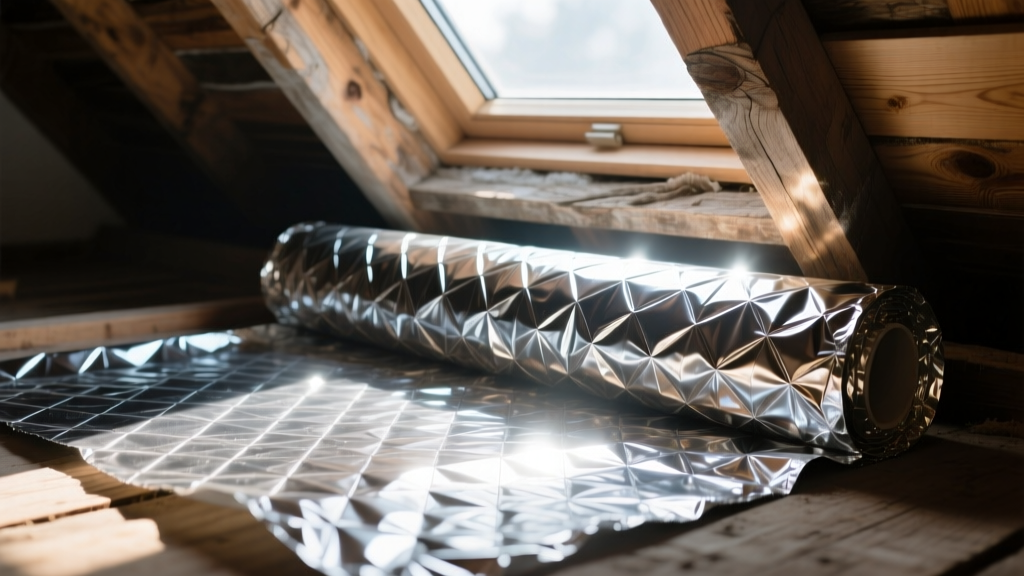
Climate Zone ROI: Where Reflective Insulation Material Actually Pays Off
The ROI of reflective insulation material is strictly dictated by the physics of radiant heat transfer. Radiant barriers are most effective when there is a high temperature differential and a direct line of sight to a radiant heat source (like the sun beating down on a roof deck). According to research from the Florida Solar Energy Center, the economic viability shifts dramatically across US climate zones.
High ROI: Zones 1, 2, and 3
Regions: Florida, Texas, Southern California, Gulf Coast.
Performance: Reduces attic heat gain by up to 40%, lowering peak cooling loads by 5% to 10%.
Payback Period: 3 to 5 years. Highly recommended as a supplement to R-38 blown-in cellulose or fiberglass.
Low/Negative ROI: Zones 5, 6, 7, and 8
Regions: Midwest, Northeast, Pacific Northwest, Mountain West.
Performance: Negligible impact on winter heating bills. Winter heat loss is primarily conductive and convective, not radiant.
Payback Period: 15+ years or never. Capital is better spent on air sealing and increasing mass insulation R-values.
Real-World Failure Modes That Destroy Your Investment
The US Department of Energy notes that improper installation can render reflective insulation material entirely useless. Before signing a contract or purchasing pallets for a DIY build, understand these three catastrophic failure modes:
- Dust Accumulation on the Reflective Surface: Pure aluminum foil has an emissivity of 0.05 (meaning it reflects 95% of radiant heat). However, if installed horizontally with the foil facing up in a dusty attic, dust accumulation will increase the emissivity to 0.30 or higher within two years. This cuts the radiant blocking performance by over 70%. Solution: Always install reflective insulation vertically on rafters or wall studs, or ensure the reflective surface faces downward where dust cannot settle.
- Compression and Missing Air Gaps: If a double-bubble reflective roll is sandwiched tightly between a roof deck and drywall with no air space, the conductive heat bypasses the reflective surface entirely. The material acts as a thin thermal bridge. Solution: Verify a minimum 3/4-inch dead air space adjacent to at least one reflective face.
- Vapor Trapping in Cold Climates: Aluminum foil is a Class I vapor retarder (perm rating near 0.0). If installed on the cold side of the wall assembly in a heating-dominated climate, it will trap interior moisture inside the wall cavity, leading to severe mold and structural rot. Solution: Consult a building scientist or use perforated reflective materials that allow moisture vapor transmission.
Reflective Insulation vs. Traditional Mass Insulation: A Cost-Performance Matrix
To contextualize the value of reflective insulation material, it must be compared against standard mass insulation options for a standard 2,000 sq. ft. attic floor application in a hot climate (Zone 2).
| Insulation Type | Total Installed Cost (2,000 sq ft) | Primary Heat Transfer Blocked | True R-Value | Air Sealing Capability |
|---|---|---|---|---|
| Blown-in Cellulose (R-38) | $2,800 - $3,600 | Conductive & Convective | R-38 | Moderate |
| Closed-Cell Spray Foam (R-35) | $6,500 - $9,000 | Conductive, Convective, Radiant | R-35 (approx 6 inches) | Excellent |
| Reflective Radiant Barrier (Foil) | $1,400 - $2,200 | Radiant Only | R-1 to R-2 (intrinsic) | None (unless taped) |
The Synthesis: Reflective insulation material should almost never be used as a standalone replacement for mass insulation in residential framing. The highest performing, most cost-effective assembly in hot climates combines R-30 to R-38 mass insulation on the attic floor (to stop conductive heat) with a reflective radiant barrier stapled to the underside of the roof rafters (to stop radiant heat before it enters the attic space). The Reflective Insulation Manufacturers Association provides extensive technical bulletins confirming that hybrid systems yield the highest energy savings.
Final Purchasing Framework and Verdict
If your project is located in Climate Zones 1 through 3, and you are dealing with a metal building, a pole barn, or an unconditioned attic with exposed rafters, reflective insulation material offers an exceptional, low-cost defense against solar heat gain. Budget between $1.90 and $2.60 per square foot for a professionally installed double-bubble system, and ensure your contractor guarantees a 3/4-inch air gap and uses UV-stable HVAC foil tape on all seams.
Conversely, if you are retrofitting a home in the Midwest or Northeast, or if the installation site is prone to heavy dust accumulation where the foil must face upward, abandon reflective systems entirely. Reallocate your budget toward dense-pack cellulose or spray foam to address the conductive and convective heat loss that actually drives your energy bills in those environments.
Written by
James ThorntonJames Thornton is a construction industry veteran with 25 years of hands-on experience in wood framing, lumber grading, and residential building codes. He started as a framing carpenter in rural Oregon, earned his ICC Residential Building Inspector certification, and eventually became a senior plan reviewer for the City of Portland Bureau of Development Services. James holds a B.S. in Wood Science & Technology from Oregon State University and is a certified lumber grader through the West Coast Lumber Inspection Bureau (WCLIB). He has inspected over 3,000 residential construction sites and authored the city's internal guide on advanced framing techniques (2x6 at 24" O.C.). James lives in Bend, OR, where he builds custom timber-frame cabins and competes in lumberjack sports.
More from James Thornton
View all
Insulation
Best Home Insulation Materials: Complete 2026 Guide
Compare top home insulation materials for 2026. Find R-values, installed costs per square foot, and best uses for fiberglass, spray foam, and mineral wool.
Aug 4, 2026

Sustainable Building
Certify Your Green Building Material for LEED and WELL
Step-by-step guide to certifying a green building material for LEED v5 and WELL v2. Master EPDs, HPDs, and VOC limits for 2026 project specifications.
Aug 4, 2026

Stone & Masonry
Veneer Stacked Stone Panels: Interior Design & Style Showcase
Discover how veneer stacked stone panels transform interiors. Explore modern design profiles, material pairings, and technical installation specs.
Aug 4, 2026