How to Shop an Insulation Materials Store for Peak R-Value
Learn how to navigate an insulation materials store for peak R-value. Compare fiberglass, mineral wool, and rigid foam performance for your 2026 build.
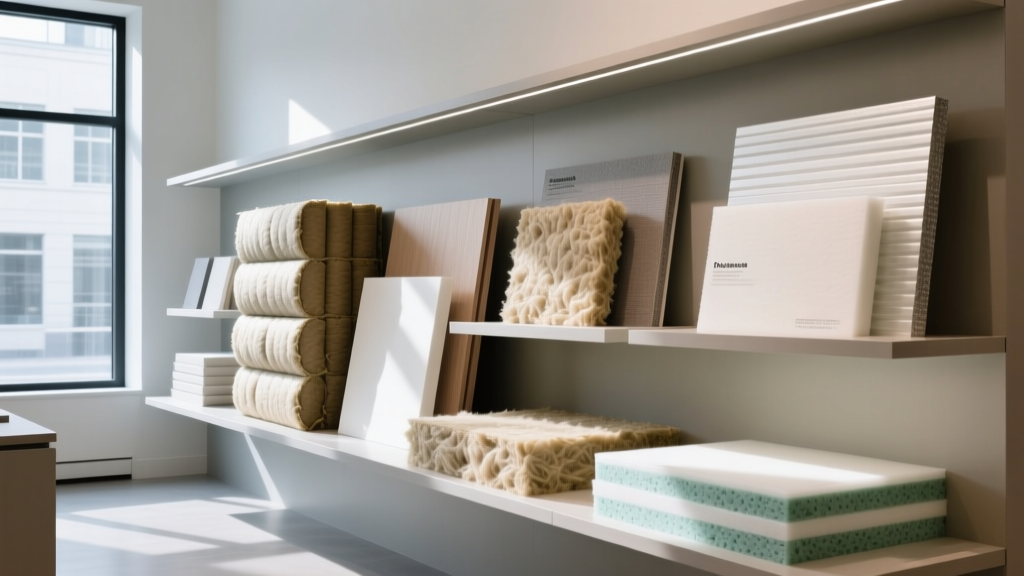
The R-Value Reality Check: Commodity vs. Performance Inventory
Walking into a dedicated insulation materials store requires a different strategy than browsing the aisles of a big-box home improvement center. While general retailers primarily stock commodity-grade R-13 and R-19 fiberglass batts designed for basic code compliance, a specialized insulation materials store carries the high-density, continuous, and acoustic-grade products required to meet the stringent 2024/2025 IECC energy codes now widely enforced in 2026. Understanding how to evaluate the true thermal performance of these products—beyond the bold R-value printed on the packaging—is the difference between a building that merely passes inspection and one that achieves peak energy efficiency.
Decoding In-Store R-Value Labels and Performance Claims
The R-value printed on a product label is measured under ideal, laboratory-controlled conditions. In the field, installation variables and environmental factors can severely degrade thermal resistance. When consulting with specialists at an insulation materials store, you must account for three primary performance penalties.
1. The Fiberglass Compression Penalty
Standard R-19 fiberglass batts are manufactured to a thickness of 6.25 inches, designed for 2x6 wall cavities. A common and disastrous field mistake is purchasing R-19 batts and forcing them into a 2x4 wall cavity (3.5 inches deep) under the assumption that 'more R-value is always better.' According to data from the North American Insulation Manufacturers Association (NAIMA), compressing a 6.25-inch R-19 batt into a 3.5-inch cavity reduces its effective R-value to approximately R-13 or R-14, while simultaneously increasing the material cost by 25%.
The Store Solution: Ask for High-Density (HD) R-15 batts. These are specifically engineered to be 3.5 inches thick but pack more glass fibers per cubic inch, delivering a true R-15 in a standard 2x4 cavity without compression.
2. Thermal Drift in Polyisocyanurate (Polyiso)
Polyiso rigid foam boards are widely available at insulation materials stores and often boast the highest center-of-cavity R-value per inch (typically R-6.0 to R-6.5). However, polyiso suffers from 'thermal drift' in cold climates. The blowing agents trapped in the foam cells condense at low temperatures. When exterior temperatures drop below 40°F (4°C), the effective R-value of polyiso can decrease by 15% to 20%.
3. Thermal Bridging and the Need for Continuous Insulation (ci)
Cavity insulation alone is no longer sufficient for high-performance envelopes. Wood framing accounts for roughly 20% to 25% of a wall's surface area, and wood has an R-value of only about R-1.25 per inch. The U.S. Department of Energy emphasizes that without continuous insulation (ci) over the sheathing, thermal bridging through the studs can reduce the overall wall assembly R-value by up to 30%. A proper insulation materials store will stock rigid foam ci panels in varying thicknesses (0.5-inch to 2-inch) specifically to break these thermal bridges.
2026 Product Spotlight: High-Performance Store Inventory
When planning your material takeoff, use this comparison matrix to evaluate the premium products available at specialized distributors. Pricing reflects early 2026 national averages for commercial-volume purchases.
| Product / Material Type | R-Value per Inch | Vapor Permeability | Best Application | Est. Cost (per sq ft) |
|---|---|---|---|---|
| High-Density Fiberglass (e.g., Owens Corning EcoTouch R-15 HD) | R-4.3 | High (Vapor Open) | Interior 2x4 cavity; requires separate air/vapor barrier | $1.15 |
| Mineral Wool Batts (e.g., Rockwool Comfortbatt) | R-4.3 | High (Vapor Open) | Fire-rated assemblies, exterior walls, acoustic partitions | $1.65 |
| Polyiso Rigid Foam (e.g., Johns Manville CI Max) | R-6.0 - R-6.5 | Low (Class II Retarder) | Exterior continuous insulation (ci) in warm/mixed climates | $1.85 |
| Graphite-Infused EPS (e.g., BASF Neopor) | R-4.7 - R-5.0 | Moderate (Vapor Semi-Open) | Exterior ci in cold climates, ICF forms, below-grade | $1.30 |

The Climate Zone Decision Matrix
To maximize your budget and performance, use this framework when discussing your project with store representatives. Your purchasing list should be dictated by your specific IECC Climate Zone.
- Zones 1-3 (Hot/Humid & Hot/Dry): Prioritize interior cavity insulation (R-13 to R-15) and exterior polyiso ci. Store Request: Ask for unfaced batts to allow the wall to dry to the interior, paired with a polyiso board that features a low-perm foil facer to act as an exterior vapor retarder, blocking humid outdoor air.
- Zones 4-5 (Mixed Climates): The most complex zone for moisture management. Store Request: Request 'smart' vapor retarders (like MemBrain) for the interior, paired with R-15 HD fiberglass or mineral wool, and a minimum of R-5 continuous exterior insulation (1-inch polyiso or EPS) to keep the sheathing above the dew point.
- Zones 6-8 (Cold & Very Cold): Thermal drift and interior condensation are the primary threats. Store Request: Demand mineral wool for cavities (R-23 in 2x6 walls) and specify Graphite-Infused EPS or XPS for exterior ci to avoid polyiso thermal drift. Ensure the interior vapor retarder is a standard 6-mil polyethylene sheet.
Acoustic Performance: The Hidden Store Metric
R-value measures thermal resistance, but it tells you nothing about sound transmission. If your project involves multi-family dwellings, home theaters, or mechanical room enclosures, you must evaluate the Sound Transmission Class (STC) of the materials in the store.
Standard R-13 fiberglass batts in a standard 2x4 wall with drywall on both sides will yield an STC of roughly 36. By swapping to dense mineral wool batts (like Rockwool Safe'n'Sound), the exact same wall assembly jumps to an STC of 45 or higher, effectively blocking loud speech and television noise without changing the wall thickness.
When shopping, do not accept 'acoustic fiberglass' as a substitute for mineral wool if high STC ratings are contractually required. Mineral wool's higher density (typically 2.5 to 8.0 lbs/ft³ compared to fiberglass at 0.5 to 1.2 lbs/ft³) physically dampens sound waves far more effectively.
Expert Purchasing Checklist for Your Store Visit
Before finalizing your order at the insulation materials store, verify these critical details with the supplier to prevent costly field corrections:
- Verify Facing Perms: If buying faced batts, check the perm rating of the kraft or foil facing. Foil facings are typically Class I vapor retarders (less than 0.1 perms). Never install foil-faced batts in an air-conditioned wall in a hot-humid climate, as it will trap moisture inside the wall cavity.
- Check Rigid Foam Dimensions: Ensure the store is selling 4x8 sheets for standard wall layouts to minimize seams, but verify the exact thickness. A nominal '2-inch' polyiso board is sometimes actually 1.9 inches at the edges due to manufacturing shiplap cuts, which can affect your total continuous R-value calculations.
- Confirm Fire Ratings for Exposed Applications: If the insulation will be left exposed in a basement, crawlspace, or garage, the EPA's Energy Star program and local building codes require specific thermal and ignition barriers. Ask the store for rigid foam boards that carry a specific UL or Intertek certification for exposed applications, or budget for the required gypsum or intumescent paint coverings.
- Acoustic Sealant Pairing: High R-value batts are useless if air leaks bypass them. Ensure your cart includes cases of acoustic sealant and expanding foam tape to seal the top and bottom plates of your framing before the insulation is laid.
Written by
David NakamuraDavid Nakamura is a licensed architect (AIA) and construction technology writer focused on sustainable building methods, mass timber engineering, and high-performance building envelopes. He holds a Master of Architecture from the University of Washington and is a certified Passive House Consultant (CPHC). David spent eight years at the Seattle firm Mithun, where he led the design of three LEED Platinum projects, before founding his own practice specializing in net-zero residential design. He serves on the editorial advisory board of GreenBuilder Magazine and has authored peer-reviewed papers on cross-laminated timber (CLT) connections for the Journal of Structural Engineering. In his spare time, David teaches woodworking at Pratt Fine Arts Center and kayaks the Puget Sound.
More from David Nakamura
View all
Construction Cost
Labor Cost to Build a Deck Per Sq Ft: 2026 Installation Guide
Discover the exact labor cost to build a deck per sq ft in 2026. This installation guide breaks down contractor rates, complexity factors, and hidden fees.
Aug 4, 2026

Construction Cost
How Much Does It Cost to Build a 3 Bedroom House? Financing Guide
Learn exactly how much it costs to build a 3 bedroom house and explore 2026 financing options, construction loan types, and budget frameworks for your build.
Aug 4, 2026

Construction Cost
Cost to Build a Tennis Court: 2026 Guide
How much does it cost to build a tennis court in 2026? Breakdowns for asphalt, concrete, and synthetic surfaces plus fencing and lighting.
Jul 30, 2026