Best Metal Building Insulation Brands & Systems 2026
Compare top metal building insulation brands for 2026. Deep dive into Johns Manville, Kingspan, and Owens Corning product lines, costs, and R-values.
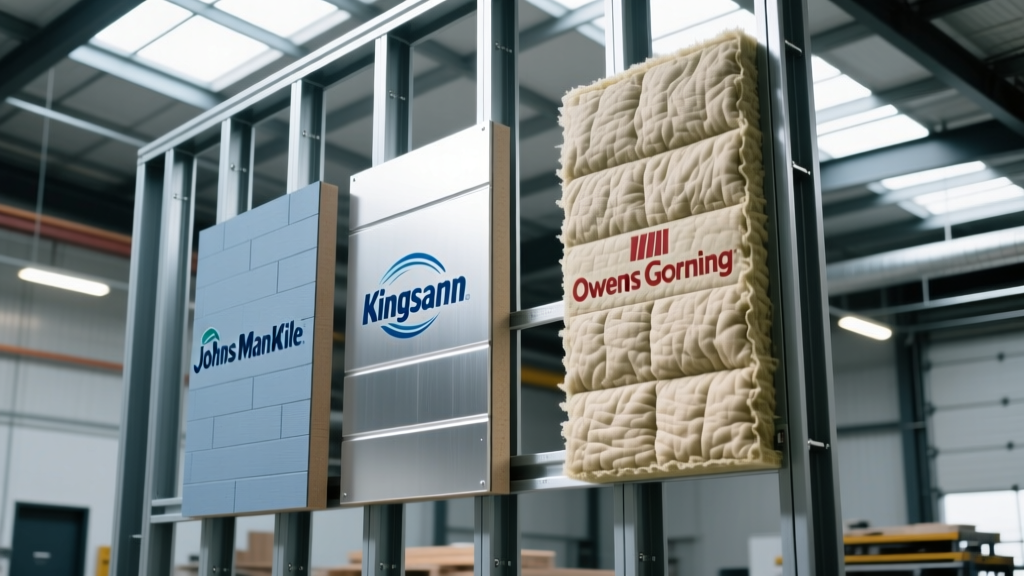
The Unique Thermal Physics of Metal Building Envelopes
Insulating a metal building is fundamentally different from insulating a wood-framed residential structure. Steel conducts heat approximately 400 times faster than dimensional lumber. This extreme thermal conductivity means that the steel framing members (purlins and girts) act as massive thermal bridges, rapidly transferring exterior temperatures to the interior. Furthermore, the impermeable nature of metal cladding traps moisture, making condensation a primary failure mode if the vapor retarder is compromised.
Standard residential batts lack the structural integrity, specialized facings, and dimensional requirements to perform in pre-engineered metal buildings. According to the North American Insulation Manufacturers Association (NAIMA), metal building insulation must serve three simultaneous functions: thermal resistance, acoustic dampening, and a continuous vapor retarder. In 2026, leading manufacturers have engineered highly specific product lines to address these exact challenges, moving far beyond simple fiberglass rolls.
Johns Manville: The Fiberglass & Liner System Standard
Johns Manville (JM) remains the dominant force in traditional metal building blanket insulation. Their flagship product line, JM SPIRIT™, is specifically manufactured to meet the Metal Building Manufacturers Association (MBMA) standards for dimensional stability and recovery.
Decoding JM Facing Options
The true value of JM’s metal building line lies in its specialized facings. Selecting the wrong facing is the most common cause of post-installation failure.
- WMP-VR (White Metalized Polypropylene, Vinyl Reinforced): Designed for exposed interiors. The white vinyl interior provides a clean, bright finish that reflects light, while the metalized layer acts as a Class 1 vapor retarder (perm rating < 0.1). Cost: $0.75 - $0.95 per sq. ft.
- FSK-25 (Foil-Scrim-Kraft): Intended for concealed applications behind liner panels. The kraft paper backing provides durability during installation, but it will degrade if exposed to UV light or physical abrasion. Cost: $0.60 - $0.80 per sq. ft.
- ASJ-25 (All Service Jacket): A heavy-duty, multi-layer facing used in high-abuse environments like agricultural or manufacturing facilities where the insulation may face physical impact.
Kingspan: Rigid Board & Insulated Metal Panels (IMPs)
For projects demanding high R-values without sacrificing interior clearances or requiring complex secondary framing, Kingspan’s Insulated Metal Panels (IMPs) represent the premium tier of metal building insulation. Their KarrierPanel® line utilizes proprietary QuadCore® polyisocyanurate foam technology.
Unlike traditional blankets that compress and lose R-value at the framing members, KarrierPanels maintain a continuous, uncompressed thermal barrier. A standard 4-inch KarrierPanel delivers an R-value of 23, while a 6-inch panel achieves R-34.6. Because the insulation and exterior/interior metal skins are factory-bonded, installation time is reduced by up to 40% compared to multi-trade blanket installations. However, the material cost is significantly higher, ranging from $9.00 to $15.00 per square foot depending on gauge and finish. As noted in the U.S. Department of Energy Building Envelope Guidelines, continuous insulation systems like IMPs are critical for achieving strict modern energy codes in commercial zones.
Owens Corning: High-Performance Blankets & Banded Systems
Owens Corning competes directly with JM through its PROPINK® Complete metal building insulation line. OC’s primary differentiator in 2026 is its focus on banded support systems for wide-purlin spacings. Many modern warehouses utilize purlin spacings of 6 feet or even 8 feet on center to reduce steel tonnage.
Over these wide spans, traditional blankets tend to sag, pulling away from the roof deck and creating convective air loops that destroy the thermal envelope. OC’s PROPINK® Complete is engineered with higher density and integrated tensile strength to be used in conjunction with steel banding (strapping) placed every 3 feet perpendicular to the purlins. This creates a trampoline effect, supporting the blanket and maintaining full loft across the entire cavity.
2026 Metal Building Insulation Comparison Matrix
| Brand | Product Line | Core Material | Nominal R-Value | Material Cost (per sq. ft.) | Best Application |
|---|---|---|---|---|---|
| Johns Manville | SPIRIT™ FSK-25 | Fiberglass Blanket | R-16 to R-30 | $0.60 - $1.10 | Concealed liner panel systems |
| Kingspan | KarrierPanel® | QuadCore® Polyiso | R-14 to R-34 | $9.00 - $15.00 | Premium architectural & cold storage |
| Owens Corning | PROPINK® Complete | Fiberglass Blanket | R-19 to R-30 | $0.65 - $1.15 | Wide-span purlin (6'+ OC) structures |
| Icynene | ProSeal Eco | Closed-Cell SPF | R-22 (at 3") | $2.50 - $3.50 | Retrofits & complex geometries |
Critical Installation Failure Modes & Edge Cases
Even the highest-rated insulation will fail if the physics of metal framing are ignored. The Metal Building Manufacturers Association (MBMA) highlights several recurring failure modes in field installations that contractors must actively mitigate.
1. The Compression Trap at Purlins
Fiberglass R-value is directly proportional to its thickness. When a 6-inch thick R-19 blanket is pinned between a steel purlin and the roof panel, it compresses to roughly 0.5 inches at that specific line. The local R-value at the compression point drops from 19 to approximately 1.5, creating a severe thermal bridge that invites condensation.
To prevent compression, you must install 1-inch or 1.5-inch thermal spacer blocks (typically high-density polyisocyanurate or EPS strips) directly over the purlins before rolling out the insulation and installing the roof panels. This maintains the blanket's loft and restores the continuous thermal envelope. Skipping spacer blocks to save $0.15 per square foot will result in massive energy losses and condensation drips.
2. Facing Seam Failures and Tape Selection
The vapor retarder is only as strong as its seams. A common edge case occurs when installers use standard HVAC foil tape or, worse, cloth duct tape to seal WMP-VR longitudinal and transverse seams. Metal buildings experience extreme thermal expansion and contraction, causing the steel skin to move. Standard tapes lose adhesion within 6 to 12 months under this stress and UV exposure.
The Fix: Use only manufacturer-specified 4-inch wide WMP-VR repair tape with aggressive acrylic adhesives. For high-humidity environments (like indoor swimming pools or food processing), all seams must be double-taped and sealed with a continuous bead of butyl mastic at the panel sidelaps.
3. Sagging in Unconditioned Transitions
When insulating a partially conditioned metal building (e.g., an office space built inside a larger unconditioned warehouse), the insulation stop-point is highly vulnerable. Fiberglass blankets tend to sag at the cut edges, pulling away from the framing and allowing unconditioned air to bypass the thermal barrier. Always install a rigid polyiso backer board at the insulation termination point, and seal the facing to the backer board using closed-cell spray foam to create an airtight transition.
"The transition from simple R-value compliance to continuous thermal envelope performance is the defining shift in 2026 metal building construction. Blankets are no longer just stuffed into cavities; they are part of a highly engineered, multi-layered air and vapor control system."
Making the Final Product Selection
If your project is a standard warehouse or agricultural building with 5-foot purlin spacing and a strict budget, Johns Manville SPIRIT™ with WMP-VR facing remains the most cost-effective and reliable choice, provided you use thermal spacer blocks. If you are building a temperature-controlled distribution center, cold storage facility, or an architecturally exposed retail space where interior aesthetics and maximum R-value per inch are paramount, the upfront premium for Kingspan KarrierPanel® IMPs will yield a faster ROI through reduced HVAC sizing and eliminated secondary framing costs.