Selection Framework: Choosing Insulated Material for Curtains
Master the selection framework for insulated material for curtains. Compare R-values, STC ratings, fabric weights, and ROI for thermal and acoustic needs.
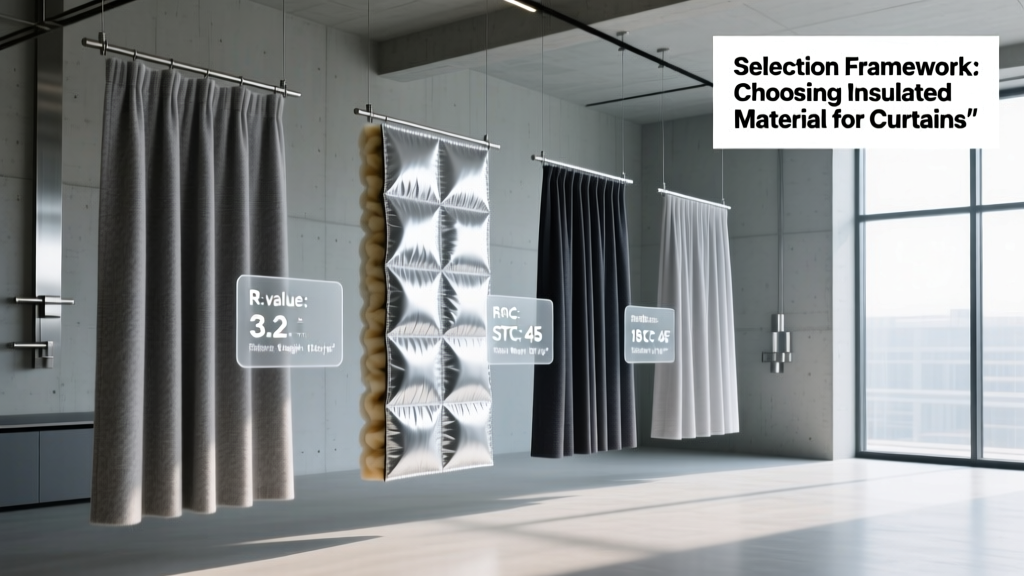
Window areas account for 25% to 30% of residential heating and cooling energy use, making them the weakest link in the building envelope. Selecting the right insulated material for curtains is not merely an aesthetic choice; it is a measurable building science intervention. Standard decorative drapes offer an R-value (thermal resistance) of just 0.1 to 0.3, providing virtually no barrier to heat transfer or sound transmission. High-performance insulated curtains, however, can achieve R-values up to 5.0 and add 15 to 25 STC (Sound Transmission Class) points to a window assembly.
This selection framework provides a systematic approach to specifying insulated curtain materials based on precise thermal, acoustic, and structural requirements for 2026 building standards.
Core Performance Metrics for Window Insulation
Before evaluating specific fabrics, you must define the primary threat vector. The material requirements for thermal retention differ fundamentally from those for acoustic dampening.
Key Metrics Defined
- R-Value (Thermal Resistance): Measures resistance to conductive heat flow. Standard single-pane windows have an R-value of 0.9. Adding an R-3 insulated curtain effectively quadruples the window's thermal resistance.
- STC (Sound Transmission Class): Rates a material's ability to block airborne sound. Standard glass scores STC 25-28. High-mass curtain liners can increase the assembly STC to 40+, effectively blocking highway traffic noise.
- NRC (Noise Reduction Coefficient): Measures sound absorption (reducing echo inside the room) rather than sound blocking. Wool and thick felt excel here, scoring 0.60 to 0.80 NRC.
- Emmissivity (e): The ability of a surface to radiate heat. Aluminum-backed curtain liners feature low-e surfaces (e < 0.05) that reflect radiant heat back into the room during winter and block solar gain in summer.
Material Matrix: Comparing Insulated Curtain Fabrics
The market offers four primary categories of insulated materials for curtains. Each possesses distinct physical properties, weight profiles, and cost structures.
| Material Type | Primary Function | R-Value / STC Impact | Weight (per sq yd) | Avg. Cost (per linear yd) |
|---|---|---|---|---|
| Triple-Weave Polyester | Light blocking, mild thermal | R-0.5 / +2 STC | 1.2 lbs | $15 - $25 |
| Acrylic Foam-Backed (e.g., Thermaweave) | Thermal insulation, draft sealing | R-2.5 to R-3.5 / +4 STC | 2.0 lbs | $22 - $38 |
| Mass Loaded Vinyl (MLV) Liners (1lb/sqft) | Acoustic blocking, heavy thermal | R-1.5 / +15 to +22 STC | 9.0 lbs | $35 - $55 |
| Wool Felt Blends (80/20) | Echo reduction (NRC), natural thermal | R-1.2 / +5 STC (NRC 0.70) | 3.5 lbs | $45 - $70 |
The 4-Step Selection Framework
Use this decision tree to specify the exact material and hardware configuration for your project.
Step 1: Vector Identification and Layering Strategy
Thermal insulation relies on trapping dead air and reflecting radiant energy, while acoustic insulation requires mass and decoupling. If a space requires both (e.g., a bedroom facing a busy, cold street), a single material will fail. You must specify a dual-layer system: a 1lb/sqft MLV liner mounted on a separate track 2 inches behind a decorative foam-backed thermal curtain. The 2-inch air gap acts as a decoupling buffer, maximizing both the STC and R-value of the assembly.
Step 2: Load-Bearing Hardware Assessment
The most common failure mode in insulated curtain installations is hardware collapse. Insulated materials are exceptionally heavy.
Rule of Thumb: Standard decorative rods (typically 1-inch diameter steel or wood) are rated for 1.5 to 2.0 lbs per linear foot. A 10-foot wide MLV acoustic curtain setup can easily exceed 60 lbs. For any material exceeding 2.5 lbs per square yard, you must specify heavy-duty architectural traverse tracks (such as the Kirsch Heavy Duty series or equivalent) rated for 5+ lbs per foot, anchored directly into wall studs or structural headers using toggle bolts.
Step 3: Fire Code and Off-Gassing Verification
As of 2026, updated commercial and multi-family residential building codes strictly regulate window treatments. According to the NFPA 701 Standard, all combustible curtain materials in public spaces and multi-family egress routes must pass rigorous flame propagation and smoke development tests. When sourcing acrylic foam-backed or MLV materials, require the manufacturer to provide a current NFPA 701 certification tag. Additionally, for indoor air quality, specify materials that carry GREENGUARD Gold certification to ensure low VOC off-gassing, particularly important for foam-backed thermal liners which can degrade and release chemicals when exposed to direct, high-UV sunlight.
Step 4: Edge-Sealing and Convective Looping Mitigation
An insulated curtain with an R-4 rating will perform at R-1.5 if installed incorrectly due to convective looping. This physics phenomenon occurs when warm room air touches the cold window glass, cools, becomes denser, and drops to the floor, creating a continuous draft cycle behind the fabric.
Cost Analysis and ROI Timeline
While insulated curtains represent a higher upfront cost than standard drapery, the energy savings in extreme climates yield a rapid return on investment. The U.S. Department of Energy notes that tightly sealed, insulated window coverings can reduce window heat loss by up to 25% in winter and solar heat gain by up to 33% in summer.
| System Configuration | Material + Hardware Cost (per 4x5 window) | Est. Annual HVAC Savings (Zone 4 Climate) | Payback Period |
|---|---|---|---|
| Standard Blackout (Triple-Weave) | $120 - $180 | $15 - $25 | 6 - 9 Years |
| Foam-Backed Thermal + Cornice Seal | $250 - $350 | $60 - $90 | 3 - 5 Years |
| Dual-Layer (MLV + Thermal + Magnetic Seals) | $600 - $850 | $85 - $120 (plus acoustic value) | 5 - 8 Years |
Sourcing and Specification Checklist
When drafting purchase orders or consulting with interior architects, use this exact specification checklist to ensure the insulated material for curtains meets performance requirements:
- Thermal Resistance: Require independent lab testing for R-value (ASTM C518), not just manufacturer estimates.
- Acoustic Mass: If specifying MLV, verify the mass is exactly 1.0 lb/sqft or 2.0 lb/sqft. Sub-1lb 'acoustic vinyl' is largely ineffective for low-frequency traffic noise.
- UV Degradation Rating: For south or west-facing windows, the exterior-facing layer must feature a UV-stabilized white backing to prevent the foam or vinyl from becoming brittle and cracking after 2-3 years of solar exposure.
- Dimensional Stability: Ensure the fabric has a maximum shrinkage rate of <1% after dry cleaning. Foam-backed materials are notorious for warping if washed in standard commercial machines; specify 'dry clean only' or professional steam cleaning protocols.
Expert Insight: Never rely on the curtain fabric alone to solve a failing window assembly. If a single-pane window is suffering from severe condensation and mold growth on the sill, adding an airtight insulated curtain will trap the moisture against the glass, accelerating wood rot and mold proliferation. In high-moisture environments, address the window glazing and frame sealing first, using insulated curtains strictly as a supplementary thermal and acoustic barrier.
Written by
Marcus ChenMarcus Chen is a licensed structural engineer (PE) and building materials analyst with over 12 years of experience across residential, commercial, and industrial construction. He holds a Master of Science in Civil Engineering from UC Berkeley and spent six years at Thornton Tomasetti before transitioning to independent consulting and technical writing. Marcus specializes in material selection for seismic-prone regions, concrete reinforcement strategies, and lifecycle cost analysis. His work has been cited by the American Concrete Institute (ACI) and the Structural Engineers Association of California (SEAOC). When he is not on a job site or at his desk, you will find him hiking the Sierra Nevada or restoring a 1920s craftsman bungalow in Oakland, CA.
More from Marcus Chen
View all
Construction Cost
How Much Did the Eiffel Tower Cost to Build?
How much did the Eiffel Tower cost to build in 1889? We adjust for inflation and compare its budget to modern skyscraper construction.
Aug 4, 2026

Fire Resistance
What Is a Fire Resistant Material? Testing & Certification Guide
Discover what is a fire resistant material through ASTM and UL testing. Learn how fire ratings, certifications, and assemblies work in construction.
Aug 4, 2026

Construction Cost
How Much Did the Burj Khalifa Cost to Build?
How much did the Burj Khalifa cost to build? We break down the $1.5B project and extract 5 money-saving strategies for your next build.
Jul 30, 2026