Polyisocyanurate Insulation Performance Specs and R-Value Ratings
Analyze polyisocyanurate insulation performance specs, including LTTR R-values, cold-weather thermal drift, fire ratings, and facer selection.
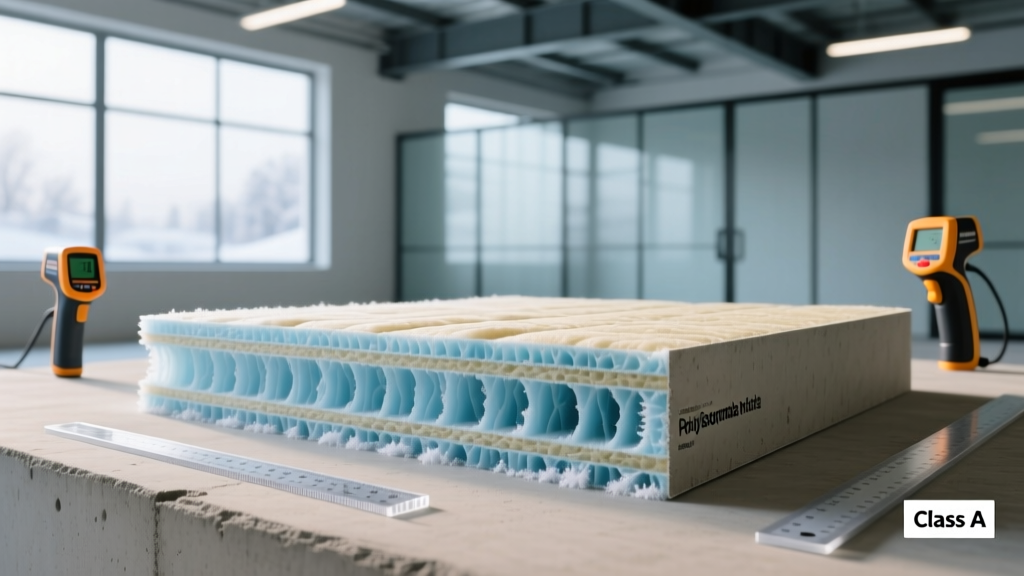
Core Thermal Metrics: Initial vs. LTTR
When specifying polyisocyanurate insulation (commonly referred to as polyiso) for commercial roofing or continuous exterior wall assemblies, relying on initial R-value data is a critical error. Polyiso is manufactured using hydrocarbon blowing agents (typically pentane) that temporarily boost its thermal resistance immediately after production. However, as these gases diffuse out of the closed cells and are replaced by air over time, the R-value stabilizes.
To address this, the Polyisocyanurate Insulation Manufacturers Association (PIMA) and building codes mandate the use of Long-Term Thermal Resistance (LTTR) values. LTTR represents the R-value measured after 15 years of simulated aging. For standard polyiso boards (2 inches or thicker), the LTTR is typically rated at R-6.0 to R-6.3 per inch at 75°F (24°C). Thinner boards (under 1 inch) often exhibit a slightly lower LTTR due to a higher surface-area-to-volume ratio, which accelerates gas exchange.
The Cold-Weather R-Value Anomaly
One of the most misunderstood performance characteristics of polyisocyanurate insulation is its thermal behavior in freezing temperatures. Unlike expanded polystyrene (EPS) or extruded polystyrene (XPS), which maintain or slightly increase their R-value as temperatures drop, standard polyiso experiences a thermal degradation in cold climates.
Research conducted by the Department of Energy and independent laboratories demonstrates that when the mean temperature of the polyiso board drops below 40°F (4°C), the blowing agent trapped within the closed cells begins to condense into a liquid. This phase change drastically reduces the insulating value of the gas within the cells. At a mean temperature of 25°F (-4°C), standard polyiso can lose up to 20% of its 75°F LTTR rating, dropping to approximately R-4.8 per inch.
Solving the Cold-Weather Drop: Hybrid Assemblies
To mitigate this vulnerability in ASHRAE Climate Zones 5 and higher, building scientists recommend a hybrid roof or wall assembly. By placing a layer of EPS or XPS insulation above the polyiso (on the exterior/cold side), the polyiso is kept warm enough to prevent the blowing agent from condensing. The outer layer of EPS/XPS takes the brunt of the cold temperature, preserving the polyiso's high R-value and ensuring the assembly meets design thermal targets year-round. The Department of Energy's rigid foam guidelines support layered rigid foam strategies to optimize thermal performance and manage condensation risks.
Fire, Smoke, and NFPA 285 Assembly Ratings
Polyiso is inherently a thermoset plastic, meaning it chars rather than melts when exposed to high heat. This gives it superior fire performance compared to thermoplastic foams like XPS and EPS. However, specifying polyiso requires strict attention to both material-level and assembly-level fire testing.
- ASTM E84 (Surface Burning Characteristics): Foil-faced polyiso typically achieves a Class A rating with a Flame Spread Index (FSI) of less than 25 and a Smoke Developed Index (SDI) of less than 450. This is mandatory for exposed interior applications or specific plenum spaces.
- FM 4474 & UL 1256: For commercial roofing, polyiso boards are tested for resistance to internal and external fire spread, often achieving FM Class 1 ratings when used in approved deck assemblies.
- NFPA 285 (Mid-Rise Wall Assemblies): When polyiso is used as continuous exterior insulation (ci) in Type I-V construction over 40 feet, the entire wall assembly must pass the NFPA 285 multi-story flame propagation test. The specific facer, adhesive, and weather-resistive barrier (WRB) must match the tested assembly exactly.
Warning on Substitutions: Substituting a coated glass mat (CGM) facer for a foil facer (or vice versa) in an NFPA 285 compliant wall assembly can void the fire rating. Foil acts as a thermal barrier that protects the foam core during the test; CGM does not provide the same thermal break.
Facers, Moisture Permeability, and Compressive Strength
The performance of polyisocyanurate insulation is heavily dictated by its facers. Under ASTM C1289 (Standard Specification for Faced Rigid Cellular Polyisocyanurate Thermal Insulation Board), manufacturers bond the foam core to various substrates that dictate moisture permeability, tensile strength, and adhesion capabilities.
| Facer Type | Permeance (Perms) | Primary Application | Key Limitation |
|---|---|---|---|
| Aluminum Foil | < 0.1 (Class I) | Mechanically attached roofing, interior sheathing, vapor barriers. | Cannot be used with fully adhered roofing membranes or asphalt-based adhesives. |
| Coated Glass Mat (CGM) | ~ 1.5 to 3.0 | Fully adhered roofing, EIFS, stucco, and fluid-applied WRB wall systems. | Requires a separate vapor retarder in cold climate interior applications. |
| Kraft Paper / FSK | ~ 1.0 to 5.0 | Metal building insulation, HVAC duct wrap, interior retrofits. | Poor moisture resistance; degrades if exposed to bulk water. |
Compressive Strength: Standard commercial-grade polyiso meets ASTM C1289 requirements with a minimum compressive strength of 16 psi to 20 psi at 10% deformation. For heavy-load applications, such as plazas, green roofs, or areas with heavy HVAC foot traffic, specifiers must request high-density polyiso (up to 25-30 psi) or transition to XPS, which routinely offers 40+ psi compressive resistance.
Specification Matrix: Choosing the Right Polyiso
To ensure long-term durability and code compliance, match the polyiso specification to the environmental and structural demands of the project using this decision framework:
- Commercial Low-Slope Roof (Mechanically Attached): Specify foil-faced polyiso (LTTR R-6.0/inch). The foil provides a secondary water-shedding layer if the membrane is punctured and acts as a radiant barrier.
- Commercial Low-Slope Roof (Fully Adhered TPO/EPDM): Specify Coated Glass Mat (CGM) faced polyiso. The porous nature of the CGM allows the roofing adhesive to create a mechanical bond with the foam core, preventing wind uplift delamination.
- Exterior Continuous Insulation (ci) over Wood Framing: Specify CGM or matte-finished polyiso to allow the wall assembly to dry to the exterior. Pair with a Class II or III interior vapor retarder (like smart membranes) to prevent interstitial condensation.
- Cold Climate Roofing (Zones 5+): Specify a hybrid assembly. Use 1.5 inches of XPS/EPS above 3 inches of polyiso to maintain the polyiso's thermal efficiency during sub-freezing winter months.
For further validation on fire testing requirements in multi-story commercial buildings, consult the NFPA 285 standard development guidelines to ensure your chosen polyiso product and facer combination aligns with the tested structural assemblies.