Marine Insulation Material Selection Framework for Vessels
Master the marine insulation material selection framework. Compare mineral wool, elastomeric foam, and aerogel for engine rooms, hulls, and cabins.

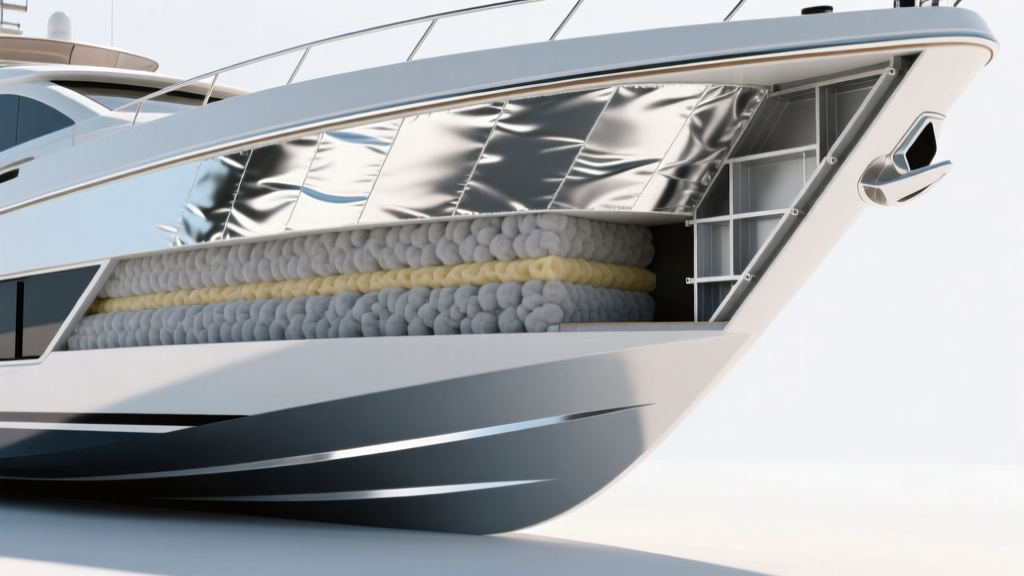
Selecting the correct marine insulation material requires navigating a complex matrix of thermal dynamics, acoustic dampening, strict fire codes, and extreme moisture exposure. Unlike residential construction, a vessel's insulation must perform flawlessly while enduring constant vibration, salt-laden air, and severe spatial constraints. A failure in marine insulation does not merely result in higher energy bills; it can lead to catastrophic condensation, structural corrosion, or rapid fire propagation.
The Core Challenges of Marine Thermal and Acoustic Insulation
Marine environments subject insulation to four distinct stressors that terrestrial materials are rarely engineered to withstand simultaneously:
- Hydrostatic and Condensation Loads: Below-deck temperatures frequently drop below the dew point, creating massive condensation risks. Open-cell materials will absorb this moisture, adding hundreds of pounds of dead weight to the vessel and losing up to 80% of their R-value.
- Vibration and Settlement: Engine harmonics and hull flexing can cause rigid foam boards to fracture and batt insulation to slump, leaving uninsulated thermal bridges at the top of the cavity.
- Stringent Fire Codes: The International Maritime Organization (IMO) and Safety of Life at Sea (SOLAS) conventions mandate strict non-combustibility and low flame-spread ratings, particularly in machinery spaces and escape routes.
- Weight and Volume Penalties: Every cubic foot of insulation displaces usable volume, and every pound affects the vessel's center of gravity and fuel efficiency.
The 4-Step Marine Insulation Material Selection Framework
Step 1: Map the Vessel Zones
Divide the vessel into three primary insulation zones: Machinery Spaces (engine rooms, generators), Accommodation Spaces (cabins, galleys, mess rooms), and Below-Deck/Bilge (hull interiors, ballast tanks). Each zone dictates a completely different material chemistry.
Step 2: Establish Fire and Safety Ratings
For passenger and commercial vessels, materials must comply with the IMO Fire Protection guidelines, specifically the FTP (Fire Test Procedures) Code. Machinery spaces require 'A-60' class divisions (capable of preventing the passage of smoke and flame for 60 minutes while restricting the temperature rise on the unexposed side to 140°C). Accommodation spaces often require 'B-15' class divisions. Always verify that the specific product holds a valid MED (Marine Equipment Directive) Wheelmark certification.
Step 3: Evaluate Moisture and Vapor Permeability
In hull and bilge applications, the water vapor transmission rate (WVTR) must be near zero. Closed-cell elastomeric foams and closed-cell spray polyurethane foam (ccSPF) are mandatory here. Mineral wool can be used in these areas only if it is fully encapsulated in a continuous, welded aluminum or PVC vapor barrier.
Step 4: Calculate Weight-to-R-Value Ratios
High-performance vessels (such as racing yachts or fast ferries) require ultra-lightweight solutions. In these cases, the cost premium for silica aerogel blankets is justified by the weight savings, offering R-10 per inch at a fraction of the weight of traditional mineral wool.
Material Comparison Matrix: Top Marine Insulation Materials
| Material Type | Leading Marine Product | R-Value (per inch) | Fire Rating | Best Application Zone | Approx. Cost (per sq. ft.) |
|---|---|---|---|---|---|
| Stone Mineral Wool | ROCKWOOL SeaRox SL 460 | R-4.0 to R-4.3 | Non-combustible (A-60) | Engine rooms, exhaust wraps | $2.50 - $4.00 |
| Closed-Cell Elastomeric | Armacell Armaflex AF | R-4.6 | Low flame spread (Class 1) | HVAC ducting, cold water pipes | $3.00 - $5.50 |
| Silica Aerogel Blanket | Aspen Aerogels Spaceloft | R-10.3 | Class A / IMO Certified | Space-constrained hulls, decks | $12.00 - $18.00 |
| Closed-Cell Spray Foam | 2 lb Marine-Grade ccSPF | R-6.5 to R-7.0 | Class 1 (with intumescent coat) | Irregular bilges, deep hull cavities | $2.50 - $4.50 (installed) |
Zone-Specific Material Recommendations
Machinery Spaces and Engine Rooms
Engine rooms generate extreme heat (often exceeding 150°F ambient) and intense low-frequency acoustic vibrations. The standard here is high-density stone wool, such as ROCKWOOL Marine products, specifically faced with reinforced aluminum foil. The foil acts as a radiant barrier and an oil/mist shield, preventing engine aerosols from saturating the porous wool. For acoustic dampening, specify a minimum density of 80 kg/m³ (5 lb/ft³) to effectively absorb low-frequency engine rumble. Secure the batts using marine-grade stainless steel weld pins with locking washers, spaced no more than 12 inches apart, to prevent sagging under heavy vibration.
Accommodation Spaces and Cabins
In crew and passenger quarters, the priority shifts to acoustic privacy and thermal comfort without sacrificing valuable headroom. Standard bulkheads (walls) often utilize a composite approach: a 2-inch layer of medium-density mineral wool (approx. 40 kg/m³) for sound absorption, paired with resilient channel mounting to decouple the gypsum or marine-plywood wall panels from the steel or aluminum superstructure. This decoupling can boost the Sound Transmission Class (STC) rating from a baseline of 35 to over 50, ensuring conversational privacy between adjacent cabins.
Below-Deck Hull and Bilge Areas
Below the waterline, the hull is constantly subjected to cold water temperatures, making condensation an absolute certainty on the interior surface if left uninsulated. Closed-cell elastomeric foams like Armacell Armaflex are the premier choice here. Because the material is 100% closed-cell, it will not wick water even if the outer jacket is punctured. When installing elastomeric foam on the hull, all seams must be sealed with the manufacturer's specific solvent-based adhesive (e.g., Armaflex 520) followed by a continuous bead of marine-grade sealant. Never use mechanical fasteners (screws or staples) below the waterline, as every puncture creates a potential pathway for moisture ingress and osmotic blistering in fiberglass hulls.
Critical Installation Edge Cases and Failure Modes
Even the highest-rated marine insulation material will fail if installed incorrectly. Marine surveyors frequently flag the following installation errors during class inspections:
- Galvanic Corrosion from Foil Facings: When aluminum-foil-faced mineral wool is pressed directly against a bare steel hull in the presence of saltwater humidity, a galvanic cell is created. The steel will rapidly corrode. Fix: Always apply a heavy-duty marine epoxy barrier coat to the steel hull before installing foil-faced insulation, or use a non-conductive PVC or fiberglass facing.
- Vapor Dams in Spray Foam: When applying ccSPF to a hull, applicators often leave small gaps at the stringers or frame intersections. These gaps allow warm, moist cabin air to reach the cold hull, resulting in localized condensation that pools in the bilge. Fix: Mandate a continuous, monolithic spray application with a minimum thickness of 2 inches, verified via depth gauges during application.
- Compression of Mineral Wool: Forcing a 4-inch batt into a 3-inch cavity to 'make it fit' compresses the air pockets within the stone wool, dropping its R-value by up to 30% and ruining its acoustic decoupling properties. Fix: Order materials cut to the exact cavity depth, or use a utility knife to trim batts 1/2 inch oversized for a friction fit, never force-compress them.
Sourcing and Procurement Strategy
When procuring marine insulation, avoid standard building-supply distributors. Materials must be sourced from specialized marine distributors who can provide the required MED Wheelmark certificates and IMO FTP Code test reports for your specific batch. Standard residential fiberglass or open-cell spray foam will fail classification society inspections (such as ABS, DNV, or Lloyd's Register) and will void marine insurance policies in the event of a fire. Budget an additional 15-20% above terrestrial insulation costs to account for marine-certified facings, specialized marine adhesives, and stainless steel fastening hardware.
Written by
Sarah WhitfieldSarah Whitfield is a chartered quantity surveyor (MRICS) and construction cost analyst with 15 years of experience in material pricing, procurement strategy, and project budgeting. She earned her degree in Construction Management from the University of Reading (UK) and has worked on projects ranging from $2M custom homes to $180M mixed-use developments across North America and Europe. Sarah currently leads cost estimating for BuildMat Insight, maintaining a proprietary database of 4,000+ material price points updated quarterly. She is a frequent contributor to RSMeans cost data panels and has presented at the International Cost Engineering Council (ICEC) congress. Based in Denver, CO, Sarah is an avid trail runner and volunteer mentor for Women in Construction.
More from Sarah Whitfield
View all
Wood & Lumber
What Are the Different Types of Wood? A Builder's Guide
Compare structural softwoods, finish hardwoods, and engineered lumber. Analyze Janka ratings, MOE values, and 2026 pricing for construction.
Aug 4, 2026

Walls & Panels
Steel Framing vs Wood Framing: Corrosion and Moisture Defense
Compare steel framing vs wood framing for moisture resistance. Learn about galvanized coatings, condensation risks, and corrosion protection strategies.
Jul 21, 2026

Stone & Masonry
How to Cut Stone Veneer: Wet Saw vs Grinder Comparison
Compare the best tools for cutting stone veneer. We review wet saws, angle grinders, and chop saws to help you achieve clean, chip-free cuts.
Jul 21, 2026