Types of Insulation Materials: R-Value and Performance Compared
Compare types of insulation materials by real-world R-value, thermal drift, and cost. Expert analysis of spray foam, polyiso, and mineral wool.

The Physics of Thermal Resistance: Beyond the Label
Evaluating the thermal performance of a building envelope requires moving beyond the nominal R-value printed on a product's packaging. The Federal Trade Commission mandates that insulation R-values be tested at a mean temperature of 75°F (24°C) using ASTM C518 standards. However, real-world building envelopes operate across extreme temperature differentials. When evaluating different types of insulation materials, architects and builders must account for thermal drift, air permeability, and moisture dynamics that drastically alter field performance.
A material's resistance to conductive heat flow is only one variable. Convective heat loss (air movement through the material) and radiant heat transfer can negate high conductive R-values if the assembly is not properly detailed. According to the U.S. Department of Energy, improper installation and air leakage can reduce the effective R-value of a batt insulation system by up to 40% in extreme climates.
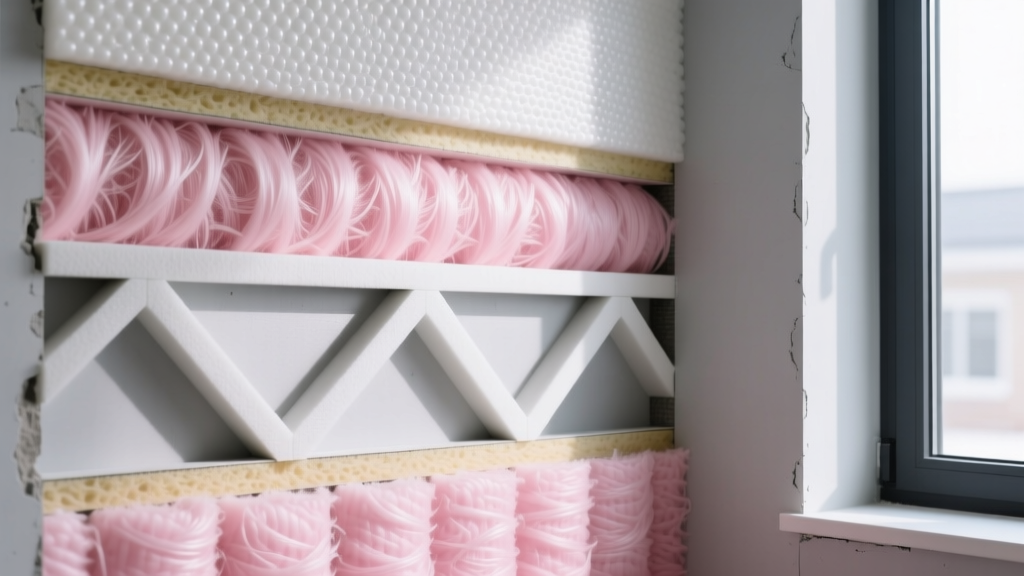
Performance Matrix: Core Insulation Types Analyzed
The following matrix compares the primary insulation categories used in residential and commercial construction, highlighting the delta between laboratory nominal values and real-world field performance.
| Material Category | Nominal R-Value / Inch | Effective R at 0°F (-18°C) | Avg. Installed Cost (per sq. ft.) | Vapor Permeability | Primary Failure Mode |
|---|---|---|---|---|---|
| Closed-Cell Spray Foam (ccSPF) | R-7.0 to R-7.5 | R-7.2 (Slight Increase) | $2.80 - $3.50 | Class II Vapor Retarder | Off-ratio mixing / Shrinkage |
| Polyisocyanurate (Polyiso) Board | R-6.0 to R-6.5 | R-5.0 (Thermal Drift) | $1.40 - $1.90 | Class I (with foil facer) | Condensation at cold sheathing |
| Mineral Wool (Stone Wool) Batt | R-4.2 to R-4.3 | R-4.3 (Stable) | $1.50 - $1.85 | Vapor Open | Convective looping if unsealed |
| Extruded Polystyrene (XPS) | R-5.0 | R-4.5 (Long-term degradation) | $1.20 - $1.60 | Class II | Moisture absorption over time |
| Fiberglass (High-Density Batt) | R-3.6 to R-4.0 | R-3.8 (Stable) | $1.10 - $1.40 | Vapor Open | Compression / Air infiltration |
Deep Dive: High-Performance Material Profiles
Closed-Cell Spray Polyurethane Foam (ccSPF)
Modern ccSPF formulations have transitioned to Hydrofluoroolefin (HFO) blowing agents, drastically reducing Global Warming Potential (GWP) while maintaining exceptional thermal resistance. Products like Demilec Heatlok H2 High Lift deliver an aged R-value of R-7.4 per inch. Beyond thermal resistance, ccSPF provides structural racking strength (increasing wall shear strength by up to 300%) and acts as a Class II vapor retarder at a 1.5-inch thickness. The critical performance constraint is installation: ambient temperatures must be strictly maintained between 60°F and 80°F during application to prevent cellular collapse and off-ratio curing.
Polyisocyanurate (Polyiso) Rigid Board
Polyiso offers the highest nominal R-value per inch among rigid foam boards (up to R-6.5), driven by the low thermal conductivity of its pentane or HFO blowing agents. However, specifiers must account for thermal drift. As temperatures drop below 50°F, the blowing gases within the closed cells begin to condense, reducing the material's thermal resistance. At 0°F, a foil-faced polyiso board like Johns Manville ENRGY 3 may perform closer to R-5.0 per inch. To mitigate this in cold climates (IECC Zones 6-8), building scientists recommend using polyiso in conjunction with a flash coat of ccSPF or mineral wool to keep the polyiso above its dew point.
Mineral Wool (Stone Wool) Batts
Mineral wool, such as ROCKWOOL Comfortbatt, provides a stable R-4.2 per inch across all temperature extremes. Its true performance advantage lies in its secondary characteristics: it is completely non-combustible (passing ASTM E136), hydrophobic, and offers superior acoustic dampening with Noise Reduction Coefficients (NRC) exceeding 0.95. Unlike fiberglass, mineral wool's high density (typically 2.5 to 8.0 lbs/ft³) resists convective air movement within the cavity, making it highly effective in cathedral ceilings and exterior continuous insulation applications where thermal bridging is a concern.
When specifying Extruded Polystyrene (XPS) for below-grade or exterior continuous insulation, note that its long-term thermal resistance (LTTR) is lower than its initial R-5.0 rating. Over a 50-year lifespan, the high-GWP blowing gases escape and are replaced by air, dropping the effective R-value to approximately R-4.2 per inch. For below-grade applications where moisture resistance is paramount, consider high-density Expanded Polystyrene (EPS Type II or IX), which maintains a stable R-4.7 per inch indefinitely because it uses pentane, which dissipates during manufacturing.
Air Sealing vs. Thermal Resistance: The Hidden Performance Gap
The most common failure in insulation performance is not a deficiency in the material's R-value, but a failure to control air transport. Air leakage carries moisture and heat at a rate that dwarfs conductive heat transfer. A 1-square-inch hole in a wall assembly can allow as much moisture-laden air to pass through as vapor diffusion does through a 4x8 sheet of gypsum board.
Air-permeable types of insulation materials, such as fiberglass and mineral wool, do not stop air movement. If a wall cavity insulated with R-38 fiberglass is subjected to a 50 Pascal pressure differential (typical during winter wind events), convective looping within the cavity will strip heat from the interior drywall and deposit it against the cold exterior sheathing. The Building Science Corporation emphasizes that air barriers must be continuous, rigid, and durable. Pairing air-permeable cavity insulation with an exterior continuous air barrier (like taped ZIP sheathing or a fluid-applied membrane) is mandatory to achieve the rated R-value performance in the field.
Decision Framework: Selecting Materials by Climate Zone
Selecting the optimal insulation requires mapping material properties to the specific hygrothermal demands of the project's climate zone, as defined by the IECC.
- Hot-Humid Climates (Zones 1-3): Prioritize vapor-open, air-impermeable materials. Open-cell spray foam (R-3.5/inch) or dense-pack cellulose allows the assembly to dry to the interior while providing the necessary air seal to prevent humid exterior air from condensing on cool interior surfaces. Avoid interior polyethylene vapor retarders.
- Mixed Climates (Zones 4-5): These zones experience both heating and cooling degree days, requiring 'smart' vapor retarders (like CertainTeed MemBrain) that adapt to seasonal humidity shifts. High-density fiberglass or mineral wool batts paired with exterior rigid mineral wool boards provide excellent thermal control while allowing bidirectional drying.
- Cold and Marine Climates (Zones 6-8): The primary risk is interior moisture condensing on freezing exterior sheathing. The Building America Solution Center recommends the 'Flash and Batt' method: applying 1.5 to 2 inches of closed-cell spray foam directly against the interior sheathing to raise its temperature above the dew point, then filling the remainder of the cavity with cost-effective mineral wool or fiberglass.
Summary of Field Execution
Specifying high-R-value materials is only the first step. True thermal performance is achieved through meticulous detailing. Ensure all rigid foam joints are taped with acrylic or butyl adhesives, spray foam substrates are clean and within temperature tolerances, and batt insulation is cut precisely to avoid compression at studs and electrical boxes. By aligning the specific thermodynamic properties of the chosen insulation type with the building's air and vapor control layers, you secure long-term energy efficiency and structural durability.
Written by
Elena RodriguezElena Rodriguez is a civil engineer and technical writer specializing in concrete technology, masonry systems, and ASTM/ACI compliance. She earned her B.S. in Civil Engineering from Texas A&M University and spent a decade at a materials testing laboratory, performing over 2,000 concrete compressive strength tests and masonry prism evaluations. Elena is an ACI-certified Field Testing Technician (Grade I) and a member of ASTM Committee C12 on Natural Building Stone. She currently consults on forensic engineering cases involving concrete failures and moisture intrusion. Based in San Antonio, TX, Elena is a proud member of the Society of Women Engineers (SWE) and coaches her daughter's FIRST Robotics team.
More from Elena Rodriguez
View all
Walls & Panels
Cost Analysis: Light Gauge Steel Framing Advantages and Disadvantages
Evaluate light gauge steel framing advantages and disadvantages through a strict cost analysis lens, comparing material, labor, and lifecycle expenses.
Aug 4, 2026

Walls & Panels
Gypsum Board Types: Exact Specifications, Thickness & Dimensions
Compare standard, Type X, and moisture-resistant gypsum board types. Get exact specifications, thicknesses, dimensions, and ASTM standards for your project.
Aug 4, 2026

Fire Resistance
Best Fire-Resistant Outdoor Decking Materials: 2026 Buyer Guide
Discover the best fire-resistant outdoor decking materials for 2026. Compare Class A PVC, aluminum, and hardwood options for WUI compliance and safety.
Aug 4, 2026