Auto Heat Insulation Material Costs for High-Temp Building Zones
Analyze the cost, R-value, and code compliance of using auto heat insulation material in commercial mechanical rooms and high-temp building zones.

The Crossover Appeal: Sourcing Auto Heat Insulation Material for Buildings
When architects and mechanical engineers face extreme spatial constraints in high-temperature building zones—such as commercial boiler rooms, data center exhaust plenums, or high-heat workshop conversions—standard mineral wool often falls short. Traditional building insulation requires 4 to 6 inches of clearance to achieve adequate thermal resistance and protect surrounding combustibles. In zero-clearance scenarios, professionals are increasingly turning to an unlikely source: auto heat insulation material. Originally engineered for automotive exhaust manifolds, EV battery thermal runaway protection, and turbocharger wraps, these ultra-thin, high-performance materials offer exceptional R-values in profiles under 15mm.
Material Breakdown and Cost Per Square Foot
To accurately budget for these specialized applications, we must evaluate the three primary categories of automotive thermal barriers and their adapted building use cases. Pricing reflects Q1 2026 commercial bulk rates.
1. Silica Aerogel Blankets (EV Battery & Exhaust Grade)
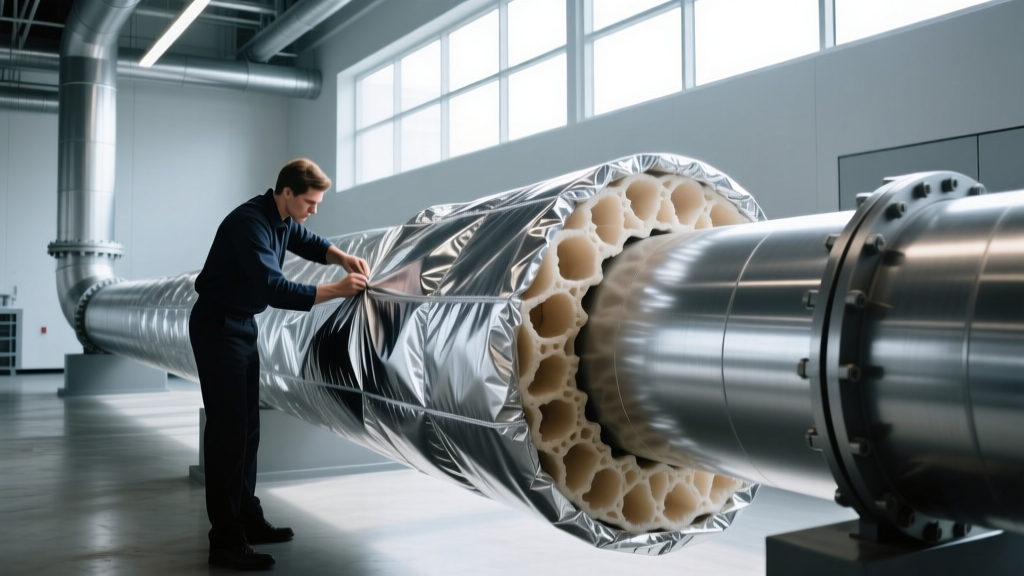
Aerogel blankets, such as Aspen Aerogels Pyrogel XT-E, represent the pinnacle of auto heat insulation material technology. Used heavily in 2025 and 2026 electric vehicle platforms to prevent thermal propagation between battery cells, these blankets offer an R-value of roughly R-10.3 per inch. They are hydrophobic, flexible, and can withstand continuous temperatures up to 1,200°F (650°C).
- Material Cost: $18.50 – $24.00 per sq. ft.
- Thickness: 5mm to 10mm
- Best Building Application: Wrapping high-pressure steam pipes in tight mechanical chases where standard pipe lagging cannot fit.
2. Aluminized Back-Side Fiberglass
Products like Thermo-Tec 13500 Aluminized Back-Side Heat Shield utilize a fiberglass core bonded to a reflective aluminum surface. Originally designed to protect automotive floor pans from exhaust heat, this material reflects up to 90% of radiant heat. It is highly cost-effective for large surface areas in building mechanical rooms.
- Material Cost: $4.50 – $6.20 per sq. ft.
- Thickness: 2mm to 3mm
- Best Building Application: Lining the interior walls of commercial wood-fired pizza oven enclosures or radiant heating manifolds.
3. Basalt and Titanium Fiber Sleeves
Basalt fiber (often marketed as "volcanic rock" fiber in the automotive sector) is spun into dense mats or sleeves. It is entirely inorganic and will not off-gas toxic smoke when exposed to extreme heat, a critical factor for indoor building environments.
- Material Cost: $8.00 – $11.50 per sq. ft.
- Thickness: 12mm to 25mm
- Best Building Application: Insulating commercial kitchen exhaust ducts passing through combustible ceiling joists.
Comparative Matrix: Auto-Grade vs. Traditional Building Insulation
| Material Type | Profile Thickness | Max Temp Rating | Cost per Sq. Ft. | Primary Limitation |
|---|---|---|---|---|
| Rockwool ProRox (Standard) | 3.0" - 4.0" | 1,200°F | $1.80 - $2.50 | Requires massive spatial clearance |
| Silica Aerogel Blanket (Auto) | 0.2" - 0.4" | 1,200°F | $18.50 - $24.00 | High upfront material cost |
| Aluminized Fiberglass (Auto) | 0.08" - 0.12" | 1,750°F (Radiant) | $4.50 - $6.20 | Poor conductive heat resistance |
| Basalt Fiber Mat (Auto) | 0.5" - 1.0" | 1,800°F | $8.00 - $11.50 | Difficult to cut and shape cleanly |
Hidden Costs: Adhesives, Fasteners, and Code Compliance
The most frequent budgeting error when specifying an auto heat insulation material for a building project is ignoring the ancillary costs required to make automotive products compliant with commercial building codes. Automotive materials are tested to SAE (Society of Automotive Engineers) standards, not ASTM (American Society for Testing and Materials) building standards.
Specialty Adhesives and Mechanical Fasteners
Standard construction adhesives will degrade or off-gas when subjected to the continuous 300°F+ temperatures typical of the surfaces these auto materials are designed to wrap. You must budget for high-temperature silicone sealants and ceramic-compatible adhesives.
- 3M Fire Barrier Silicone Sealant 2000+: ~$18.00 per 10.1 oz tube (covers approx. 15 linear feet).
- High-Temp Stainless Steel Zip Ties & Bands: ~$0.85 per fastener (required for basalt and aerogel pipe wraps).
- Ceramic Adhesive (e.g., Rutland 500°F RTV): ~$12.00 per tube for bonding aluminized fiberglass to metal ductwork.
ROI and Lifecycle Cost Analysis
Why pay $20 a square foot for aerogel when mineral wool costs $2? The answer lies in spatial economics and HVAC load reduction. According to the U.S. Department of Energy, proper insulation of mechanical ducts and piping can reduce building HVAC energy losses by up to 20%. However, in high-density urban builds (like New York or San Francisco), commercial real estate is valued at $800 to $1,500+ per square foot.
If wrapping a main steam riser with 4-inch mineral wool requires building a 12-inch x 12-inch chase, you are losing 1 square foot of leasable floor space for every linear foot of pipe. Over a 50-foot run, that is 50 square feet of lost space—potentially worth $50,000 in asset value. By using a 10mm auto-grade aerogel blanket, the chase can be reduced to 4x4 inches, reclaiming nearly 45 square feet of leasable area. In this scenario, the $1,000 premium for the auto heat insulation material yields a 5,000% return on investment in spatial value alone.
Decision Framework: When to Specify Auto-Grade Materials
Use this diagnostic framework during the schematic design phase to determine if automotive thermal barriers are justified for your building project:
- Evaluate the Clearance: Is the available clearance between the heat source and the nearest combustible material less than 3 inches?
- If Yes: Proceed to Step 2. Standard building insulation is physically unviable.
- If No: Stop. Use standard high-density mineral wool (e.g., Rockwool ProRox SL 960) to minimize costs.
- Identify the Heat Transfer Type: Is the primary concern radiant heat (e.g., a glowing boiler flue) or conductive heat (e.g., touching a hot steam pipe)?
- If Radiant: Specify Aluminized Back-Side Fiberglass. It reflects 90% of radiant energy at a fraction of the cost of aerogel.
- If Conductive: Specify Silica Aerogel Blankets. Aluminized fiberglass will fail to stop conductive heat transfer.
- Check the Occupancy Zone: Is the space a return-air plenum or occupied zone?
- If Yes: You must budget for 5/8" Type X drywall encapsulation to meet ASTM E84 fire codes, regardless of the auto material chosen.
- If No (e.g., sealed mechanical shaft): You may be able to leave the material exposed, provided the local AHJ (Authority Having Jurisdiction) approves the SAE fire testing data in lieu of ASTM.
Frequently Asked Questions
Can auto heat insulation material be used in residential attics or walls?
No. Automotive materials are entirely over-engineered for standard residential temperature differentials and lack the vapor-permeability required for building envelope assemblies. Using them in residential walls will likely trap moisture, leading to severe rot and mold issues. Restrict these materials to localized, high-heat mechanical applications.
Do aerogel blankets compress over time and lose their R-value?
Silica aerogel blankets are highly resistant to compression set compared to traditional fiberglass. However, if subjected to continuous mechanical vibration (such as being strapped tightly to a heavy commercial air compressor), the aerogel matrix can slowly fracture and settle, reducing the R-value by 10-15% over a decade. Use vibration-dampening mounts where possible.
Are there VOC concerns when using automotive insulation indoors?
Some lower-tier automotive exhaust wraps utilize binders that off-gas volatile organic compounds (VOCs) when heated to 400°F. When sourcing an auto heat insulation material for indoor building use, always demand the manufacturer's SDS (Safety Data Sheet) and verify that the binder is rated for zero-VOC off-gassing at the maximum expected operating temperature.
Written by
Sarah WhitfieldSarah Whitfield is a chartered quantity surveyor (MRICS) and construction cost analyst with 15 years of experience in material pricing, procurement strategy, and project budgeting. She earned her degree in Construction Management from the University of Reading (UK) and has worked on projects ranging from $2M custom homes to $180M mixed-use developments across North America and Europe. Sarah currently leads cost estimating for BuildMat Insight, maintaining a proprietary database of 4,000+ material price points updated quarterly. She is a frequent contributor to RSMeans cost data panels and has presented at the International Cost Engineering Council (ICEC) congress. Based in Denver, CO, Sarah is an avid trail runner and volunteer mentor for Women in Construction.
More from Sarah Whitfield
View all
Wood & Lumber
What Are the Different Types of Wood? A Builder's Guide
Compare structural softwoods, finish hardwoods, and engineered lumber. Analyze Janka ratings, MOE values, and 2026 pricing for construction.
Aug 4, 2026

Walls & Panels
Steel Framing vs Wood Framing: Corrosion and Moisture Defense
Compare steel framing vs wood framing for moisture resistance. Learn about galvanized coatings, condensation risks, and corrosion protection strategies.
Jul 21, 2026

Stone & Masonry
How to Cut Stone Veneer: Wet Saw vs Grinder Comparison
Compare the best tools for cutting stone veneer. We review wet saws, angle grinders, and chop saws to help you achieve clean, chip-free cuts.
Jul 21, 2026