Beyond R-Value: What Makes a Good Insulation Material?
Discover what makes a good insulation material beyond just R-value. Compare moisture resistance, acoustic performance, and fire ratings for your build.

The R-Value Illusion and Thermal Bridging
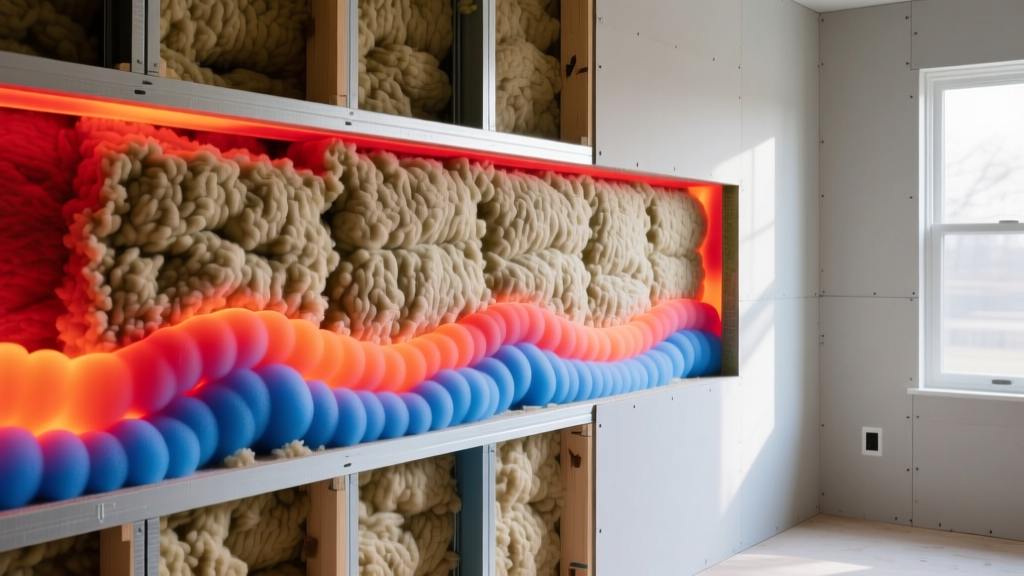
Most contractors and homeowners fixate on a single metric when evaluating building envelopes: R-value. But asking 'what makes a good insulation material' requires looking far beyond laboratory thermal resistance. A material with an impressive R-38 rating will still fail catastrophically if it traps moisture, allows convective heat loss, or off-gasses toxic smoke during a fire. R-value measures conductive heat flow in a controlled 75°F environment, completely ignoring air leakage, thermal bridging, and real-world temperature fluctuations.
Thermal bridging alone can reduce the effective whole-wall R-value of a standard 2x6 framed wall by 15% to 20%. When wood studs (which have an R-value of roughly 1.25 per inch) bypass the cavity insulation, heat escapes regardless of how thick the fiberglass or cellulose is. Therefore, a truly 'good' insulation strategy pairs high-R cavity fill with continuous exterior insulation (like mineral wool or polyiso boards) to break the thermal bridge. According to the U.S. Department of Energy, addressing these bypasses is just as critical as the material selection itself.
The 5 Core Traits of Premium Insulation
To evaluate insulation holistically, building scientists look at five distinct performance pillars. If a material fails in any of these categories, its long-term viability is compromised.
1. Air Impermeability vs. Breathability
Air leakage accounts for up to 40% of a building's heating and cooling losses. Materials like closed-cell spray polyurethane foam (ccSPF) act as both insulation and an air barrier, stopping convective loops. Conversely, 'breathable' materials like fiberglass batts do nothing to stop air movement. As noted by the Building Science Corporation, if you use an air-permeable insulation, you must pair it with a dedicated, continuous air control layer (like fluid-applied membranes or taped sheathing) to prevent moisture-laden indoor air from reaching the dew point inside the wall cavity.
2. Moisture Buffering and Drying Potential
Walls get wet. The mark of a good insulation material is not just how it resists water, but how it allows the assembly to dry. Dense-pack cellulose is highly hygroscopic; it can absorb significant moisture and safely redistribute it, allowing the wall to dry to the interior or exterior. Closed-cell foam, however, is a Class II vapor retarder. If water gets behind it via a roof leak, the foam traps the moisture against the OSB sheathing, leading to rapid rot.
3. Acoustic Attenuation (STC Ratings)
Thermal resistance does not equal soundproofing. Lightweight, porous materials with high thermal R-values (like rigid EPS foam) transmit low-frequency noise easily. For acoustic isolation, mass and density are required. Mineral wool and dense-pack cellulose excel here, disrupting sound waves through their dense, fibrous matrices.
4. Fire Resistance and Smoke Toxicity
In a fire, insulation must either resist ignition or self-extinguish without producing lethal off-gassing. Mineral wool (rock wool) is inherently non-combustible, withstanding temperatures up to 2,150°F (ASTM E119). Standard spray foams, while treated with flame retardants, will eventually melt and produce dense, toxic smoke, requiring a 15-minute thermal barrier (like 1/2-inch drywall) over them in living spaces.
5. Dimensional Stability Over Time
Insulation must maintain its physical footprint for the 50+ year lifespan of the building. Materials that settle, shrink, or compress leave uninsulated gaps at the top of wall cavities or around rim joists, destroying the thermal envelope.
Comprehensive Material Comparison Matrix
The table below breaks down the most common insulation materials across the critical performance metrics discussed above. Costs reflect 2026 national averages for installed residential applications.
| Material Type | R-Value per Inch | Air Sealing Capability | Moisture Risk Profile | Acoustic (STC in 2x4 Wall) | Avg. Installed Cost (per bd ft) |
|---|---|---|---|---|---|
| Closed-Cell SPF (2 lb) | R-6.5 to R-7.0 | Excellent (Air Impermeable) | High (Traps water against sheathing) | 38 - 40 | $1.50 - $2.20 |
| Mineral Wool Batts | R-4.2 to R-4.5 | Poor (Requires air barrier) | Low (Hydrophobic, drains well) | 45 - 50 | $1.10 - $1.60 |
| Dense-Pack Cellulose | R-3.6 to R-3.8 | Moderate (Reduces drafts) | Medium (Buffers moisture, needs drying) | 44 - 48 | $0.85 - $1.25 |
| Fiberglass Batts (High-Density) | R-3.1 to R-3.4 | Poor (Highly air permeable) | Medium (Loses R-value when wet) | 35 - 38 | $0.60 - $0.95 |
| Polyiso Rigid Foam | R-6.0 to R-6.5 | Excellent (When taped/sealed) | Low (Foil-faced acts as vapor barrier) | 30 - 32 | $1.20 - $1.80 |
Real-World Failure Modes and Edge Cases
Even the highest-rated materials fail when installed incorrectly or specified for the wrong assembly. Here are the most common edge cases that compromise insulation performance:
- Cellulose Settling: If cellulose is not dense-packed to a minimum density of 3.0 to 3.5 lbs per cubic foot in wall cavities, it will settle up to 20% over the first three years. This leaves the top plates completely uninsulated. Always require a contractor to use a calibrated blowing machine and verify density via netting deflection tests.
- Fiberglass Compression: Stuffing an R-19 fiberglass batt (designed for a 6.25-inch 2x6 cavity) into a 5.5-inch space to accommodate wiring or plumbing compresses the glass fibers. This reduces the R-value to roughly R-15, as the trapped air pockets—the actual insulators—are squeezed out.
- Spray Foam Shrinkage and Off-Gassing: Closed-cell foam relies on a precise 1:1 chemical mix ratio and specific substrate temperatures (ideally above 60°F). If applied to cold sheathing in late autumn, the foam can delaminate, shrink, and pull away from the studs, creating massive convective air channels.
- Polyiso Thermal Drift: Polyisocyanurate foam uses blowing gases that slowly diffuse out over time, replaced by air. This 'thermal drift' means a board rated at R-6.5 on day one may drop to an aged R-value of R-5.6 over a decade. Always design your envelope using the aged, long-term thermal resistance (LTTR) values provided by the manufacturer.
Climate-Specific Decision Framework
What makes a 'good' material in Miami makes it a liability in Minneapolis. Use this framework based on the IECC Climate Zones to finalize your material selection:
Hot-Humid Climates (Zones 1-3): Prioritize vapor-open cavity insulation (like fiberglass or mineral wool) paired with an exterior air/water-resistive barrier. Avoid interior vapor retarders like closed-cell foam or foil-faced polyiso on the inside of the wall, as they will trap inward-driven solar moisture from the hot exterior, causing mold on the back of the interior drywall.
Mixed Climates (Zones 4-5): The 'Flash and Batt' method is highly effective here. Apply 1.5 to 2 inches of closed-cell spray foam against the interior sheathing to seal air leaks and raise the sheathing temperature above the dew point, then fill the remainder of the cavity with cost-effective fiberglass or mineral wool batts.
Cold Climates (Zones 6-8): Maximize continuous exterior insulation (rigid mineral wool or polyiso) to keep the structural framing warm and prevent interstitial condensation. You can safely use a Class II or III interior vapor retarder (like kraft-faced batts or specific smart membranes) to prevent warm, humid indoor winter air from condensing inside the cold wall cavity.
Final Specification Checklist
Before signing an insulation contract, verify these specific details with your builder:
- Confirm the whole-wall R-value, not just the cavity R-value, accounting for framing factors and thermal bridging.
- Specify the exact air-barrier strategy (e.g., taped Zip system, fluid-applied membrane, or ccSPF) independent of the thermal insulation.
- Require third-party blower door testing post-installation, targeting an air exchange rate (ACH50) of 2.0 or lower for standard code, or 0.6 for Passive House standards.
- Ensure all spray foam installations include a code-compliant thermal or ignition barrier if left exposed in conditioned spaces or basements.
By shifting the evaluation criteria from a single laboratory metric to a holistic view of air, moisture, fire, and acoustic performance, you can select an insulation system that actually performs in the field for the lifetime of the structure.
Written by
Sarah WhitfieldSarah Whitfield is a chartered quantity surveyor (MRICS) and construction cost analyst with 15 years of experience in material pricing, procurement strategy, and project budgeting. She earned her degree in Construction Management from the University of Reading (UK) and has worked on projects ranging from $2M custom homes to $180M mixed-use developments across North America and Europe. Sarah currently leads cost estimating for BuildMat Insight, maintaining a proprietary database of 4,000+ material price points updated quarterly. She is a frequent contributor to RSMeans cost data panels and has presented at the International Cost Engineering Council (ICEC) congress. Based in Denver, CO, Sarah is an avid trail runner and volunteer mentor for Women in Construction.
More from Sarah Whitfield
View all
Wood & Lumber
What Are the Different Types of Wood? A Builder's Guide
Compare structural softwoods, finish hardwoods, and engineered lumber. Analyze Janka ratings, MOE values, and 2026 pricing for construction.
Aug 4, 2026

Walls & Panels
Steel Framing vs Wood Framing: Corrosion and Moisture Defense
Compare steel framing vs wood framing for moisture resistance. Learn about galvanized coatings, condensation risks, and corrosion protection strategies.
Jul 21, 2026

Stone & Masonry
How to Cut Stone Veneer: Wet Saw vs Grinder Comparison
Compare the best tools for cutting stone veneer. We review wet saws, angle grinders, and chop saws to help you achieve clean, chip-free cuts.
Jul 21, 2026