R-Value Performance of Top Materials for Insulation Compared
Compare the effective R-value, thermal drift, and real-world performance of top materials for insulation across different climate zones.

The Physics of Thermal Resistance: Beyond the Lab Label
When selecting materials for insulation, architects and builders frequently rely on the manufacturer's stated R-value. However, this metric is derived from controlled laboratory testing under ASTM C518 standards at a mean temperature of 75°F (24°C). In real-world building assemblies, factors like thermal bridging, wind washing, moisture accumulation, and extreme temperature fluctuations drastically alter thermal resistance. Understanding the delta between "lab R-value" and "effective R-value" is the defining factor in achieving long-term energy efficiency and preventing interstitial condensation.
A standard 2x6 wood-framed wall with R-19 cavity insulation does not perform at R-19. The wooden studs (which have an R-value of roughly 1.25 per inch) act as thermal bridges. Without continuous exterior insulation (ci), the whole-wall effective R-value of a 2x6 assembly drops to approximately R-13.5. Always calculate assembly performance using the PNNL Building America guidelines for whole-wall R-values.
R-Value Matrix: Comparing Materials for Insulation
The following matrix evaluates the leading insulation categories based on installed performance, material properties, and current market pricing for residential and light-commercial applications.
| Material Category | Product Benchmark | Lab R-Value / Inch | Effective R-Value | Vapor Permeability | Est. Cost (per sq ft) |
|---|---|---|---|---|---|
| Closed-Cell Spray Foam (ccSPF) | Demilec Heatlok XT | R-6.5 - R-7.0 | R-6.5 (Maintains) | Class II (at 1.5") | $2.80 - $3.40 |
| Mineral Wool Batts | Rockwool Comfortbatt | R-4.22 | R-4.0 - R-4.2 | Vapor Open | $1.15 - $1.45 |
| Polyisocyanurate (Polyiso) | Hunter Xci 286 | R-6.0 - R-6.5 | R-5.0 (Cold Climate) | Semi-Impermeable | $0.85 - $1.10 |
| Fiberglass Batts (High-Density) | Owens Corning EcoTouch | R-3.1 - R-3.4 | R-2.8 (if compressed) | Vapor Open | $0.65 - $0.85 |
Material Deep Dives: Performance Nuances and Failure Modes
Closed-Cell Spray Polyurethane Foam (ccSPF)
ccSPF provides the highest R-value per inch among widely available materials for insulation, typically yielding R-6.5 to R-7.0. Its primary performance advantage is structural: it adheres directly to substrates and cures into a rigid matrix, increasing the racking strength of shear walls by up to 300%. Furthermore, at a thickness of 1.5 inches, ccSPF qualifies as a Class II vapor retarder, eliminating the need for separate poly sheeting in mixed-humid climates. Failure mode: Improper chemical mixing during installation can result in unreacted isocyanates, leading to persistent off-gassing and shrinkage away from studs, creating convective loops that destroy the assembly's thermal envelope.
Mineral Wool (Stone Wool) Batts
Mineral wool, such as Rockwool Comfortbatt, offers a stable R-4.22 per inch. While slightly lower than spray foam, its real-world performance is exceptionally resilient. Mineral wool is hydrophobic; the binder repels liquid water while remaining vapor-permeable, allowing the wall cavity to dry to the interior or exterior. It is also non-combustible, passing the ASTM E136 standard, making it mandatory in fire-stopping applications and multifamily party walls. Failure mode: Mineral wool is dense and difficult to cut cleanly around electrical boxes and plumbing penetrations. If installers leave gaps rather than meticulously sealing with acoustic fire-stop sealant, thermal bypass occurs.
Polyisocyanurate (Polyiso) Rigid Board
Polyiso is the standard for exterior continuous insulation (ci) due to its high lab-tested R-value of R-6.0 to R-6.5 per inch. However, specifiers must account for thermal drift. The blowing agents trapped in the closed cells of polyiso condense at low temperatures. In climate zones 5 and above, when exterior sheathing temperatures drop below 50°F (10°C), the R-value of polyiso can degrade by 15% to 20%. For cold-climate applications, building scientists recommend pairing polyiso with exterior mineral wool or using EPS (Expanded Polystyrene), which maintains a stable R-3.8 per inch regardless of temperature drops.
The "Effective R-Value" Trap: Real-World Degradation
Specifying materials for insulation based solely on the packaging label leads to underperforming buildings. Three primary mechanisms degrade effective R-value in the field:
- Compression Penalties: Fiberglass relies on trapped air pockets for thermal resistance. Forcing a standard R-13 (3.5-inch) fiberglass batt into a 3-inch wall cavity does not yield R-13 in a thinner profile; it crushes the air pockets, dropping the effective R-value to approximately R-11.
- Wind Washing: In vented attics or rain-screen cavities, unsealed fiberglass or mineral wool allows convective air movement to strip heat from the surface of the insulation. Installing a wind-baffle or housewrap directly against the cavity-side of the insulation is mandatory in high-wind zones.
- Moisture Saturation: Water has a thermal conductivity roughly 25 times greater than still air. If a roof leak or bulk water intrusion saturates cellulose or fiberglass, the R-value effectively drops to near zero, and the material becomes a conduit for heat loss and mold propagation.
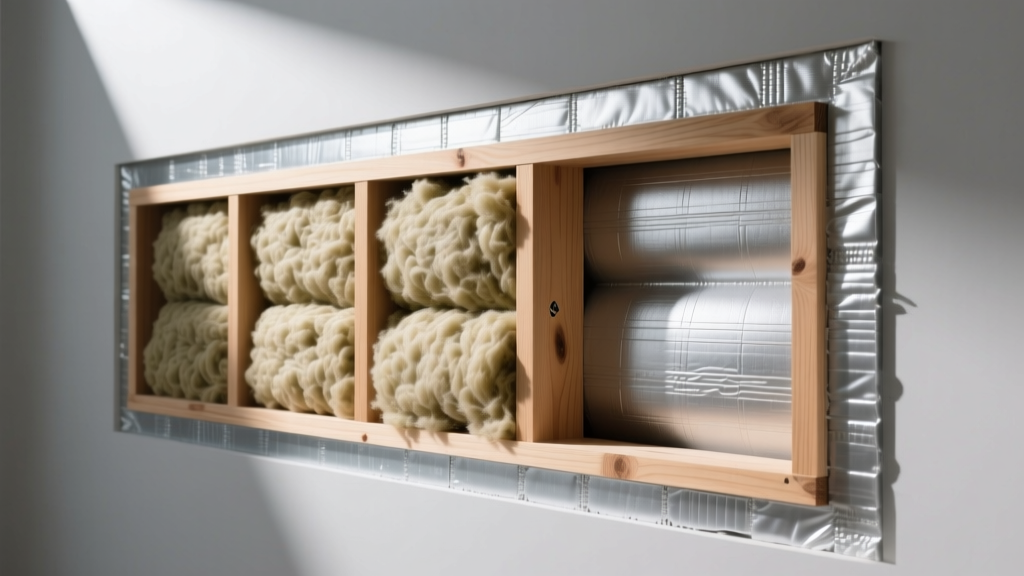
Decision Framework: Selecting by Wall Assembly
Assembly-Specific Selection Guide
- Standard 2x4 Framing (Climate Zones 1-3): Use High-Density Fiberglass (R-15) or standard Mineral Wool (R-15). Cost-effective and meets baseline IECC requirements without exterior ci.
- Standard 2x6 Framing (Climate Zones 4-5): Use Mineral Wool (R-23) in the cavity, supplemented by 1-inch Polyiso (R-5 to R-6) on the exterior sheathing to break thermal bridging and keep the sheathing above the dew point.
- High-Moisture / High-Risk Zones (Bathrooms, Basements): Use 2 to 3 inches of ccSPF. The vapor-impermeable nature of closed-cell foam prevents interior moisture from reaching the cold concrete or exterior sheathing.
- Cold Climate Advanced Framing (Zone 6+): Use a "flash and batt" hybrid. Apply 1.5 inches of ccSPF (R-10) against the exterior sheathing to seal and control vapor, then fill the remainder of the 2x6 cavity with Mineral Wool (R-15) for cost efficiency and acoustic dampening.
Building Code Compliance and Continuous Insulation (ci)
Modern energy codes, including the IECC and ASHRAE 90.1, have aggressively targeted thermal bridging. In Climate Zone 5, prescriptive code paths for wood-framed walls now frequently mandate an assembly of R-20+7.5ci or R-13+10ci. This means cavity insulation alone is no longer legally sufficient for code compliance in much of the northern United States. Specifiers must integrate rigid exterior materials for insulation—such as polyiso, EPS, or exterior mineral wool boards (e.g., Rockwool Comfortboard 80)—directly behind the cladding. When detailing continuous insulation, ensure that the water-resistive barrier (WRB) is integrated correctly; placing the WRB outboard of the ci is generally preferred to protect the rigid foam from bulk water and UV exposure during construction delays.
Written by
David NakamuraDavid Nakamura is a licensed architect (AIA) and construction technology writer focused on sustainable building methods, mass timber engineering, and high-performance building envelopes. He holds a Master of Architecture from the University of Washington and is a certified Passive House Consultant (CPHC). David spent eight years at the Seattle firm Mithun, where he led the design of three LEED Platinum projects, before founding his own practice specializing in net-zero residential design. He serves on the editorial advisory board of GreenBuilder Magazine and has authored peer-reviewed papers on cross-laminated timber (CLT) connections for the Journal of Structural Engineering. In his spare time, David teaches woodworking at Pratt Fine Arts Center and kayaks the Puget Sound.
More from David Nakamura
View all
Construction Cost
Labor Cost to Build a Deck Per Sq Ft: 2026 Installation Guide
Discover the exact labor cost to build a deck per sq ft in 2026. This installation guide breaks down contractor rates, complexity factors, and hidden fees.
Aug 4, 2026

Construction Cost
How Much Does It Cost to Build a 3 Bedroom House? Financing Guide
Learn exactly how much it costs to build a 3 bedroom house and explore 2026 financing options, construction loan types, and budget frameworks for your build.
Aug 4, 2026

Construction Cost
Cost to Build a Tennis Court: 2026 Guide
How much does it cost to build a tennis court in 2026? Breakdowns for asphalt, concrete, and synthetic surfaces plus fencing and lighting.
Jul 30, 2026