What Is the Best Insulation Material? A Climate & Assembly Guide
Discover what is the best insulation material for your home. We compare R-values, costs, and ideal applications across all IECC climate zones for 2026.

The Short Answer: Why a Universal Best Material Does Not Exist
When builders and homeowners ask, "what is the best insulation material?", the most accurate answer is that a single, universally superior product does not exist. The ideal material depends entirely on three variables: your IECC climate zone, the specific building assembly (attic, basement, or wall cavity), and your budget. A material that performs flawlessly in the hot-humid South (Zone 2) can cause catastrophic moisture trapping in the cold Northeast (Zone 6).
Instead of chasing a single "best" product, high-performance building science dictates matching the insulation's thermal resistance (R-value), vapor permeability, and air-sealing capabilities to the assembly's hygrothermal profile. Below, we break down the top four insulation materials used in 2026, their exact costs, and where they belong.
Air Sealing Priority: Closed-Cell Spray Foam (ccSPF)
Fire & Acoustic Priority: Mineral Wool Batts/Boards
Continuous Exterior (CI) Priority: Polyisocyanurate or Mineral Wool
Retrofit & Eco-Friendly Priority: Dense-Pack Cellulose
Best Insulation Materials by Climate Zone (IECC Framework)
The U.S. Department of Energy categorizes the country into eight distinct climate zones. The target R-values and material choices shift dramatically across these borders. For example, using an interior polyethylene vapor retarder with fiberglass batts is standard in Zone 7, but applying that same poly sheet in Zone 4 (Mixed-Humid) will trap summer moisture inside your walls, leading to rot.
| IECC Zone | Climate Type | Wood Wall Target | Recommended Primary Material |
|---|---|---|---|
| Zone 1-2 | Hot-Humid / Hot-Dry | R-13 to R-15 | Open-cell spray foam or unfaced fiberglass + exterior air barrier |
| Zone 3 | Warm-Humid / Marine | R-13 + R-5 CI | Cellulose cavity + Polyiso or Mineral Wool continuous exterior |
| Zone 4-5 | Mixed-Humid / Cool | R-20 or R-13+R-5 CI | Dense-pack cellulose + exterior Mineral Wool (vapor semi-permeable) |
| Zone 6-7 | Cold / Very Cold | R-20+R-5 to R-20+R-10 | ccSPF flash coat + fiberglass, or Mineral Wool with interior smart retarder |
| Zone 8 | Subarctic / Arctic | R-30+ R-15 CI | Thick exterior Polyiso/XPS + dense cavity fill |
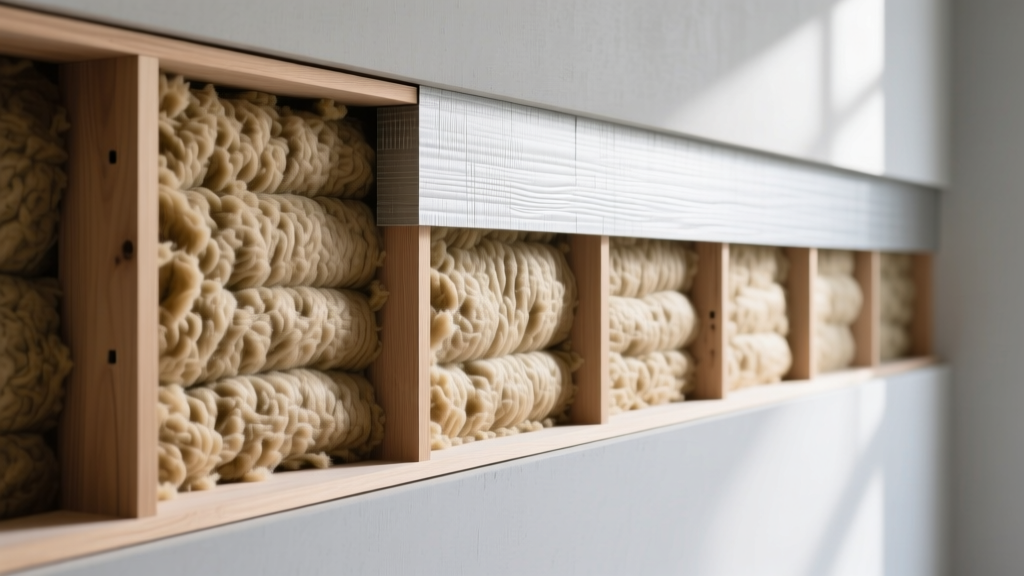
Deep Dive: Top 4 Insulation Materials Compared
To determine what is the best insulation material for your specific project, you must understand the physical properties and real-world costs of the leading options available on the market today.
1. Closed-Cell Spray Polyurethane Foam (ccSPF)
Closed-cell spray foam, such as Icynene ProSeal Eco or Demilec Heatlok XT High Rise, is a two-part polyurethane system that expands to fill cavities and hardens into a rigid, structural matrix.
- R-Value: R-6.5 to R-7.0 per inch.
- 2026 Installed Cost: $1.80 to $2.50 per board foot.
- Best Application: Rim joists, unvented cathedral ceilings, and below-grade concrete walls.
- The Edge Case: ccSPF acts as a Class II vapor retarder at just 1.5 inches thick. If applied to the interior of a brick veneer wall in a cold climate, it can trap moisture in the masonry, causing spalling during freeze-thaw cycles. Always consult Building Science Corporation guidelines for vapor profiles before specifying interior foam.
2. Mineral Wool (Rockwool) Batts and Boards
Manufactured from basalt rock and slag, mineral wool (like ROCKWOOL Comfortbatt and Comfortboard 80) is the premier choice for fire resistance, acoustic dampening, and vapor-permeable continuous insulation (CI).
- R-Value: R-4.2 per inch (batts); R-4.3 per inch (rigid boards).
- 2026 Installed Cost: $1.20 to $1.60 per square foot (material only).
- Best Application: Exterior continuous insulation (CI) over wood sheathing, fire-stopping at floor lines, and interior acoustic partition walls.
- The Edge Case: Mineral wool is heavy and lacks compressive strength compared to XPS. When installing thick layers (e.g., 4 inches of Comfortboard 80) on exterior walls, you must use specialized structural thermal breaks and long, heavy-duty mechanical fasteners (like EJOT or Heco-Therm) to prevent the cladding from sagging over time.
3. Polyisocyanurate (Polyiso) Rigid Boards
Polyiso, such as Owens Corning FOAMULAR NGX (Note: NGX is XPS, Polyiso example is Hunter Panels Thermapor or Carlisle Securock), offers the highest R-value per inch of any rigid board at room temperature. It is faced with foil or fiberglass, giving it excellent radiant reflective properties.
- R-Value: R-6.0 to R-6.5 per inch (at 75°F).
- 2026 Installed Cost: $0.90 to $1.30 per square foot.
- Best Application: Above-sheathing continuous insulation, commercial roof decks, and exterior retrofits.
- The Edge Case: Polyiso suffers from "thermal drift." The blowing agents used in its manufacturing condense at sub-freezing temperatures, causing the R-value to drop by 15% to 20% at 25°F. In Zones 6 and colder, polyiso should be paired with a flash coat of spray foam or a layer of XPS to maintain its rated thermal resistance in deep winter.
4. Dense-Pack Cellulose
Made from recycled newsprint treated with borate for fire and pest resistance, cellulose is blown into wall cavities at high pressure (3.0 to 3.5 lbs per cubic foot) to eliminate convective looping.
- R-Value: R-3.8 to R-4.0 per inch.
- 2026 Installed Cost: $0.75 to $1.10 per square foot.
- Best Application: Existing wall retrofits (drill-and-fill), attic floor blow-in, and new construction netted walls.
- The Edge Case: If the installer fails to achieve the required 3.5 lbs/cu ft density, the cellulose will settle over the first year, leaving uninsulated gaps at the top of the wall cavities. Always require your contractor to provide a density verification chart and use an infrared camera post-installation to verify full coverage.
Assembly-Specific Recommendations for 2026
Knowing what is the best insulation material requires looking at the entire assembly, not just the cavity.
Never install fiberglass batts directly against a below-grade concrete basement wall, and never place a polyethylene vapor barrier on the interior warm side of a basement wall. Concrete is highly porous and constantly wicks ground moisture. If you trap that moisture behind poly and fiberglass, mold is guaranteed. Use 2 inches of XPS or ccSPF directly against the concrete to act as a vapor-impermeable thermal break, then frame your stud wall inward.
Attic Assemblies (Vented vs. Unvented)
For standard vented attics, the most cost-effective and high-performing method is air-sealing the attic floor with caulk and canned foam, followed by blowing in 18 to 24 inches of loose-fill cellulose or fiberglass (R-49 to R-60). For unvented "hot" roofs, ccSPF applied directly to the underside of the roof deck (R-38 minimum) creates a conditioned, semi-exterior attic space that protects HVAC ductwork from extreme temperature swings.
Exterior Wall Assemblies (The "Pencil Test")
The modern standard for high-performance walls is the "flash and batt" or "flash and fill" method. This involves applying 1.5 to 2 inches of ccSPF against the interior side of the wood sheathing to seal all joints and act as a vapor retarder, then filling the remainder of the 2x6 cavity with inexpensive fiberglass or cellulose. This hybrid approach gives you the air-sealing benefits of foam at a fraction of the total cost.
Common Installation Failures and How to Avoid Them
Even the best insulation material will fail if installed incorrectly. Watch out for these three common site errors:
- Compressing Batts: Fiberglass and mineral wool rely on trapped air for their R-value. Stuffing an R-19 batt into a 2x4 wall cavity does not give you R-19; it compresses the material, increasing thermal conductivity and dropping the effective R-value to roughly R-12. Always use the correct thickness for the cavity depth.
- Missing Air Barriers: Insulation is like a wool sweater; it keeps you warm until the wind blows. Without a continuous air barrier (like taped Zip-R sheathing, interior drywall sealed with gaskets, or spray foam), wind washing will strip the heat right out of your batts.
- Recessed Can Lights in Insulated Ceilings: Standard IC-rated recessed lights leak massive amounts of conditioned air into the attic. In 2026, builders should exclusively use surface-mounted LED wafers or build sealed drywall soffits around any penetrations to maintain the thermal boundary.
Frequently Asked Questions
Is spray foam insulation worth the extra cost?
Yes, but primarily in complex geometries (like cathedral ceilings or rim joists) where achieving a perfect air seal with batts is nearly impossible. For simple, flat attic floors or standard 2x6 walls, dense-pack cellulose combined with an exterior air barrier provides a better return on investment.
What is the best eco-friendly insulation material?
Dense-pack cellulose and mineral wool are the top contenders. Cellulose is composed of up to 85% recycled post-consumer paper and requires very little embodied energy to manufacture. Mineral wool is made from abundant basalt rock and recycled steel slag, and both materials are completely free of HFC blowing agents that contribute to global warming.
Can I mix different types of insulation in the same wall?
Yes, hybrid assemblies are highly recommended. A common and effective mix is using closed-cell spray foam on the exterior sheathing for air/vapor control, combined with mineral wool or cellulose in the interior cavity for bulk thermal resistance. Just ensure you calculate the dew point correctly so moisture does not condense at the intersection of the two materials.
Written by
Elena RodriguezElena Rodriguez is a civil engineer and technical writer specializing in concrete technology, masonry systems, and ASTM/ACI compliance. She earned her B.S. in Civil Engineering from Texas A&M University and spent a decade at a materials testing laboratory, performing over 2,000 concrete compressive strength tests and masonry prism evaluations. Elena is an ACI-certified Field Testing Technician (Grade I) and a member of ASTM Committee C12 on Natural Building Stone. She currently consults on forensic engineering cases involving concrete failures and moisture intrusion. Based in San Antonio, TX, Elena is a proud member of the Society of Women Engineers (SWE) and coaches her daughter's FIRST Robotics team.
More from Elena Rodriguez
View all
Walls & Panels
Cost Analysis: Light Gauge Steel Framing Advantages and Disadvantages
Evaluate light gauge steel framing advantages and disadvantages through a strict cost analysis lens, comparing material, labor, and lifecycle expenses.
Aug 4, 2026

Walls & Panels
Gypsum Board Types: Exact Specifications, Thickness & Dimensions
Compare standard, Type X, and moisture-resistant gypsum board types. Get exact specifications, thicknesses, dimensions, and ASTM standards for your project.
Aug 4, 2026

Fire Resistance
Best Fire-Resistant Outdoor Decking Materials: 2026 Buyer Guide
Discover the best fire-resistant outdoor decking materials for 2026. Compare Class A PVC, aluminum, and hardwood options for WUI compliance and safety.
Aug 4, 2026