R13 Insulation Brand Deep Dive: Owens Corning vs Rockwool
Compare Owens Corning R-13 fiberglass and Rockwool mineral wool batts. Expert specs, 2026 pricing, IECC code compliance, and installation failure modes.
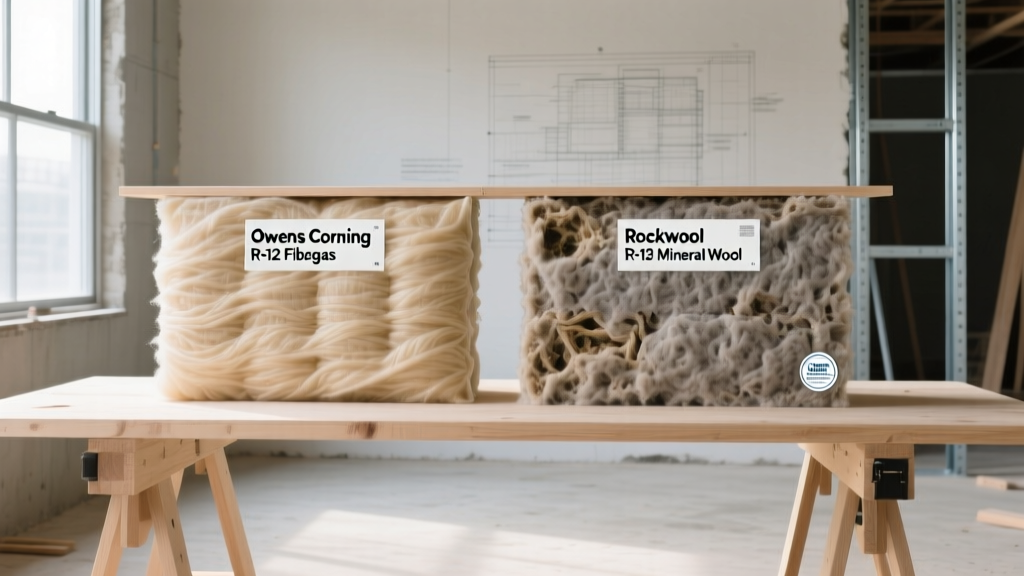
The R-13 Cavity: What It Actually Means in 2026
When architects and framers specify a 2x4 exterior wall assembly, the default cavity fill has historically been R13 insulation. Physically, an R-13 batt measures exactly 3.5 inches thick, designed to fit flush within a standard 2x4 stud bay (which is actually 3.5 inches deep). However, as building science has evolved and energy codes have tightened, the "R-13 cavity" has become a battleground between traditional fiberglass manufacturers and high-density mineral wool producers.
Choosing the right brand for this specific 3.5-inch depth is no longer just about the R-value printed on the bag. It is about density, acoustic dampening, moisture management, and friction-fit mechanics. In this deep dive, we analyze the two dominant product lines for 2x4 wall cavities: Owens Corning EcoTouch Fiberglass and Rockwool Comfortbatt Mineral Wool, breaking down exact specifications, 2026 market pricing, and critical installation failure modes.
Brand Deep Dive: Owens Corning EcoTouch R-13 Fiberglass
Owens Corning’s EcoTouch line remains the most ubiquitous fiberglass batt on the market. For 2x4 walls, the standard product is the EcoTouch Kraft-Faced R-13 Fiberglass Batt. Manufactured with up to 73% recycled content (primarily post-consumer glass), this product relies on trapped air within spun glass fibers to achieve its thermal resistance.
Product Specs & Pricing
- Dimensions: 3.5" thick x 15" wide x 93" long (designed for 16" on-center stud spacing).
- Density: Approximately 0.7 lbs per cubic foot.
- Facing: Kraft paper (Asphalt-laminated), which serves as a Class I vapor retarder (perm rating < 1.0).
- 2026 Pricing: $0.65 to $0.85 per square foot, depending on regional distributor volume.
The primary advantage of the EcoTouch line is cost-efficiency and widespread availability. However, its low density means it offers minimal acoustic isolation (STC rating of roughly 39 for a standard 2x4 wall) and is highly susceptible to convective heat loss if air sealing is not perfectly executed behind the drywall. According to the North American Insulation Manufacturers Association (NAIMA), fiberglass performance is entirely dependent on a Grade I installation, meaning zero gaps, compressions, or misalignments.
Brand Deep Dive: Rockwool Comfortbatt (The Mineral Wool Upgrade)
Rockwool (formerly Roxul) approaches the 2x4 cavity with a fundamentally different material: stone wool. While they do not sell a product explicitly labeled "R-13," their Comfortbatt 3.5-inch product is engineered specifically for 2x4 stud bays and achieves an R-15 rating. This higher thermal resistance in the exact same 3.5-inch physical footprint makes it the direct, albeit premium, competitor to standard R-13 fiberglass.
The "R-15 in an R-13 Space" Advantage
Rockwool achieves R-15 by increasing the density of the batt to roughly 2.5 lbs per cubic foot—more than three times the density of standard fiberglass. This density provides structural rigidity, allowing the batt to stand upright in the wall cavity before drywall is installed, and offers superior resistance to convective air loops within the cavity.
- Dimensions: 3.5" thick x 15.25" wide x 47" long.
- Facing: Unfaced. (Requires a separate polyethylene sheet or vapor-retarding primer in cold climates).
- Fire & Acoustics: ASTM E84 Class A fire rating (non-combustible up to 2,150°F); NRC (Noise Reduction Coefficient) of 0.95+.
- 2026 Pricing: $1.15 to $1.40 per square foot.
"The slight width oversizing of Rockwool Comfortbatt (15.25 inches for a 14.5-inch stud cavity) creates an aggressive friction fit that eliminates the need for stapling, drastically reducing the installer error associated with sagging batts."
Head-to-Head Comparison Matrix
| Feature | Owens Corning EcoTouch R-13 | Rockwool Comfortbatt R-15 |
|---|---|---|
| Material | Fiberglass (Spun Glass) | Mineral Wool (Basalt/Slag) |
| Cavity R-Value | R-13 | R-15 |
| Density | ~0.7 lbs/cu ft | ~2.5 lbs/cu ft |
| Vapor Retarder | Integrated Kraft (Class I) | None (Requires separate membrane) |
| Soundproofing (STC) | Moderate (~39 STC) | High (~45+ STC) |
| Avg. Cost (2026) | $0.75 / sq. ft. | $1.25 / sq. ft. |
Critical Installation Failure Modes
Regardless of whether you specify fiberglass or mineral wool, the 3.5-inch cavity is unforgiving of poor workmanship. The U.S. Department of Energy notes that a 4% gap in insulation coverage can reduce the effective R-value of a wall assembly by up to 50%. Here are the most common failure modes specific to these product lines:
Installers frequently encounter plumbing lines or electrical junction boxes and attempt to compress R-13 fiberglass behind them. Compressing a 3.5-inch batt into a 2-inch space does not yield R-13 in a smaller package; it destroys the trapped air pockets, dropping the localized R-value to roughly R-7. Fix: Split the batt, routing one half behind the pipe and one half in front, maintaining total cavity depth.
Owens Corning EcoTouch Kraft-faced batts act as a vapor retarder. In cold climates (Zones 5+), the kraft paper MUST face the interior (warm-in-winter side). In hot, humid climates (Zones 1-3), interior vapor barriers can trap moisture inside the wall cavity, leading to mold and sheathing rot. Fix: In southern climates, specify unfaced R-13 batts and rely on exterior continuous insulation or vapor-permeable house wraps for moisture management.
Code Compliance: When R-13 Isn't Enough
As mentioned, the era of the standalone R-13 exterior wall is ending. Under modern building science principles championed by organizations like Building Science Corporation, whole-wall R-value must account for thermal bridging through the wood studs. A 2x4 wood stud has an R-value of roughly R-4.37. Because studs make up about 25% of the wall surface area, the "whole-wall" R-value of an R-13 cavity is actually closer to R-10.5.
To meet 2026 energy targets, building officials increasingly require a "hybrid" approach. If you are using R-13 or R-15 cavity batts, you must pair them with exterior rigid foam (e.g., 1 inch of XPS or polyiso) to break the thermal bridge and manage condensation risks at the sheathing layer.
Final Verdict: Which Brand Should You Specify?
The decision between Owens Corning and Rockwool for 2x4 cavities ultimately hinges on your project's budget, acoustic requirements, and fire-safety mandates.
- Specify Owens Corning EcoTouch R-13 if: You are building in a mild climate zone (Zone 3 or lower), working with a strict material budget, and require an integrated vapor retarder to save on labor costs. It remains the most cost-effective baseline for residential tract building.
- Specify Rockwool Comfortbatt if: You are building custom homes, multi-family dwellings requiring high STC (Sound Transmission Class) ratings between units, or structures in high wildfire-risk areas where non-combustible cavity fills provide critical passive fire protection. The 40% price premium is easily offset by the upgrade to R-15 and the elimination of sagging callbacks.
By understanding the physical density, facing mechanics, and thermal limitations of these specific product lines, contractors and architects can move beyond the generic "R-13" label and specify wall assemblies that perform as intended in the field.