Sound Insulation Materials for Walls: 2026 Cost Analysis & Guide
Compare the cost of sound insulation materials for walls in 2026. Detailed pricing, STC ratings, and ROI for mineral wool, MLV, and decoupling systems.

The True Cost of Silence: 2026 Market Overview
Upgrading interior and exterior walls for acoustic performance requires navigating a complex matrix of material costs, labor rates, and physics. In 2026, the pricing landscape for sound insulation materials for walls has stabilized following the supply chain volatility of the early 2020s, but raw material costs for basalt, fiberglass, and PVC remain elevated. A standard 2x4 wood-framed wall with single-layer 1/2-inch drywall on each side yields a Sound Transmission Class (STC) of roughly 33—adequate for basic privacy, but insufficient for blocking low-frequency noise like bass, HVAC rumble, or street traffic.
To achieve an STC of 50 or higher (the threshold where loud music or speech is inaudible), builders must layer mass, decoupling, and damping. This guide breaks down the exact 2026 material costs, labor multipliers, and acoustic returns for the most effective wall soundproofing assemblies.
Quick Cost Snapshot: 2026 Upgrades
- Basic Cavity Insulation (Mineral Wool): $0.65 – $0.90 per sq. ft. (Adds ~4-6 STC points)
- Mass Loaded Vinyl (1 lb/sq ft): $1.30 – $1.85 per sq. ft. (Adds ~8-12 STC points)
- Decoupling Clips & Hat Channel: $2.10 – $3.50 per sq. ft. (Adds ~10-15 STC points)
- Damping Compound (Green Glue): $1.10 – $1.40 per sq. ft. (Adds ~8-10 STC points)
Material Breakdown: Price vs. Acoustic Performance
Not all insulation addresses the same acoustic frequencies. Porous absorbers handle mid-to-high frequency reverberation, while dense, limp barriers block low-frequency transmission. Below is a comparative matrix of the primary materials used in 2026 wall assemblies.
| Material Type | Specific Product Example | 2026 Cost (per sq. ft.) | Primary Acoustic Function | STC Delta (Improvement) |
|---|---|---|---|---|
| Mineral Wool Batts | Rockwool Safe'n'Sound (2.5") | $0.65 - $0.85 | Cavity Absorption | +4 to +6 |
| Mass Loaded Vinyl | Soundsulate 1 lb MLV | $1.30 - $1.85 | Limp Mass Barrier | +8 to +12 |
| Acoustic Fiberglass | Owens Corning 703 (2") | $2.60 - $3.40 | High-NRC Absorption | +2 to +4 (Transmission) |
| Resilient Channels | USG RC-1 | $0.45 - $0.70 | Decoupling | +6 to +9 |
| Damping Compound | Green Glue Noiseproofing | $1.10 - $1.40 | Viscoelastic Damping | +8 to +10 |
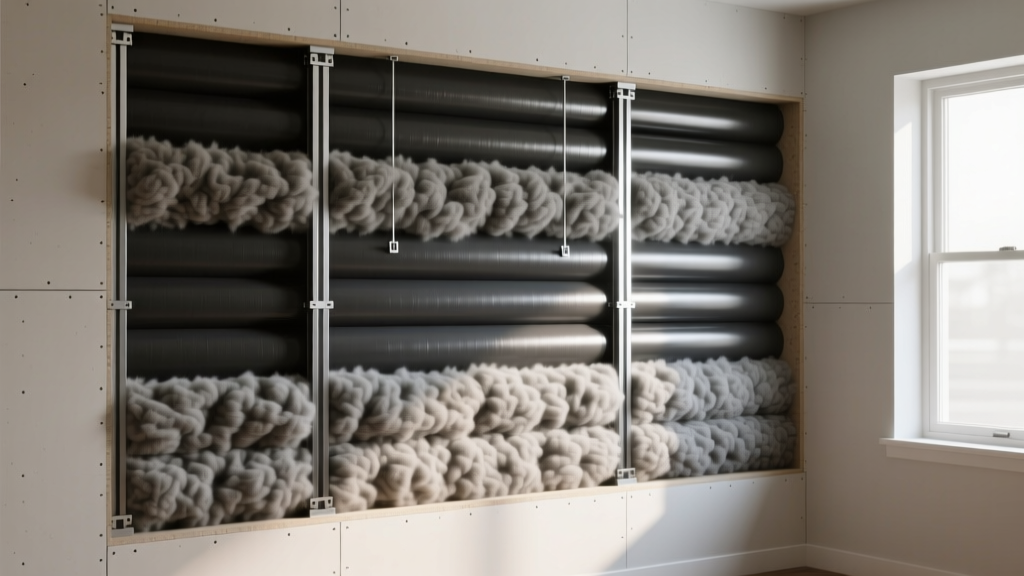
Deep Dive: Core Sound Insulation Materials for Walls
1. Mineral Wool Batts (The Cavity Standard)
Mineral wool remains the baseline requirement for any soundproofed wall cavity. Unlike standard pink fiberglass, which is designed primarily for thermal resistance (R-value), high-density mineral wool like Rockwool Safe'n'Sound is engineered to absorb mid-to-high frequency sound waves bouncing inside the wall cavity, preventing the "drum effect" that amplifies noise.
Cost Reality: Expect to pay between $0.65 and $0.85 per square foot. For a standard 10x12 bedroom wall (120 sq. ft.), cavity insulation will cost roughly $80 to $100 in materials. Installation Edge Case: Mineral wool must be friction-fit with zero gaps. Even a 1/4-inch gap around the perimeter or near electrical boxes will compromise the STC rating by up to 20%. Do not compress the batts to fit; cut them 1/2-inch oversized to ensure a tight seal.
2. Mass Loaded Vinyl (The Low-Frequency Blocker)
Mineral wool cannot stop low-frequency bass or mechanical rumble. For that, you need mass. Mass Loaded Vinyl (MLV) is a dense, flexible PVC material loaded with barium salts. The 1 lb/sq. ft. variant is the industry standard for residential party walls and home theaters.
Cost Reality: A 4x25 foot roll (100 sq. ft.) of 1 lb MLV costs between $130 and $185 in 2026. Failure Mode: MLV only works as a "limp mass" barrier. If you screw it tightly against the drywall or frame it rigidly, it transfers vibration. It must be allowed to hang slightly loose or be decoupled using furring strips. Furthermore, seams must be overlapped by 2 inches and sealed with acoustic caulk ($8-$12 per tube); otherwise, sound will flank through the microscopic gaps.
3. Acoustic Fiberglass Boards (The Studio Choice)
Rigid acoustic fiberglass boards, such as Owens Corning 703, are rarely used inside standard residential wall cavities due to their high cost and rigidity. Instead, they are utilized as surface-mounted acoustic panels or in specialized, high-budget studio wall assemblies where maximum Noise Reduction Coefficient (NRC) is required to eliminate internal reverberation.
Cost Reality: At $2.60 to $3.40 per square foot, it is 3x to 4x more expensive than mineral wool. For standard wall transmission loss, mineral wool provides a better ROI.
The Decoupling Multiplier: Clips vs. Channels
Stuffing a wall with insulation and adding mass is only half the battle. Sound travels structurally through the wooden or metal studs. To achieve an STC above 45, you must break the mechanical connection between the drywall and the framing.
- Resilient Channels (RC): Costing $0.45 to $0.70 per linear foot, RC is the budget-friendly decoupling method. However, it is highly prone to "short-circuiting" during installation. If a drywall screw penetrates the channel and bites into the wood stud behind it, the decoupling is destroyed, and the STC drops back to baseline. RC is best reserved for ceilings or low-budget renovations.
- Isolation Clips and Hat Channel: Systems like WhisperClips or RSIC-1 cost between $2.10 and $3.50 per square foot (including the 25-gauge hat channel). While significantly more expensive than RC, they offer superior low-frequency isolation and are virtually impossible to short-circuit during drywall installation. According to building acoustics guidelines outlined by the National Research Council of Canada, properly decoupled clip systems consistently outperform resilient channels in field-tested STC ratings.
Hidden Costs: Damping, Drywall, and Labor
When budgeting for sound insulation materials for walls, contractors often quote the insulation alone, leaving homeowners blindsided by the assembly costs. A true soundproof wall requires a multi-layered drywall approach.
Warning: The Green Glue Budget Trap
Viscoelastic damping compounds like Green Glue are incredibly effective at converting sound vibration into trace amounts of heat, effectively killing resonance between two layers of drywall. However, the coverage rate is strictly 2 tubes per 4x8 sheet of drywall. At $9 to $11 per tube in 2026, damping compound alone adds $0.55 to $0.70 per square foot. You must also factor in the cost of the second layer of 5/8-inch drywall ($0.50/sq. ft.) and the specialized acoustic sealant required for the perimeter.
Labor Rates and Installation Time
Soundproofing is labor-intensive. While a standard drywall crew can hang 40 sheets a day, a soundproof assembly requires meticulous sealing, MLV overlapping, and careful screw depth management to avoid piercing decoupling channels. Expect labor rates for specialized acoustic installers to range from $65 to $95 per hour in major metropolitan areas in 2026. A standard 10x12 room wall that takes 2 hours to insulate conventionally will take 6 to 8 hours to properly soundproof with MLV, clips, and double-drywall.
Addressing Flanking Paths: Where Budgets Fail
The most expensive sound insulation materials for walls will fail entirely if flanking paths are ignored. Sound behaves like water; it will find the path of least resistance. The Gypsum Association emphasizes in their design manuals that structural penetrations are the primary cause of acoustic failure in rated assemblies.
- Electrical Boxes: Never place electrical outlets back-to-back on opposite sides of a soundproofed stud bay. If unavoidable, wrap each box in a specialized acoustic putty pad ($4 to $6 per pad) to maintain the mass barrier.
- HVAC Ductwork: If a wall cavity houses a return air duct, sound will travel freely through the metal. Line ducts with acoustic duct liner or install baffles.
- Top and Bottom Plates: The gap between the drywall and the floor/ceiling must be sealed with non-hardening acoustic caulk. Standard latex painter's caulk will crack and open over time, creating a massive acoustic leak.
Strategic Sourcing and 2026 ROI
Purchasing sound insulation materials directly from big-box home improvement centers often results in paying a 20% to 30% premium on items like MLV and isolation clips. For whole-home projects or dedicated home theater builds, source materials directly from specialized acoustic distributors or regional building supply yards that carry commercial framing and drywall inventory. Buying 25-gauge hat channel and isolation clips in bulk pallets can reduce decoupling costs by up to 15%.
Ultimately, the decision on how much to spend on sound insulation materials for walls hinges on the room's purpose. For a home office requiring basic speech privacy, a $1.50/sq. ft. upgrade (mineral wool + resilient channel) is highly cost-effective. For a bedroom bordering a noisy street or a dedicated media room, investing the $7.00+ per square foot for a fully decoupled, damped, and mass-loaded assembly is the only way to achieve true acoustic isolation in modern wood-framed construction.
Written by
James ThorntonJames Thornton is a construction industry veteran with 25 years of hands-on experience in wood framing, lumber grading, and residential building codes. He started as a framing carpenter in rural Oregon, earned his ICC Residential Building Inspector certification, and eventually became a senior plan reviewer for the City of Portland Bureau of Development Services. James holds a B.S. in Wood Science & Technology from Oregon State University and is a certified lumber grader through the West Coast Lumber Inspection Bureau (WCLIB). He has inspected over 3,000 residential construction sites and authored the city's internal guide on advanced framing techniques (2x6 at 24" O.C.). James lives in Bend, OR, where he builds custom timber-frame cabins and competes in lumberjack sports.
More from James Thornton
View all
Insulation
Best Home Insulation Materials: Complete 2026 Guide
Compare top home insulation materials for 2026. Find R-values, installed costs per square foot, and best uses for fiberglass, spray foam, and mineral wool.
Aug 4, 2026

Sustainable Building
Certify Your Green Building Material for LEED and WELL
Step-by-step guide to certifying a green building material for LEED v5 and WELL v2. Master EPDs, HPDs, and VOC limits for 2026 project specifications.
Aug 4, 2026

Stone & Masonry
Veneer Stacked Stone Panels: Interior Design & Style Showcase
Discover how veneer stacked stone panels transform interiors. Explore modern design profiles, material pairings, and technical installation specs.
Aug 4, 2026