Best House Insulation Materials for Maximum Energy Efficiency
Compare top house insulation materials for energy efficiency. Explore R-values, costs, and ideal applications for spray foam, mineral wool, and rigid boards.

The Physics of Thermal Resistance: Beyond Basic R-Values
Selecting the right house insulation materials requires moving past the simplistic metric of center-of-cavity R-value. In modern building science, thermal resistance is only one component of a high-performance enclosure. Air leakage accounts for up to 40% of a building's energy loss, meaning an insulation material's ability to act as an air barrier is often more critical than its raw R-value per inch. Furthermore, thermal bridging through wood or steel framing can reduce a wall assembly's effective R-value by 15% to 25%. According to the Building Science Corporation, achieving maximum energy efficiency mandates a 'Perfect Wall' approach, which integrates continuous exterior insulation (ci) to eliminate thermal bridges and manage bulk water, air, vapor, and thermal control layers in a specific, climate-dependent order.
Comprehensive Matrix: Top House Insulation Materials Compared
The following matrix evaluates the primary insulation categories based on 2026 market data, focusing on their thermodynamic properties and installation characteristics.
| Material Type | R-Value / Inch | Material Cost (per sq ft) | Air Sealing | Vapor Permeability |
|---|---|---|---|---|
| Closed-Cell Spray Foam (ccSPF) | R-6.5 to R-7.0 | $1.50 - $2.50 | Excellent (Air Barrier) | Impermeable (Class I) |
| Mineral Wool Batts (e.g., Rockwool) | R-4.2 to R-4.3 | $0.90 - $1.20 | Poor (Requires Membrane) | Highly Permeable |
| Polyisocyanurate Rigid Board | R-6.0 (Derated in cold) | $0.80 - $1.10 | Good (When Taped) | Impermeable (Foil-faced) |
| Dense-Pack Cellulose | R-3.5 to R-3.8 | $0.40 - $0.60 | Fair (Reduces Drafts) | Highly Permeable |
| Open-Cell Spray Foam (ocSPF) | R-3.5 to R-3.7 | $0.60 - $0.90 | Excellent (Air Barrier) | Permeable (Class III) |
Deep Dive: Selecting the Right Material by Climate Zone
The U.S. Department of Energy categorizes the country into distinct climate zones, each requiring a specific hygrothermal strategy. Installing the wrong house insulation materials for your zone will lead to condensation, mold, and structural rot.
Cold Climates (Zones 5-8): Keeping the Sheathing Warm
In heating-dominated climates, the primary risk is warm, moisture-laden interior air migrating outward and condensing on the cold exterior sheathing. To prevent this, the sheathing must be kept above the dew point. This requires a high ratio of exterior continuous insulation (ci) to cavity insulation. Closed-cell spray foam (ccSPF) applied to the interior acts as both an insulator and a Class I vapor retarder, making it highly effective. Alternatively, using exterior mineral wool boards (like Rockwool Comfortboard 80) over the sheathing provides excellent thermal resistance while remaining vapor-open, allowing any trapped moisture to dry outward.
Mixed Climates (Zones 3-4): The Drying Potential Dilemma
Mixed climates experience both significant heating and cooling seasons. Walls here must be able to dry in both directions (inward during summer, outward during winter). Impermeable materials like foil-faced polyiso or interior ccSPF can trap moisture if a leak occurs. The optimal strategy is dense-pack cellulose in the cavities combined with a semi-permeable exterior insulation, such as unfaced expanded polystyrene (EPS) or specialized vapor-variable membranes. This assembly provides robust thermal performance while maintaining bidirectional drying capacity.
Hot-Humid Climates (Zones 1-2): Stopping Exterior Moisture
In cooling-dominated, humid environments, the vapor drive is reversed. Hot, humid outdoor air enters the wall cavity and condenses on the cool interior drywall (which is chilled by the air conditioning). Here, you must use an exterior impermeable barrier. Foil-faced polyisocyanurate rigid boards are the premier choice. The foil facing acts as a Class I vapor retarder on the exterior, blocking humid air from entering the assembly, while the high R-value per inch maximizes energy efficiency without adding excessive wall thickness.
Real-World Cost Breakdown: Material vs. Installed Pricing
When budgeting for energy-efficient house insulation materials, material costs represent only a fraction of the total expense. Labor, specialized equipment (like blowing machines or spray rigs), and preparation work drastically alter the final price. Below are the average installed costs per square foot of wall area for a standard 2x6 framed home in 2026:
- Fiberglass Batts (Standard): $1.50 - $2.00 per sq. ft. (Lowest upfront cost, but highest long-term energy loss due to thermal bridging and air leakage).
- Dense-Pack Cellulose: $2.20 - $3.00 per sq. ft. (Requires netting and specialized blowing equipment; excellent ROI for retrofit and new build cavities).
- Mineral Wool Batts: $2.80 - $3.80 per sq. ft. (Higher material cost and requires more labor to cut and fit tightly around electrical boxes).
- Open-Cell Spray Foam: $2.50 - $3.50 per sq. ft. (Fast installation, superior air sealing, but requires a separate vapor retarder in cold climates).
- Closed-Cell Spray Foam: $4.50 - $6.50 per sq. ft. (Premium pricing due to chemical costs and certified installer requirements; provides structural racking strength).
- Exterior Continuous Polyiso (2-inch): $3.00 - $4.50 per sq. ft. (Includes material, furring strips for siding attachment, and specialized taping for air sealing).
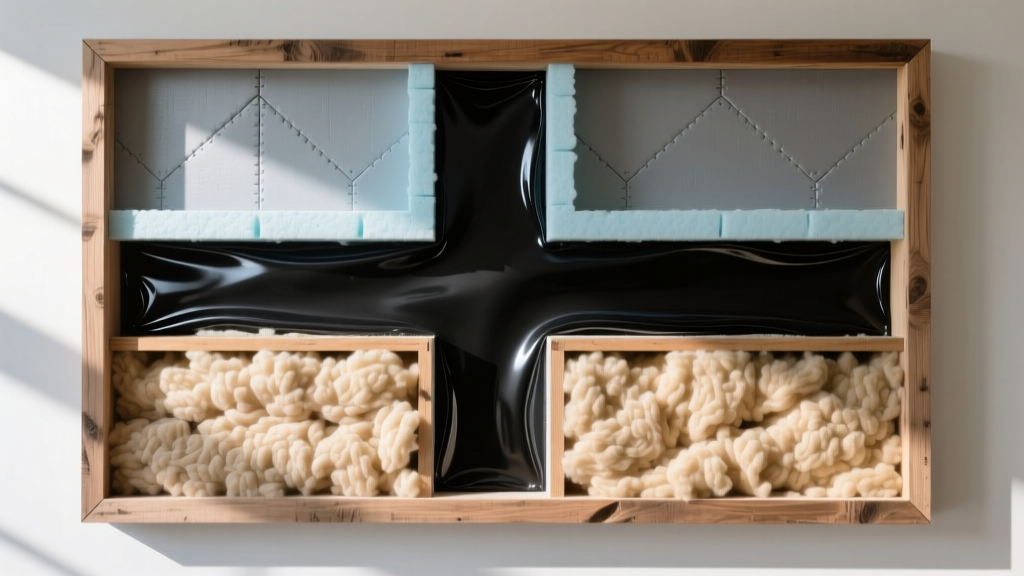
Critical Failure Modes and How to Avoid Them
Even the most expensive house insulation materials will fail if the assembly physics are ignored. Avoid these three common, catastrophic installation errors:
- The Interior Vapor Trap in Brick Veneer: Applying closed-cell spray foam to the interior side of a masonry or brick veneer wall in a cold climate is a major failure mode. Brick absorbs rainwater and needs to dry inward. ccSPF blocks this drying path, trapping moisture against the brick and causing severe spalling and freeze-thaw damage. Fix: Use a ventilated air gap and vapor-permeable cavity insulation like mineral wool.
- Unsealed Rigid Board Joints: Rigid foam boards only act as an air barrier if the seams are perfectly sealed. Using standard duct tape will fail within a year due to UV degradation and temperature fluctuations. Fix: Use manufacturer-specific acrylic tapes (like Zip System tape or 3M All Weather Flashing Tape) and seal the perimeter of the foam to the foundation and roof framing with fluid-applied sealants or canned spray foam.
- Compression of Batts: Forcing an R-19 fiberglass batt into a 2x4 cavity (which is only 3.5 inches deep) does not yield R-19. The R-value is a function of thickness and trapped air. Compressing the batt increases its density but reduces its overall thermal resistance, dropping its performance to roughly R-13 while eliminating its ability to fill minor gaps. Fix: Always match the batt thickness to the cavity depth, or switch to high-density R-15 batts designed specifically for 2x4 framing.
Actionable Decision Framework
To finalize your selection, follow this sequential framework aligned with ENERGY STAR certification protocols:
- Identify your IECC Climate Zone: Determine your local code requirements for continuous insulation (ci) ratios. If you are in Zone 5+, plan for a minimum of R-7.5 to R-10 of exterior continuous insulation.
- Establish the Air Barrier Strategy: Decide whether your air barrier will be the interior drywall (sealed with airtight drywall approach), the exterior sheathing (taped seams), or the insulation itself (spray foam). You only need one primary, continuous air barrier.
- Run a WUFI or Dew Point Calculation: Use hygrothermal modeling software to ensure your chosen ratio of cavity-to-exterior insulation keeps the condensing surface above the dew point during the coldest week of the year.
- Select the Cavity Fill: If budget allows, default to dense-pack cellulose or mineral wool for cavities due to their superior acoustic dampening, fire resistance, and vapor permeability compared to standard fiberglass.
Written by
David NakamuraDavid Nakamura is a licensed architect (AIA) and construction technology writer focused on sustainable building methods, mass timber engineering, and high-performance building envelopes. He holds a Master of Architecture from the University of Washington and is a certified Passive House Consultant (CPHC). David spent eight years at the Seattle firm Mithun, where he led the design of three LEED Platinum projects, before founding his own practice specializing in net-zero residential design. He serves on the editorial advisory board of GreenBuilder Magazine and has authored peer-reviewed papers on cross-laminated timber (CLT) connections for the Journal of Structural Engineering. In his spare time, David teaches woodworking at Pratt Fine Arts Center and kayaks the Puget Sound.
More from David Nakamura
View all
Construction Cost
Labor Cost to Build a Deck Per Sq Ft: 2026 Installation Guide
Discover the exact labor cost to build a deck per sq ft in 2026. This installation guide breaks down contractor rates, complexity factors, and hidden fees.
Aug 4, 2026

Construction Cost
How Much Does It Cost to Build a 3 Bedroom House? Financing Guide
Learn exactly how much it costs to build a 3 bedroom house and explore 2026 financing options, construction loan types, and budget frameworks for your build.
Aug 4, 2026

Construction Cost
Cost to Build a Tennis Court: 2026 Guide
How much does it cost to build a tennis court in 2026? Breakdowns for asphalt, concrete, and synthetic surfaces plus fencing and lighting.
Jul 30, 2026