Best Insulation Materials for Soundproofing Walls & Floors
Discover the best insulation materials for soundproofing walls and floors. Compare STC ratings, costs, and installation methods for optimal acoustic control.

The Physics of Sound Control: Airborne vs. Impact Noise
Selecting the best insulation materials for acoustic control requires understanding how sound travels through building assemblies. Sound transmission is categorized into two distinct metrics: Sound Transmission Class (STC) for airborne noise (voices, television, traffic) and Impact Insulation Class (IIC) for structure-borne impact noise (footsteps, dropped objects). According to the Architectural Record, a standard uninsulated 2x4 wall with single-layer drywall yields an STC of roughly 33, allowing normal speech to be easily understood through the partition. Upgrading to an STC of 50 or higher ensures loud speech is reduced to a faint murmur.
Insulation alone does not block sound; it absorbs acoustic energy within the wall cavity, reducing resonance and the 'drum effect' that amplifies noise. To achieve true soundproofing, insulation must be paired with mass, decoupling, and damping.
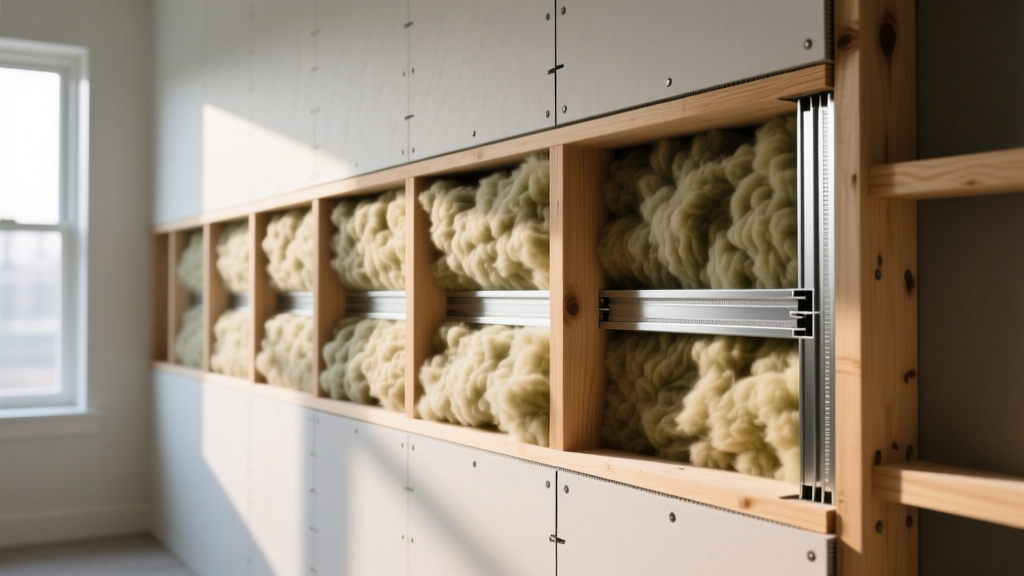
Top-Tier Acoustic Insulation Materials Compared
Not all batts are created equal. Thermal insulation prioritizes trapped air pockets (R-value), while acoustic insulation prioritizes density and fiber friction to convert sound waves into negligible heat energy. Below is a comparative matrix of the leading materials available in 2026.
| Material Type | Specific Product Benchmark | Density (lb/cu ft) | Best Application | Avg. 2026 Cost / Sq Ft |
|---|---|---|---|---|
| Mineral Wool | Rockwool Safe'n'Sound | 2.5 | Interior partitions, home theaters | $1.25 - $1.45 |
| Acoustic Fiberglass | Owens Corning QuietZone | 0.8 - 1.0 | Standard bedroom walls, budget builds | $0.65 - $0.85 |
| Dense-Pack Cellulose | Blown-in recycled paper | 3.0 - 3.5 | Retrofitting existing finished walls | $1.50 - $2.10 (installed) |
| Mass Loaded Vinyl | 1lb or 2lb MLV rolls | N/A (Limp Mass) | Floor underlayments, wrapping pipes | $1.80 - $2.60 |
1. Mineral Wool (The Industry Standard for Acoustics)
Mineral wool, specifically engineered for acoustics like Rockwool Safe'n'Sound, is widely considered the best insulation material for interior soundproofing. Its high density (2.5 lbs per cubic foot) and random fiber orientation create immense internal friction, effectively trapping mid-to-high frequency airborne noise. Unlike fiberglass, mineral wool is non-combustible and hydrophobic, meaning it will not sag or lose acoustic performance if exposed to minor moisture during construction. For a standard 2x4 interior wall framed 16 inches on center, a 3-inch thick batt provides optimal cavity absorption without compressing against the drywall, which would otherwise create a rigid sound bridge.
2. Unfaced Acoustic Fiberglass Batts
Owens Corning QuietZone unfaced fiberglass batts offer a cost-effective alternative to mineral wool. While less dense (approx. 0.8 lbs per cubic foot), they still provide a significant STC boost over empty cavities. The critical rule when using fiberglass for sound control is to never use kraft-faced batts. The paper facing acts as a vapor barrier but also creates a rigid membrane that can reflect certain sound frequencies back into the room. Unfaced batts allow sound waves to penetrate the material where the friction of the glass fibers dissipates the energy.
3. Dense-Pack Cellulose for Retrofits
When tearing down existing drywall is not an option, dense-pack cellulose is the premier choice. Installed by drilling 2-inch holes into the existing drywall and blowing cellulose at 3.0 to 3.5 lbs per cubic foot, it completely fills irregular cavities, blocks flanking paths around plumbing, and adds substantial mass to the wall assembly. The Environmental Protection Agency (EPA) notes that reducing ambient indoor noise is critical for long-term health, making cellulose retrofits a high-ROI solution for existing urban apartments and older homes.
The Decoupling & Damping Imperative
Insulation absorbs cavity resonance, but it cannot stop structural vibration. To maximize the performance of the best insulation materials, you must decouple the drywall from the framing. Install 25-gauge resilient channels spaced 24 inches on center, perpendicular to the studs. Furthermore, apply a viscoelastic damping compound like Green Glue Noiseproofing Compound between two layers of 5/8-inch Type X drywall. Green Glue converts mechanical sound energy into microscopic heat, effectively eliminating low-frequency bass transmission that insulation alone cannot touch.
Real-World Assembly Costs & ROI for Acoustic Upgrades
Budgeting for acoustic control requires looking at the entire wall or floor assembly, not just the insulation batt. Below is a breakdown of complete assembly costs per 100 square feet of surface area, reflecting 2026 material and labor averages.
| Assembly Configuration | Key Components | Est. Cost (per 100 sq ft) | Expected STC Rating |
|---|---|---|---|
| Baseline Builder Grade | Standard R-13 fiberglass, single 1/2" drywall | $180 - $220 | STC 35 - 38 |
| Acoustic Upgrade | Rockwool Safe'n'Sound, single 5/8" Type X drywall | $260 - $310 | STC 45 - 48 |
| Pro Decoupled System | Mineral wool, resilient channels, double 5/8" drywall with Green Glue | $650 - $820 | STC 56 - 62 |
| Floor Impact System | Subfloor, 1lb MLV, acoustic underlayment, engineered hardwood | $450 - $600 | IIC 55 - 60 |
Common Installation Failure Modes & How to Avoid Them
Even the best insulation materials will fail if the installation ignores acoustic weak points. Sound behaves like water; it will exploit the smallest gap or rigid connection. Avoid these critical failure modes:
- Flanking Paths via Electrical Boxes: Back-to-back electrical outlets on a shared wall destroy acoustic isolation. Fix: Stagger outlets on opposite studs. Seal the perimeter of the box with OSI SC-175 Acoustic Sealant and wrap the back of the box with a Putty Pad (intumescent acoustic clay) to restore the mass barrier.
- Compression of Batts: Forcing a 3.5-inch batt into a 2.5-inch cavity increases thermal R-value slightly but destroys acoustic performance by reducing the air space required for sound wave dissipation. Fix: Always match batt thickness to cavity depth, or use 3-inch specific acoustic batts in 2x4 walls to leave a 1/2-inch air gap behind the drywall.
- Rigid Perimeter Connections: Allowing drywall to touch the floor or ceiling creates a direct vibration bridge. Fix: Leave a 1/4-inch gap at the floor and ceiling perimeters, and fill it with non-hardening acoustic sealant before installing baseboards and crown molding. As detailed in guides by Family Handyman, this flexible perimeter is non-negotiable for decoupled rooms.
- Hardwood Floor Impact Noise: Insulation between floor joists stops airborne noise from traveling down, but does nothing for footsteps. Fix: Install a 1/4-inch acoustic mat (like Homasote SoundBuffer) or 1lb MLV directly over the subfloor before laying the finished flooring to improve the IIC rating.
Strategic Decision Framework: Which Material to Choose?
To select the exact right material for your project, apply this decision matrix based on your specific constraints:
- New Construction / Open Studs (Interior Walls): Use Rockwool Safe'n'Sound. The high density and fire resistance provide the best baseline STC improvement for the cost.
- New Construction (Budget Constrained): Use Owens Corning QuietZone unfaced fiberglass. It outperforms empty cavities and standard thermal batts while keeping material costs under $0.80 per square foot.
- Existing Finished Walls (No Demolition): Use Dense-pack cellulose. It is the only viable method to add mass and cavity absorption without removing drywall.
- Floor/Ceiling Assemblies (Multi-Family): Combine Mineral wool in the joist bays with Mass Loaded Vinyl (MLV) under the subfloor to tackle both airborne (STC) and impact (IIC) requirements simultaneously.
By pairing the correct density of insulation with proper decoupling techniques and rigorous sealing of flanking paths, you can achieve studio-grade acoustic isolation in standard residential and commercial framing.
Written by
Marcus ChenMarcus Chen is a licensed structural engineer (PE) and building materials analyst with over 12 years of experience across residential, commercial, and industrial construction. He holds a Master of Science in Civil Engineering from UC Berkeley and spent six years at Thornton Tomasetti before transitioning to independent consulting and technical writing. Marcus specializes in material selection for seismic-prone regions, concrete reinforcement strategies, and lifecycle cost analysis. His work has been cited by the American Concrete Institute (ACI) and the Structural Engineers Association of California (SEAOC). When he is not on a job site or at his desk, you will find him hiking the Sierra Nevada or restoring a 1920s craftsman bungalow in Oakland, CA.
More from Marcus Chen
View all
Construction Cost
How Much Did the Eiffel Tower Cost to Build?
How much did the Eiffel Tower cost to build in 1889? We adjust for inflation and compare its budget to modern skyscraper construction.
Aug 4, 2026

Fire Resistance
What Is a Fire Resistant Material? Testing & Certification Guide
Discover what is a fire resistant material through ASTM and UL testing. Learn how fire ratings, certifications, and assemblies work in construction.
Aug 4, 2026

Construction Cost
How Much Did the Burj Khalifa Cost to Build?
How much did the Burj Khalifa cost to build? We break down the $1.5B project and extract 5 money-saving strategies for your next build.
Jul 30, 2026