Rock Wool Insulation Lifespan: Durability and Failure Analysis
Analyze the lifespan and durability of rock wool insulation. Discover failure modes, moisture resistance, and long-term R-value retention data.
The True Lifespan of Rock Wool Insulation
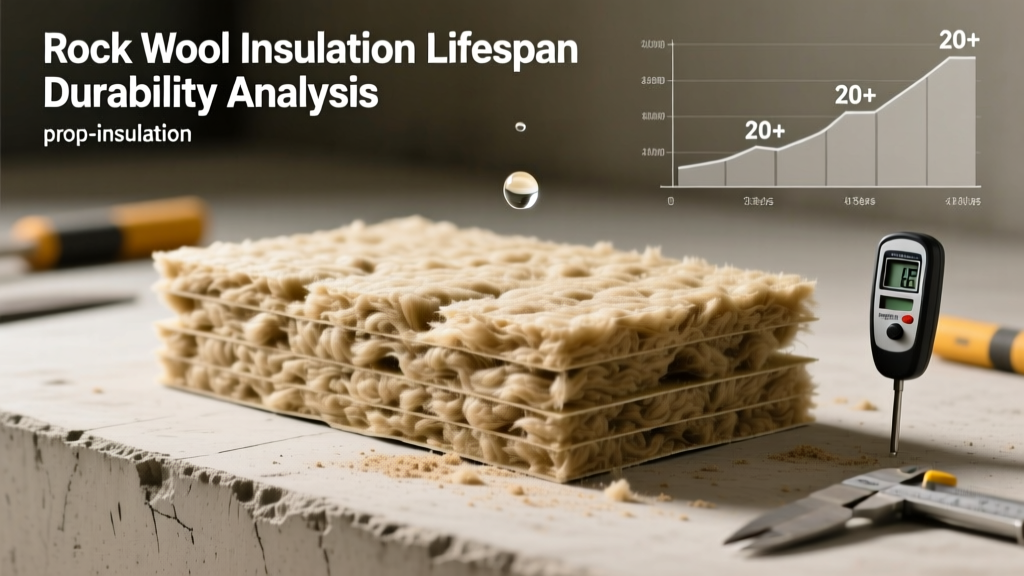
When evaluating building envelope materials, the functional lifespan of the insulation dictates long-term energy performance and structural health. Rock wool insulation (also known as mineral wool or stone wool) possesses an effective lifespan that routinely exceeds 100 years, effectively outlasting the structural framing it occupies. Unlike organic or petroleum-based insulations that degrade via chemical breakdown, UV exposure, or biological consumption, rock wool is an inorganic, vitrified material. However, claiming a 'lifetime' lifespan requires a critical caveat: the material itself does not degrade, but its installed performance can fail catastrophically if subjected to specific environmental and mechanical stressors. This analysis breaks down the material science, real-world failure modes, and long-term data governing rock wool durability.
Material Science: Why Basalt and Slag Do Not Degrade
Rock wool is manufactured by melting basaltic rock and recycled steel slag at temperatures exceeding 3,000°F (1,648°C), then spinning the molten liquid into a dense matrix of interlocking fibers. This vitrification process creates a material with zero nutritional value for mold, mildew, or pests. According to the North American Insulation Manufacturers Association (NAIMA), the inorganic nature of mineral wool renders it inherently immune to the biological degradation that plagues cellulose and some natural fiber insulations.
- Melting Point: > 2,150°F (1,177°C) — Maintains structural integrity during ASTM E119 fire-rated assemblies.
- Density: 2.5 to 8.0 lbs/ft³ — Up to 6x denser than standard fiberglass, preventing gravitational settling.
- Vapor Permeability: ~30 to 50 perms (unfaced) — Allows bidirectional drying, preventing trapped moisture.
- Biological Resistance: ASTM C518 compliant; zero mold food source.
Primary Failure Modes in Real-World Applications
While the basalt fibers will not chemically break down, the insulation system can fail. Understanding these edge cases is critical for architects and builders aiming for a 50+ year building envelope.
1. Mechanical Compression and Rebound Failure
Rock wool relies on a friction-fit installation to maintain its thermal resistance and acoustic dampening. A common failure mode occurs when installers forcefully compress a 5.5-inch R-23 batt into a standard 3.5-inch 2x4 wall cavity to 'make it fit.' Unlike low-density fiberglass, high-density rock wool resists compression. If forced, it exerts continuous outward pressure on the drywall and interior sheathing, potentially causing fastener pops and drywall bowing over time. Furthermore, permanently compressing the batt alters its thermal conductivity, reducing the effective R-value and creating localized thermal bridging.
2. Chronic Moisture Entrapment
Rock wool fibers are naturally hydrophobic (water-repellent), but the voids between the fibers can hold liquid water if subjected to a chronic leak or bulk water intrusion. While the insulation itself will not rot or grow mold, it can act as a sponge, holding water against wooden studs and plates. As noted by the U.S. Environmental Protection Agency (EPA), chronic moisture exposure in wall cavities leads to structural wood rot. Because rock wool is highly vapor-permeable, it dries out rapidly from minor condensation events, but it must be removed and replaced if subjected to unremediated bulk water flooding.
3. UV Degradation During Construction
If rock wool is left exposed to direct sunlight on a job site for extended periods before the exterior cladding or interior drywall is installed, the binder resins can experience superficial UV degradation. This causes the surface fibers to become brittle and slough off. While this does not compromise the core R-value, it degrades the acoustic surface and creates installation irritation.
50-Year Degradation Matrix: Rock Wool vs. Alternatives
To contextualize rock wool's durability, it must be compared against other common cavity insulations over a 50-year lifecycle.
| Material | 50-Year R-Value Retention | Settling / Sagging Risk | Fire Degradation | Moisture Recovery |
|---|---|---|---|---|
| Rock Wool Batts | 100% | None (High Density) | None (Non-combustible) | Excellent (Dries rapidly) |
| Fiberglass Batts | 90-95% (If undisturbed) | High (Loses friction fit) | Melts at ~1,000°F | Poor (Traps water) |
| Closed-Cell Foam | ~95% (Blowing agent shift) | None (Adheres to substrate) | Chars / Off-gasses | N/A (Impermeable) |
| Cellulose (Dense Pack) | 85-90% (Settling over time) | Moderate to High | Chars (Fire retardants) | Very Poor (Holds moisture) |
Long-Term R-Value Retention: The Physics of Permanence
The most significant durability advantage of rock wool is its permanent thermal resistance. According to the U.S. Department of Energy (DOE), mineral fiber insulations derive their R-value entirely from the physical structure of the trapped air within the fiber matrix. Unlike extruded polystyrene (XPS) or polyisocyanurate (Polyiso) rigid foams, which rely on high-R-value chemical blowing agents that slowly diffuse out of the foam over 10 to 20 years (a process known as thermal drift), rock wool contains no blowing agents. The R-value you measure on day one is the exact R-value you will measure in year 50, provided the batt has not been physically crushed or saturated with water.
Acoustic Durability: Maintaining STC Ratings Over Time
In interior partition walls, acoustic insulation durability is frequently overlooked. Standard fiberglass batts often sag within wall cavities after a decade due to gravity and thermal cycling, creating empty air gaps at the top of the stud bay. These gaps act as acoustic flanking paths, severely degrading the wall's Sound Transmission Class (STC) rating.
Rock wool products engineered for acoustics, such as Rockwool Safe'n'Sound, are manufactured at a higher density (typically around 2.5 lbs/ft³) with a stiffer fiber matrix. This density creates a robust friction-fit against the wooden or steel studs. The material does not sag, ensuring that an interior wall designed for an STC 45 or STC 50 rating will maintain that acoustic isolation for the life of the building without requiring retrofitting.
Installation Protocols for Maximum Lifespan
To ensure rock wool insulation achieves its theoretical century-long lifespan, building professionals must adhere to strict installation parameters:
- Friction Fit Tolerances: Cut batts exactly 1 inch wider than the cavity opening (e.g., cut a 16-inch wide batt for a 15-inch on-center stud bay). Do not leave gaps at the edges, and do not compress the material to force it into undersized cavities.
- Vapor Retarder Strategy: Because unfaced rock wool is highly vapor-permeable, it is ideal for 'flash-and-batt' assemblies or walls utilizing exterior continuous mineral wool. Avoid trapping unfaced rock wool between an interior Class I vapor retarder (polyethylene) and an exterior foil-faced foam, as this prevents bidirectional drying and guarantees condensation-induced wood rot.
- Site Storage: Store pallets indoors or under heavy-duty, opaque tarps. While the material will not be ruined by a single rainstorm, prolonged UV exposure and chronic wetting will degrade the packaging and compromise the binder resins on the outer layers of the batts.
- Electrical Box Sealing: Rock wool cannot be easily stuffed into small gaps around electrical boxes without losing its structural integrity. Use mineral wool-specific acoustic sealants or pre-formed gaskets to maintain the continuous thermal and acoustic barrier around penetrations.
Final Verdict on Longevity
Rock wool insulation represents one of the most durable, chemically stable, and thermally permanent insulation materials available in modern construction. Its immunity to thermal drift, biological consumption, and gravitational settling makes it the superior choice for high-performance building envelopes where a 50-to-100-year lifecycle is expected. By avoiding mechanical compression during installation and designing wall assemblies that allow for adequate vapor diffusion, builders can leverage rock wool to create structures that remain energy-efficient, fire-resilient, and acoustically isolated for generations.