Ship Insulation Lifespan: Marine Durability and Degradation Analysis
Analyze the lifespan and failure modes of ship insulation. Compare marine mineral wool, aerogel, and elastomeric foam for vessel durability.
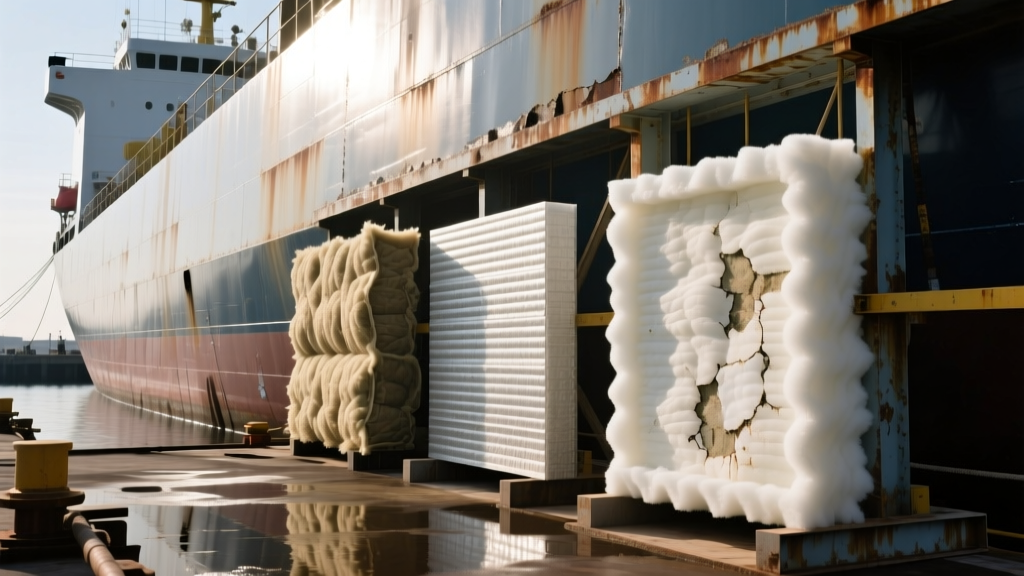
The Unique Degradation Environment of Marine Vessels
Specifying insulation for land-based commercial buildings is fundamentally different from engineering thermal and acoustic barriers for maritime vessels. Ship insulation operates in one of the most aggressively destructive environments on earth. Materials must endure continuous 60-120 Hz engine vibrations, high-salinity humidity, extreme thermal cycling from sub-zero LNG cargo holds to 600°C exhaust stacks, and strict International Maritime Organization (IMO) fire safety mandates.
When ship insulation fails, the consequences extend beyond energy loss. Degraded insulation leads to Corrosion Under Insulation (CUI) on critical structural bulkheads, acoustic fatigue in crew accommodation zones, and catastrophic fire propagation risks. As of 2026, the maritime industry is increasingly shifting away from traditional organic-faced materials toward hydrophobic, vibration-resistant systems to extend dry-dock maintenance intervals from 2.5 years to 5 years.
Marine Insulation Degradation Matrix
The operational lifespan of ship insulation is dictated by its chemical composition and physical structure. The following matrix compares the four primary marine insulation materials based on real-world degradation metrics.
| Material Type | Expected Lifespan | Vibration Resistance | Moisture Tolerance | Primary Failure Mode |
|---|---|---|---|---|
| Marine Mineral Wool (e.g., SeaRox) | 15–25 Years | High | Poor (Hydrophilic) | CUI, binder degradation, compression set |
| Aerogel Blankets (e.g., Pyrogel XT-E) | 30+ Years | Moderate | Excellent (Hydrophobic) | Mechanical tearing if improperly jacketed |
| Closed-Cell Elastomeric (e.g., Armaflex) | 10–15 Years | Low | Good | UV/Ozone cracking, adhesive delamination |
| Calcium Silicate | 20–30 Years | Very Poor | Moderate | Brittle fracture, vibration-induced dusting |
Critical Failure Modes in Ship Insulation
Understanding how and why marine insulation degrades is essential for naval architects and marine superintendents planning lifecycle maintenance.
1. Vibration-Induced Delamination and Compression Set
Marine diesel engines and reduction gears generate constant low-frequency vibrations. Standard building-grade mineral wool lacks the tensile strength of marine-grade binders (typically phenol-formaldehyde or advanced bio-resins) and will rapidly pulverize into dust, settling at the bottom of the jacket and leaving the top of the pipe bare. To prevent this, marine-grade mineral wool must be secured with 16-gauge galvanized or AISI 304 stainless steel wire netting, stitched at maximum 100mm intervals. Elastomeric foams, while excellent for condensation control on chilled water lines, suffer from compression set under continuous vibration, losing up to 30% of their thickness and R-value over a decade.
2. Corrosion Under Insulation (CUI) in High-Salinity Zones
CUI is the silent killer of maritime infrastructure. When hydrophilic insulation like standard mineral wool absorbs ambient moisture or seawater spray from deck washdowns, it acts as a sponge. The water concentrates chlorides against the carbon steel substrate, accelerating pitting corrosion at temperatures between 0°C and 120°C. For below-deck bilge areas, bow thruster rooms, and exterior deck piping, hydrophobic aerogel blankets are now the standard. Aerogels repel liquid water while allowing water vapor to escape, effectively eliminating the CUI risk profile even if the outer metal cladding is breached.
3. Thermal Cycling and Binder Off-Gassing
Exhaust manifolds and turbocharger lagging experience rapid thermal cycling from ambient to 500°C. Lower-grade insulations utilize organic binders that carbonize and off-gas when subjected to sustained temperatures above 250°C. This carbonization destroys the structural matrix of the insulation board. For high-temperature marine applications, specify calcium silicate or high-temperature silica textiles with inorganic binders that maintain structural integrity up to 1000°C without off-gassing toxic fumes in enclosed engine rooms.
Do not rely solely on visual inspection of the outer cladding to determine insulation health. Maritime classification societies (DNV, Lloyd's Register, ABS) increasingly require non-destructive testing (NDT), such as pulsed eddy current (PEC) scanning, on insulated carbon steel pipes older than 10 years. If your vessel utilizes hydrophilic mineral wool in splash zones, schedule partial cladding removal and ultrasonic thickness (UT) measurements at every special survey.
Jacketing and Cladding: The First Line of Defense
The insulation material itself will only achieve its maximum lifespan if the protective jacketing is specified correctly for the marine environment. The jacket protects against mechanical abuse, UV radiation, and water ingress.
- Exterior / Weather Deck Applications: Specify a minimum 0.5 mm (24 gauge) AISI 316L stainless steel cladding. The molybdenum content in 316L is critical for resisting pitting from salt spray. All longitudinal seams must be overlapped by 50mm and sealed with a marine-grade silicone mastic (e.g., Foster 30-45 or equivalent) to prevent capillary water draw.
- Interior Engine Room Applications: 0.4 mm aluminum jacketing with a 150-micron PVC marine coating (such as Proto-clad) is optimal. The PVC coating resists degradation from oil mists, hydrocarbon spills, and the harsh chemical cleaners used during engine room detailing.
- Cold Pipe / Cryogenic Applications: For LNG and LPG cargo lines, use a multi-layer vapor barrier system consisting of alternating layers of bituminous mastic and glass scrim fabric, followed by a stainless steel outer shell, to prevent vapor drive from freezing the insulation matrix.
Zone-Specific Selection Framework for Naval Architects
Selecting the right ship insulation requires mapping the material to the specific operational zone of the vessel. Use this decision framework during the outfitting or retrofit design phase:
Zone A: Main Engine Room & Generator Flats
Primary Threats: High vibration, hydrocarbon exposure, extreme heat, fire safety.
Specification: High-density marine mineral wool (minimum 120 kg/m³) for acoustic absorption and thermal lagging, finished with PVC-coated aluminum cladding. Ensure all materials carry the MED (Marine Equipment Directive) Wheelmark certification for non-combustibility per IMO FTP Code Part 1.
Zone B: Crew Accommodation & HVAC Plenums
Primary Threats: Airborne noise transmission, indoor air quality (IAQ), mold growth.
Specification: Low-binder, bio-soluble mineral wool faced with a reinforced aluminum foil vapor barrier (FSK facing). The foil prevents fiberglass particulate migration into the HVAC stream while providing a wipeable surface for cabin maintenance. Avoid elastomeric foams here, as they offer poor acoustic attenuation for low-frequency engine rumble.
Zone C: Exterior Deck Piping & Bow Thruster Rooms
Primary Threats: Saltwater immersion, freezing, CUI, physical impact.
Specification: Hydrophobic aerogel blankets (e.g., 10mm Pyrogel XT-E) for superior thermal resistance in minimal space, jacketed in 0.8 mm AISI 316L stainless steel with screwed and sealed bands. The aerogel's extreme hydrophobicity ensures that even if the stainless steel jacket is dented or breached by deck equipment, the insulation will not absorb seawater and initiate CUI.
"The shift toward hydrophobic aerogels in marine retrofits is not just about thermal efficiency; it is a risk mitigation strategy against Corrosion Under Insulation. By eliminating the sponge effect of traditional mineral wools, vessel operators are seeing a measurable reduction in premature pipe replacements during 5-year special surveys."
— Marine Engineering Lifecycle Review, 2025
Regulatory Compliance Over the Lifespan
Ship insulation must maintain its fire-retardant properties for the life of the vessel. The marine insulation sector is heavily regulated by SOLAS Chapter II-2. When specifying materials, verify that the product's non-combustibility rating is inherent to the base material, not reliant on a topical chemical fire retardant. Topical treatments can leach out over 10-15 years due to high humidity and condensation, leaving the vessel non-compliant and vulnerable to rapid fire spread. Always demand the manufacturer's MED Wheelmark certificate and verify the specific batch testing for smoke density and toxicity, which are critical for enclosed spaces like submarine or deep-sea research vessel habitats.