Clevermade Insulated Collapsible Leakproof Materials vs Rigid Foam
Compare clevermade insulated collapsible leakproof materials with rigid XPS and Polyiso foams for modular and mobile building envelopes.

The Shift to Flexible Thermal Barriers in Modular Construction
The rapid expansion of mobile architecture, disaster-relief housing, glamping pavilions, and custom camper conversions has exposed a critical gap in traditional building envelopes. Standard rigid insulation fails when structures require kinetic movement, collapsible hinges, or extreme weight restrictions. When sourcing flexible thermal barriers for these dynamic environments, specifiers increasingly look toward what the industry categorizes as clevermade insulated collapsible leakproof materials—heavy-duty, heat-welded Thermoplastic Polyurethane (TPU) and closed-cell Ethylene-Vinyl Acetate (EVA) composite membranes. Originally popularized in high-end consumer thermal containment, these advanced textile-foam laminates are now engineered for architectural tension structures and mobile building envelopes.
This analysis provides a rigorous technical comparison between these flexible composite membranes and traditional rigid board insulations, specifically Extruded Polystyrene (XPS) and Polyisocyanurate (Polyiso), to determine the optimal thermal strategy for non-static and modular construction projects in 2026.
Deconstructing Flexible TPU/EVA Composite Membranes
The term clevermade insulated collapsible leakproof materials refers to a specific class of multi-layer architectural textiles. Unlike standard building wraps (like Tyvek) which offer zero thermal resistance, these composites integrate insulation directly into a flexible, waterproof chassis.
Material Anatomy and Thermal Performance
A standard architectural-grade flexible membrane consists of three distinct strata:
- Outer Shell: 1000-Denier PVC or TPU-coated polyester. This layer provides UV resistance, puncture protection (up to 400 lbf tear strength), and complete hydrostatic impermeability.
- Thermal Core: 10mm to 25mm closed-cell EVA foam. EVA is chosen over open-cell foams because its closed-cell structure prevents moisture migration and retains its shape after repeated compression and folding. A 20mm EVA core typically yields an R-value of R-3.2 to R-3.8.
- Inner Radiant Barrier: A diamond-grid ripstop PE (polyethylene) film with a reflective aluminum vapor deposition, which redirects radiant heat and provides an additional R-1.0 to R-1.5 depending on the presence of an adjacent dead-air space.
Combined, a premium 25mm flexible membrane achieves an approximate R-5.0 to R-5.5. While this falls short of rigid foams, its ability to fold, roll, and withstand high-velocity wind loads without cracking makes it indispensable for collapsible structures.
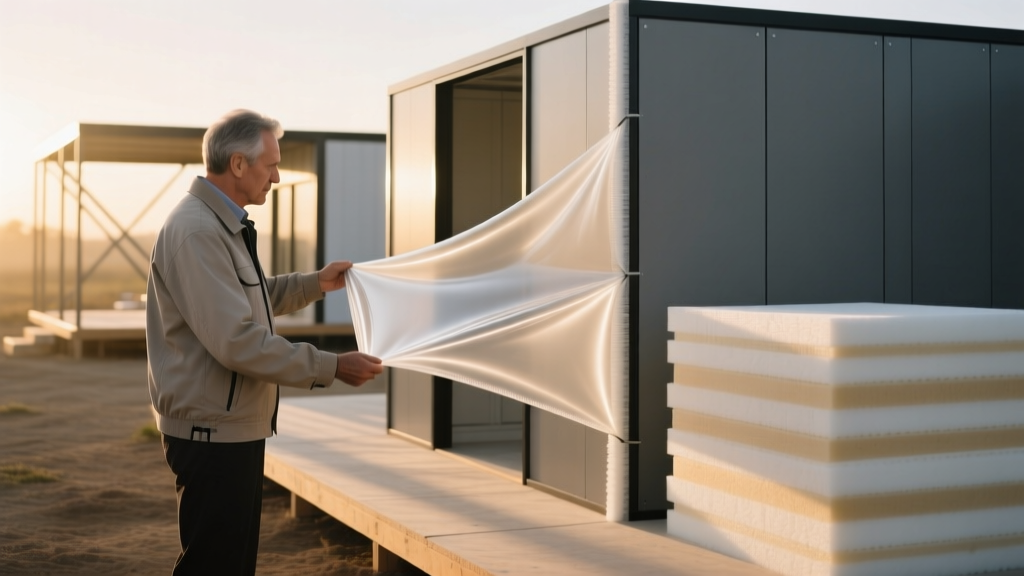
Traditional Rigid Foams: XPS and Polyiso
For permanent modular builds and static tiny homes, rigid boards remain the baseline. According to the U.S. Department of Energy, rigid foam boards provide excellent thermal resistance and structural sheathing capabilities.
- Extruded Polystyrene (XPS): Recognized by its blue or pink coloring, XPS offers an R-value of R-5.0 per inch. It is highly resistant to moisture absorption but degrades under prolonged UV exposure and is brittle, making it impossible to use on folding joints or tensioned fabric structures.
- Polyisocyanurate (Polyiso): Featuring foil facers, Polyiso boasts the highest R-value per inch of standard commercial insulations (R-6.0 to R-6.5). However, the foil facers are easily punctured, and the foam core is highly friable. It cannot withstand the kinetic stress of collapsible building components.
Head-to-Head Performance Matrix
| Property | Flexible TPU/EVA Membranes | XPS Rigid Board (2-inch) | Polyiso Rigid Board (2-inch) |
|---|---|---|---|
| Core R-Value | R-3.2 to R-5.5 (Total composite) | R-10.0 | R-12.0 to R-13.0 |
| Flexibility / Hinge Tolerance | Excellent (10,000+ fold cycles) | None (Fractures under bending) | None (Crushes and snaps) |
| Hydrostatic Resistance | 100% Leakproof (RF Welded) | High (but seams require taping) | Low (Foil facers tear easily) |
| Weight per Sq. Ft. | 0.8 lbs | 1.2 lbs | 1.5 lbs |
| Installation Method | RF Heat Welding, Keder Bead | Adhesive, Mechanical Fasteners | Mechanical Fasteners, Cap Nails |
Moisture Management and the Leakproof Advantage
The most critical failure point in mobile and temporary structures is moisture ingress at the seams. Traditional building science, as documented by the Building Science Corporation, emphasizes that rigid foam boards rely on taped seams or spray foam to achieve an air and water barrier. In a collapsible structure, tape peels and spray foam cracks when the joint moves.
This is where clevermade insulated collapsible leakproof materials demonstrate their primary engineering advantage. The TPU outer layers are joined using Radio Frequency (RF) welding or high-frequency thermal welding. This process melts the TPU molecules together at the seam, creating a monolithic, homogeneous bond that is physically stronger than the surrounding fabric and entirely leakproof. Water cannot penetrate an RF-welded seam, eliminating the need for secondary weather-resistive barriers (WRBs) and drastically reducing the overall weight and complexity of the wall assembly.
Application Decision Framework
Selecting between flexible membranes and rigid foams requires matching the material to the structural kinematics of the project.
When to Specify Flexible TPU/EVA Membranes
- Deployable Disaster Relief Shelters: Where units must be folded flat for shipping and expanded on-site without specialized framing tools.
- Pop-Up Retail and Event Pavilions: Tensioned fabric structures where the insulation must act as the primary weather barrier and flex under high wind loads.
- Camper Van and Overland Conversions: Specifically in areas with complex curves, sliding doors, or pop-top roofs where rigid boards cannot physically fit or move.
- Temporary HVAC Plenums: Collapsible ducting for temporary climate control in large tents or construction sites.
When to Specify Rigid XPS or Polyiso
- Static Modular Tiny Homes: Permanent structures built off-site and craned into place, where wall cavities are fixed and maximum R-value per inch is required to meet local residential energy codes.
- Below-Grade Foundations: XPS remains the undisputed standard for sub-slab and below-grade insulation due to its high compressive strength and long-term moisture resistance in soil.
- Continuous Exterior Insulation (ci): Over static wood or steel stud framing to eliminate thermal bridging in permanent commercial modular units.
2026 Pricing and Procurement Analysis
Material costs for specialized architectural textiles fluctuate based on petroleum derivatives and supply chain logistics. As of early 2026, the pricing landscape for these materials is as follows:
- Architectural TPU/EVA Membranes (20mm core): $4.50 to $7.20 per square foot. This higher upfront cost includes the integrated WRB and interior finish, effectively combining three building layers into one.
- XPS Rigid Board (2-inch): $1.10 to $1.60 per square foot. (Requires additional costs for house wrap, interior drywall, and seam taping, bringing the total assembled wall cost closer to $3.50/sq ft).
- Polyiso Rigid Board (2-inch): $1.30 to $1.85 per square foot.
While the raw material cost of flexible composites is roughly 4x that of rigid foam, the assembled system cost for a mobile structure is often lower. By eliminating the need for rigid framing, interior sheathing, and exterior cladding, flexible membranes offer a highly optimized labor and weight savings for non-static builds.
Technical FAQ
Can flexible TPU membranes be repaired in the field?
Yes. Unlike rigid foams which require cutting out and replacing damaged sections, punctured TPU/EVA membranes can be repaired using field-expedient RF welders or specialized TPU repair tape and solvent cements. A 2-inch patch applied with TPU solvent cement restores both the structural integrity and the leakproof moisture barrier within 15 minutes.
How does UV degradation affect flexible insulation compared to rigid foam?
Unprotected XPS and Polyiso will degrade into dust within 30 to 60 days of direct UV exposure. Architectural-grade TPU membranes are manufactured with integrated UV inhibitors and titanium dioxide pigments, allowing them to withstand 5,000+ hours of direct UV exposure (equivalent to roughly 3 to 5 years of continuous outdoor use) before showing signs of chalking or tensile loss.
Are these materials suitable for extreme cold environments?
Standard EVA foam remains flexible down to -20°F (-29°C). For arctic deployments or high-altitude mobile clinics, specifiers must upgrade the core to closed-cell Elastomeric Nitrile Rubber (ENR), which maintains its kinetic flexibility and R-value down to -40°F without becoming brittle or cracking at the fold lines.
Written by
Sarah WhitfieldSarah Whitfield is a chartered quantity surveyor (MRICS) and construction cost analyst with 15 years of experience in material pricing, procurement strategy, and project budgeting. She earned her degree in Construction Management from the University of Reading (UK) and has worked on projects ranging from $2M custom homes to $180M mixed-use developments across North America and Europe. Sarah currently leads cost estimating for BuildMat Insight, maintaining a proprietary database of 4,000+ material price points updated quarterly. She is a frequent contributor to RSMeans cost data panels and has presented at the International Cost Engineering Council (ICEC) congress. Based in Denver, CO, Sarah is an avid trail runner and volunteer mentor for Women in Construction.
More from Sarah Whitfield
View all
Wood & Lumber
What Are the Different Types of Wood? A Builder's Guide
Compare structural softwoods, finish hardwoods, and engineered lumber. Analyze Janka ratings, MOE values, and 2026 pricing for construction.
Aug 4, 2026

Walls & Panels
Steel Framing vs Wood Framing: Corrosion and Moisture Defense
Compare steel framing vs wood framing for moisture resistance. Learn about galvanized coatings, condensation risks, and corrosion protection strategies.
Jul 21, 2026

Stone & Masonry
How to Cut Stone Veneer: Wet Saw vs Grinder Comparison
Compare the best tools for cutting stone veneer. We review wet saws, angle grinders, and chop saws to help you achieve clean, chip-free cuts.
Jul 21, 2026