Best Floor Insulation Options for Energy Efficiency in 2026
Discover the best floor insulation options for 2026. Compare R-values, costs, and materials like spray foam, rigid foam, and mineral wool for maximum efficiency.

The Physics of Floor Heat Loss and Energy Codes
Uninsulated or poorly insulated floors account for 10% to 20% of a building's total thermal envelope heat loss. While walls and attics typically receive immediate attention, floor assemblies present unique thermodynamic challenges, primarily due to convective looping, thermal bridging through structural joists, and complex moisture dynamics. Under the widely adopted 2024 and 2026 International Energy Conservation Code (IECC) updates, floor insulation requirements have tightened significantly. For instance, Climate Zones 4 through 8 now mandate a minimum of R-30 for wood-frame floors over unconditioned spaces, pushing builders and homeowners away from standard R-19 fiberglass batts toward high-performance floor insulation options.
Selecting the correct material requires more than just chasing the highest R-value. The U.S. Department of Energy emphasizes that the effectiveness of floor insulation is heavily dependent on proper air sealing and the specific geometry of the subfloor assembly. A material that performs exceptionally well in a suspended timber floor may fail catastrophically in a damp, vented crawlspace.
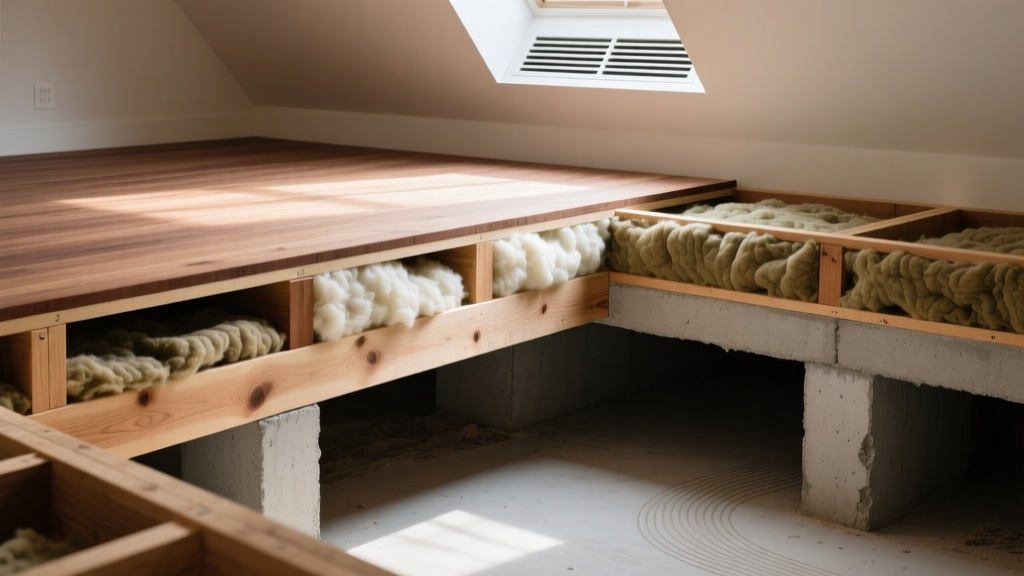
Material Matrix: Comparing Top Floor Insulation Options
The following matrix breaks down the leading materials used in modern floor assemblies, comparing their thermal resistance, installed costs, and ideal applications based on current 2026 market data.
| Material Type | R-Value per Inch | Avg. Installed Cost (per sq ft) | Vapor Permeability | Best Application |
|---|---|---|---|---|
| Closed-Cell Spray Foam (ccSPF) | R-6.5 - R-7.0 | $2.80 - $3.50 | Impermeable (Class I) | Irregular joist bays, rim joists, unvented crawlspaces |
| Mineral Wool Batts (e.g., Rockwool) | R-4.2 - R-4.3 | $1.60 - $2.20 | Permeable | Suspended timber floors, acoustic separation, fire-rated floors |
| Extruded Polystyrene (XPS) Rigid | R-5.0 | $1.80 - $2.50 | Semi-Impermeable (Class II) | Concrete slab perimeters, continuous insulation under subfloors |
| Expanded Polystyrene (EPS) Type IX | R-3.8 - R-4.0 | $1.20 - $1.70 | Permeable | Under-slab insulation, high-load bearing floor decks |
| Open-Cell Spray Foam (ocSPF) | R-3.5 - R-3.8 | $1.50 - $2.00 | Permeable | Deep timber joist cavities where air-sealing is the primary goal |
Application-Specific Recommendations
The 'best' floor insulation option is entirely dictated by the structural assembly and the conditioning status of the space below. Here is how to specify materials for the three most common floor types.
1. Suspended Timber Floors Over Vented Crawlspaces
In a vented crawlspace, the floor assembly is the primary thermal boundary. The historical standard—friction-fit fiberglass batts—suffers from severe sagging, compression, and convective looping. The optimal 2026 upgrade is mineral wool batts (such as Rockwool Comfortbatt). Mineral wool is hydrophobic, meaning it will not wick moisture from the damp crawlspace air, and its high density provides superior friction fit that resists gravity-induced sagging.
Critical Detail: Mineral wool must be supported by rigid wire netting or synthetic insulation hangers spaced no more than 12 inches apart. Furthermore, a Class I or II vapor retarder must be installed on the warm-in-winter side (the top of the batt, against the subfloor) to prevent interior moisture from condensing within the cold joist cavity.
2. Concrete Slab-on-Grade Perimeters
Heat loss in slab-on-grade foundations occurs primarily at the perimeter, where the concrete edge is exposed to exterior ambient temperatures. Insulating the entire underside of a residential slab rarely yields a positive ROI; instead, vertical or horizontal perimeter insulation is required. Extruded Polystyrene (XPS) remains the dominant choice here due to its high compressive strength and moisture resistance.
Look for next-generation XPS products like Owens Corning FOAMULAR NGX, which utilize HFO blowing agents that drastically reduce the Global Warming Potential (GWP) compared to legacy HFC-blown foams. Install a minimum of 2 inches of XPS (R-10) vertically along the stem wall, extending down to the frost line, or horizontally extending 2 to 4 feet outward from the foundation base.
3. Unconditioned Basements and Rim Joists
The rim joist (band joist) is notoriously difficult to insulate due to the convergence of wiring, plumbing, and irregular framing. Closed-cell spray foam (ccSPF) is the undisputed best option here. It provides an R-value of roughly R-6.5 per inch, acts as its own vapor retarder, and expands to seal the microscopic air leaks that account for the majority of thermal loss in this zone. The EPA's Seal and Insulate program specifically identifies rim joists as a top priority for air-sealing and insulating to prevent stack-effect drafts.
Insulating between floor joists ignores the fact that wood itself conducts heat. In a 2x10 floor system, the wood joists account for roughly 15% to 20% of the floor area, creating continuous thermal bridges that bypass the cavity insulation. To achieve true energy efficiency in high-performance builds, apply a continuous layer of rigid foam (EPS or XPS) directly beneath the joists before installing the drywall or ceiling of the space below.
Critical Installation Failure Modes
Even premium floor insulation options will underperform if installed incorrectly. Avoid these three common field failures:
- Compression of Batts: Forcing an R-19 (6.25-inch) fiberglass or mineral wool batt into a 5.5-inch 2x6 joist cavity does not yield R-19. The compression increases the material's density but decreases its overall thermal resistance, dropping the effective R-value to approximately R-15. Always match the batt thickness to the exact cavity depth.
- Missing the Air Barrier: Insulation stops conductive heat flow, but it does not stop convective heat flow. If the top of the floor cavity (the subfloor sheathing) is not sealed against air leakage from the living space above, warm air will bypass the insulation entirely. Use acoustic sealant or spray foam to seal all top plates, plumbing penetrations, and electrical cutouts before placing the batts.
- Incorrect Vapor Retarder Placement: Placing a polyethylene vapor barrier on the cold side (bottom) of a timber floor assembly traps moisture inside the joist bay. When warm, humid summer air enters the cool crawlspace and hits the poly, it condenses, leading to rapid wood rot and mold. Refer to the Building Science Corporation's guidelines on crawlspace dynamics for climate-specific vapor control strategies.
Cost vs. ROI: Calculating Your Payback Period
Upgrading from baseline code-minimum floor insulation to high-performance options requires capital, but the thermodynamic payback is highly predictable. For a standard 2,000-square-foot single-family home in Climate Zone 5, upgrading the floor assembly from R-19 fiberglass to R-38 mineral wool or spray foam typically costs between $2,800 and $4,500 (including labor and air-sealing).
Based on current 2026 energy pricing models, this upgrade reduces annual heating and cooling loads by 8% to 14%, translating to $250 to $450 in annual utility savings. The simple payback period ranges from 7 to 11 years. However, when factoring in the increased structural longevity (due to moisture control), enhanced acoustic dampening (particularly with mineral wool), and the elimination of cold floor drafts, the holistic ROI makes advanced floor insulation one of the most effective envelope upgrades available.
Written by
Priya KapoorPriya Kapoor is a real estate market analyst and construction economics researcher with expertise in housing affordability, development feasibility, and infrastructure investment. She holds a Master of Regional Planning from Cornell University and previously worked as a senior analyst at CBRE's Investment Properties group, where she modeled returns for $4B in mixed-use development pipelines. Priya now runs an independent research practice advising developers, municipalities, and REITs on construction cost forecasting and market timing. She publishes the quarterly "BuildMat Market Pulse" report tracking material price indices across 12 commodity categories. Based in Austin, TX, Priya serves on the board of Habitat for Humanity Austin and is a marathon runner.
More from Priya Kapoor
View all
Construction Cost
Cost to Build a 1600 Sq Ft Home in 2026: Full Breakdown
Accurate 2026 cost to build a 1600 sq ft home—material, labor, and regional pricing breakdowns included. Plan your budget with real-time estimates.
Aug 11, 2026

Wood & Lumber
Name the Types of Wood for Pressure Treatment and Preservation
Learn how to name the types of wood best suited for pressure treatment. Compare species treatability, chemical retention levels, and 2026 preservation costs.
Aug 4, 2026

Stone & Masonry
Stone Veneer Suppliers Lindenhurst: 2026 Cost Analysis
Analyze 2026 stone veneer costs in Lindenhurst, NY. Compare local supplier pricing, delivery fees, and Suffolk County installation labor rates.
Aug 4, 2026