Spray Foam Insulation Material R-Value and Performance Guide
Analyze spray foam insulation material R-value, thermal drift, and 2026 performance data for open-cell vs. closed-cell polyurethane applications.
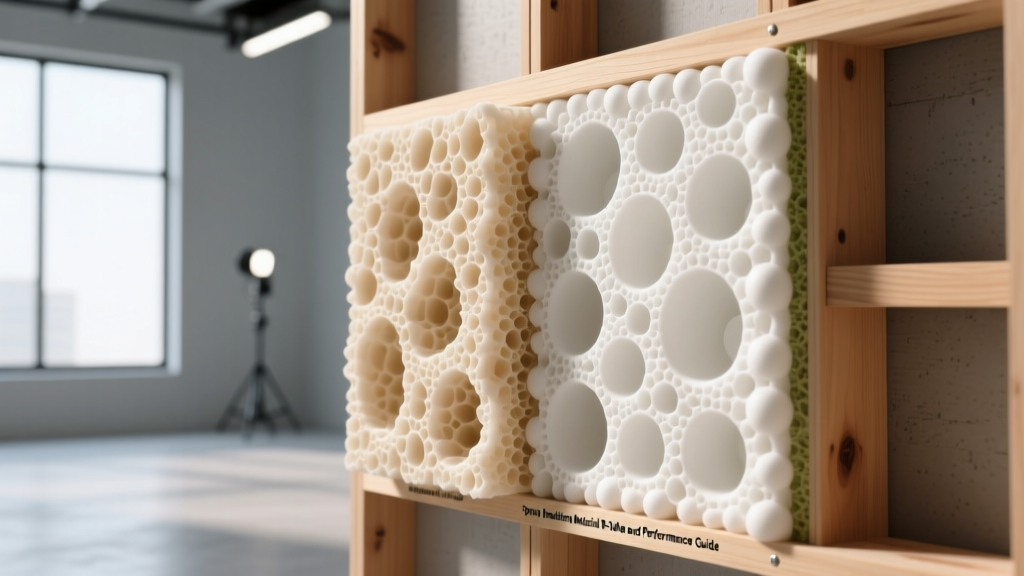
The Physics of Spray Foam Insulation Material R-Value
The thermal resistance of spray foam insulation material is not a static number; it is a dynamic property influenced by cellular structure, blowing agent chemistry, and long-term thermal drift. Unlike fiberglass batts, which rely entirely on trapped still air to resist heat flow, spray polyurethane foam (SPF) utilizes a combination of the polymer matrix and the specific gaseous blowing agents trapped within its cells. According to the U.S. Department of Energy, the R-value of insulation materials must be evaluated based on their aged, in-situ performance rather than their initial day-one laboratory readings.
In 2026, the industry has largely transitioned away from high-GWP (Global Warming Potential) HFC blowing agents like HFC-245fa. Modern closed-cell spray foam insulation material now predominantly utilizes HFOs (Hydrofluoroolefins), such as Honeywell Solstice. This chemical shift has stabilized the Long-Term Thermal Resistance (LTTR), effectively eliminating the severe thermal drift that plagued older formulations, where R-values would drop by 15-20% over the first five years as blowing agents diffused out and air diffused in.
Core R-Value Benchmarks (LTTR)
- Low-Density Open-Cell (0.4 - 0.5 lb/ft³): R-3.5 to R-3.8 per inch
- Medium-Density Closed-Cell (1.7 - 2.0 lb/ft³): R-6.5 to R-7.0 per inch
- High-Density Closed-Cell (2.5+ lb/ft³): R-5.5 to R-6.0 per inch (used primarily for roofing/structural strength)
Open-Cell vs. Closed-Cell: Performance Matrix
Choosing between open-cell and closed-cell spray foam insulation material requires looking beyond just the R-value per inch. Building scientists emphasize that moisture management, air sealing, and structural rigidity are equally critical to overall envelope performance. The Building Science Corporation notes that the vapor permeability of the foam dictates how a wall assembly dries, which ultimately prevents rot and mold.
| Performance Metric | Open-Cell (e.g., BASF Enertite) | Closed-Cell (e.g., JM Corbond III) |
|---|---|---|
| Density | 0.4 - 0.5 lbs/ft³ | 1.7 - 2.0 lbs/ft³ |
| LTTR per Inch | R-3.6 | R-6.7 |
| Vapor Permeability (ASTM E96) | Vapor Permeable (>10 perms at 5") | Class II Retarder (~1.5 perms at 1.5") |
| Air Barrier Rating | Meets code at 3.5 inches | Meets code at 1.0 inch |
| Water Absorption | High (Will hold water like a sponge) | Extremely Low (<2% by volume) |
| Structural Racking Strength | Negligible | Increases wall racking strength by up to 300% |

Real-World Performance Degradation and Thermal Drift
Historically, the highest point of failure in spray foam insulation material performance was thermal drift. When closed-cell foam is first applied, the blowing agent inside the cells yields an initial R-value of nearly R-8.0 per inch. However, over time, these high-molecular-weight gases diffuse out of the foam and are replaced by ambient air, which has a lower thermal resistance.
To regulate this, the FTC mandates that manufacturers report the LTTR (Long-Term Thermal Resistance), which is calculated using the CAN/ULC-S770 standard test method over a 5-year aged equivalent. With the 2026 market dominance of HFO-blown closed-cell foams, the delta between day-one R-value and LTTR has shrunk from roughly 1.5 points down to less than 0.5 points. When specifying materials, always verify the manufacturer's LTTR data sheet rather than relying on marketing materials that may highlight the unaged initial R-value.
Cost-to-Performance Ratio: 2026 Market Pricing
Evaluating the cost-effectiveness of spray foam requires calculating the price per R-value unit, not just the price per square foot. Pricing in 2026 reflects the stabilized supply chains for HFO blowing agents and updated labor rates for certified SPF applicators.
Pricing Breakdown (Material & Professional Installation)
- Open-Cell (0.5 lb): $0.45 to $0.65 per board foot. (A standard 2x6 wall cavity filled at 5.5 inches costs $2.47 - $3.57 per sq. ft. of wall area, yielding R-19.8).
- Closed-Cell (2.0 lb): $1.15 to $1.55 per board foot. (Filling the same 2x6 cavity at 5.5 inches costs $6.32 - $8.52 per sq. ft. of wall area, yielding R-36.8).
Because closed-cell foam is roughly 2.5 times more expensive but only provides roughly 1.8 times the R-value per inch, open-cell is often the more cost-effective choice for achieving high R-values in deep cavities (like attic rooflines), provided the climate zone allows for vapor-permeable assemblies.
Application-Specific Decision Framework
The Spray Polyurethane Foam Alliance (SPFA) emphasizes that material selection must align with the specific hygrothermal control layers required by the building's climate zone.
Cold Climates (IECC Zones 5, 6, 7, and 8)
In heating-dominated climates, the primary risk is interior moisture vapor driving outward and condensing on the cold exterior sheathing. Strategy: Use closed-cell spray foam insulation material against the interior side of the sheathing. At 2 inches thick, closed-cell foam acts as a Class II vapor retarder, keeping the sheathing warm and preventing condensation. You can then use the highly cost-effective 'Flash and Batt' method: flash 2 inches of closed-cell foam for air sealing and vapor control, and fill the remaining 3.5 inches with inexpensive fiberglass or mineral wool batts to reach code-required R-values without the massive expense of a full closed-cell fill.
Hot, Humid Climates (IECC Zones 1, 2, and 3)
In cooling-dominated climates, the moisture drive is reversed: hot, humid exterior air pushes inward toward the cool, air-conditioned interior drywall. Strategy: Open-cell spray foam insulation material is highly effective here when paired with an exterior vapor-impermeable barrier or specialized exterior rigid foam. Because open-cell is vapor permeable, it allows the wall assembly to dry to the interior if any moisture bypasses the exterior cladding. Using closed-cell foam on the interior of a wall in Zone 2 can trap moisture against the interior drywall, leading to mold growth if the exterior cladding leaks.
Expert Troubleshooting: Common R-Value Killers
Even the highest-rated spray foam insulation material will underperform if the installation fails. Inspectors and building scientists frequently identify the following physical defects that destroy thermal resistance:
- Shrinkage and Delamination: If the foam pulls away from the wooden studs or sheathing, it creates microscopic air channels. This bypasses the air-sealing benefit and allows convective heat looping, effectively dropping the assembly's real-world R-value by 20% or more. Shrinkage is usually caused by an improper A/B component mix ratio or spraying too thick of a single pass (lifts should never exceed 3-4 inches per pass to prevent overheating and charring).
- Voids and 'Holidays': Missed spots around complex framing intersections, electrical boxes, and plumbing penetrations. Because spray foam relies on a continuous monolithic seal, a 2% void area can reduce overall thermal performance by up to 15% due to uncontrolled air infiltration.
- Moisture Saturation (Open-Cell): If an open-cell foam application suffers a roof leak, the material will wick and hold water directly against the wood framing. Wet insulation loses nearly all its R-value (water conducts heat 25 times faster than air) and will not dry out quickly, guaranteeing structural rot. Open-cell must never be used in below-grade applications or areas prone to bulk water intrusion.
Written by
David NakamuraDavid Nakamura is a licensed architect (AIA) and construction technology writer focused on sustainable building methods, mass timber engineering, and high-performance building envelopes. He holds a Master of Architecture from the University of Washington and is a certified Passive House Consultant (CPHC). David spent eight years at the Seattle firm Mithun, where he led the design of three LEED Platinum projects, before founding his own practice specializing in net-zero residential design. He serves on the editorial advisory board of GreenBuilder Magazine and has authored peer-reviewed papers on cross-laminated timber (CLT) connections for the Journal of Structural Engineering. In his spare time, David teaches woodworking at Pratt Fine Arts Center and kayaks the Puget Sound.
More from David Nakamura
View all
Construction Cost
Labor Cost to Build a Deck Per Sq Ft: 2026 Installation Guide
Discover the exact labor cost to build a deck per sq ft in 2026. This installation guide breaks down contractor rates, complexity factors, and hidden fees.
Aug 4, 2026

Construction Cost
How Much Does It Cost to Build a 3 Bedroom House? Financing Guide
Learn exactly how much it costs to build a 3 bedroom house and explore 2026 financing options, construction loan types, and budget frameworks for your build.
Aug 4, 2026

Construction Cost
Cost to Build a Tennis Court: 2026 Guide
How much does it cost to build a tennis court in 2026? Breakdowns for asphalt, concrete, and synthetic surfaces plus fencing and lighting.
Jul 30, 2026