What Materials Make a Good Insulator? R-Value & Performance Guide
Discover what materials make a good insulator by comparing R-values, thermal performance, and costs of spray foam, mineral wool, and rigid boards.

The Physics of Thermal Resistance
When builders, architects, and homeowners ask what materials make a good insulator, the answer hinges on a material's ability to trap still air or low-conductivity gases to resist heat flow. In the building industry, this resistance is quantified as the R-value. According to the Federal Trade Commission's R-Value Rule, manufacturers must test and label insulation based on standardized thermal resistance, ensuring consumers can compare materials on an equal basis. However, a high laboratory R-value does not always translate to real-world performance. Air leakage, moisture accumulation, and thermal bridging can severely degrade an insulator's effectiveness.
R-value measures thermal resistance (higher is better). U-factor measures the rate of heat transfer (lower is better). They are mathematical inverses. A wall assembly with an R-value of 20 has a U-factor of 0.05. When evaluating what materials make a good insulator for entire wall assemblies, building scientists often prefer U-factor calculations because they account for thermal bridging and material layers.
The Core Contenders: Material Performance Deep Dive
To determine the best insulator for a specific application, we must look beyond the basic R-value per inch and evaluate air sealing, vapor permeability, and long-term thermal stability.
1. Closed-Cell Spray Polyurethane Foam (ccSPF)
Closed-cell spray foam (typically 2.0 lb/ft³ density) remains the gold standard for high-performance envelopes. It delivers an R-value of R-6.5 to R-7.2 per inch. As of 2026, the industry has largely transitioned away from high-GWP (Global Warming Potential) HFC blowing agents to next-generation HFOs (Hydrofluoroolefins) like Opteon 1100. While HFOs are environmentally superior, they diffuse out of the foam matrix slightly faster than legacy HFCs, meaning the long-term thermal drift curve of ccSPF requires careful modeling. At 1.5 inches thick, ccSPF acts as a Class II vapor retarder and provides a monolithic air barrier, eliminating convective looping.
- R-Value: R-6.5 to R-7.2 per inch
- Installed Cost: $2.80 to $3.50 per board foot
- Best Application: Unvented rooflines, rim joists, and flood-prone foundations.
2. Polyisocyanurate (Polyiso) Rigid Foam
Polyiso is a rigid thermoset plastic foam typically faced with aluminum foil, yielding an impressive R-5.6 to R-6.5 per inch at room temperature. However, polyiso exhibits a phenomenon known as thermal drift. As ambient temperatures drop below 40°F, the blowing gases inside the foam cells condense, causing the R-value to drop by up to 20%. Despite this cold-weather penalty, it remains highly cost-effective for continuous exterior insulation (ci). As noted by the Pacific Northwest National Laboratory's Building America program, polyiso is critical for breaking thermal bridges in wood and steel-framed walls.
- R-Value: R-5.6 to R-6.5 per inch (temperature dependent)
- Installed Cost: $1.20 to $1.60 per square foot (1-inch thickness)
- Best Application: Exterior continuous insulation (ci) and commercial roof decking.
3. Mineral Wool (Stone Wool)
Manufactured by spinning molten basalt rock and slag, mineral wool batts (such as ROCKWOOL Comfortbatt) offer an R-value of R-4.2 to R-4.3 per inch. While its thermal resistance per inch is lower than foams, mineral wool is dimensionally stable, completely non-combustible (withstands temperatures up to 2,150°F), and highly vapor-permeable, allowing walls to dry to the exterior. Its dense fiber matrix also provides exceptional acoustic dampening, achieving Noise Reduction Coefficients (NRC) of 0.95 or higher.
- R-Value: R-4.2 to R-4.3 per inch
- Installed Cost: $0.90 to $1.25 per square foot
- Best Application: Fire-rated assemblies, party walls, and exterior cavity fill in vapor-open wall designs.
4. Silica Aerogel Blankets
When space is at an absolute premium, aerogel is the undisputed champion. Composed of a silica nanoparticle matrix where the liquid has been replaced with gas, aerogel blankets (like Spaceloft) achieve an astonishing R-10.3 per inch. It is highly hydrophobic and vapor-permeable. The primary barrier to widespread adoption is cost, making it reserved for specialized applications like historic masonry retrofits where adding 4 inches of rigid foam would ruin architectural detailing.
- R-Value: R-10.0 to R-10.3 per inch
- Installed Cost: $4.50 to $6.50 per square foot
- Best Application: Historic building retrofits, thermal bridge breaks at structural connections.
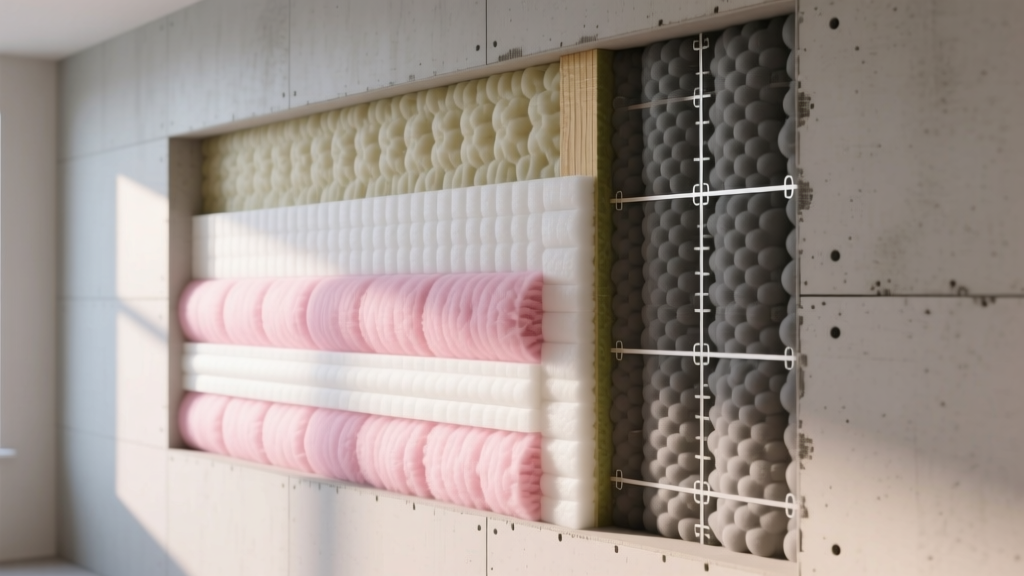
Performance Matrix: Comparing the Contenders
The table below synthesizes these materials based on real-world performance metrics, moving beyond just the laboratory R-value to show how they function in a complete wall assembly.
| Material | R-Value / Inch | Air Barrier? | Vapor Permeance | Cost per R-10 |
|---|---|---|---|---|
| Closed-Cell SPF | R-6.8 | Yes (at 1.5") | Class II Retarder | $4.50 |
| Polyiso (Foil-Faced) | R-6.0 | Yes (if taped) | Class I Retarder | $2.30 |
| Mineral Wool Batt | R-4.2 | No | Highly Permeable | $2.40 |
| Silica Aerogel | R-10.3 | No | Highly Permeable | $5.50 |
Real-World Failure Modes: Why Good Insulators Fail
According to the U.S. Department of Energy, the theoretical R-value of an insulator is rarely achieved in the field. Understanding failure modes is just as important as selecting the right material.
Thermal Bridging
A wall cavity filled with R-23 mineral wool is compromised by the wood studs (R-1.25 per inch) or steel studs (highly conductive) that frame it. In a standard 2x6 framed wall with 16-inch on-center spacing, the studs make up roughly 25% of the wall area. This thermal bridging can reduce the whole-wall R-value by 15% to 30%. The mandatory fix in modern energy codes (IECC 2024 and beyond) is the addition of continuous exterior insulation (ci) to blanket the framing.
Convective Looping
Fiberglass and mineral wool batts are air-permeable. If the drywall and exterior sheathing are not perfectly sealed, temperature differentials will cause air to circulate inside the wall cavity. This convective looping acts as a thermal conveyor belt, stripping heat from the interior and depositing it at the cold sheathing, effectively dropping the insulation's performance by up to 40%. Air sealing with fluid-applied membranes or spray foam is non-negotiable when using fibrous batts.
Polyiso Thermal Drift in Cold Climates
As mentioned, polyiso loses R-value in freezing temperatures. If an architect specifies 1 inch of polyiso (R-6.0) for exterior sheathing in Climate Zone 6, they are assuming a 75°F interior baseline. In January, when exterior temperatures hit 10°F, that same board may perform at only R-4.8. Designers must calculate the dew point using the cold-weather degraded R-value to prevent interstitial condensation inside the wall cavity.
Decision Framework: Matching Material to Climate Zone
What materials make a good insulator depends entirely on your climate zone and moisture management strategy. Use this framework to guide your assembly design:
- IECC Climate Zones 1-3 (Hot/Humid & Hot/Dry): Prioritize radiant barriers and open-cell spray foam or standard fiberglass. Vapor retarders should be minimal or Class III to allow inward drying. Air conditioning drives the moisture load; ensure the interior drywall is sealed to prevent warm, humid exterior air from reaching cold interior surfaces.
- IECC Climate Zones 4-5 (Mixed Humid): This is the most complex zone due to both heating and cooling loads. Use dense-pack cellulose or mineral wool in the cavity, paired with 1 inch of exterior unfaced polyiso or EPS. This provides a thermal break while allowing the wall to dry in both directions.
- IECC Climate Zones 6-8 (Cold & Very Cold): Heating dominates. You must use exterior continuous insulation with a high enough R-value to keep the interior sheathing above the dew point. Typically, this requires 2 inches of polyiso (or mineral wool boards) on the exterior, combined with closed-cell spray foam or dense fiberglass in the cavity. A Class I or II interior vapor retarder is mandatory.
Summary
There is no single 'best' insulator. Closed-cell spray foam offers the highest R-value per inch and superior air sealing but carries a premium cost and environmental considerations regarding blowing agents. Polyiso provides the most cost-effective thermal break for exterior applications, provided thermal drift is accounted for. Mineral wool excels in fire safety, acoustics, and vapor-open assemblies. By evaluating materials based on whole-wall U-factors, air barrier integration, and climate-specific dew point calculations, you can build enclosures that perform as well in reality as they do on paper.
Written by
Priya KapoorPriya Kapoor is a real estate market analyst and construction economics researcher with expertise in housing affordability, development feasibility, and infrastructure investment. She holds a Master of Regional Planning from Cornell University and previously worked as a senior analyst at CBRE's Investment Properties group, where she modeled returns for $4B in mixed-use development pipelines. Priya now runs an independent research practice advising developers, municipalities, and REITs on construction cost forecasting and market timing. She publishes the quarterly "BuildMat Market Pulse" report tracking material price indices across 12 commodity categories. Based in Austin, TX, Priya serves on the board of Habitat for Humanity Austin and is a marathon runner.
More from Priya Kapoor
View all
Construction Cost
Cost to Build a 1600 Sq Ft Home in 2026: Full Breakdown
Accurate 2026 cost to build a 1600 sq ft home—material, labor, and regional pricing breakdowns included. Plan your budget with real-time estimates.
Aug 11, 2026

Wood & Lumber
Name the Types of Wood for Pressure Treatment and Preservation
Learn how to name the types of wood best suited for pressure treatment. Compare species treatability, chemical retention levels, and 2026 preservation costs.
Aug 4, 2026

Stone & Masonry
Stone Veneer Suppliers Lindenhurst: 2026 Cost Analysis
Analyze 2026 stone veneer costs in Lindenhurst, NY. Compare local supplier pricing, delivery fees, and Suffolk County installation labor rates.
Aug 4, 2026