High Performance Insulation Materials: A Builder's Selection Framework
Discover the ultimate selection framework for high performance insulation materials. Compare R-values, costs, and applications for optimal building envelopes.
The Paradigm Shift in Building Envelopes
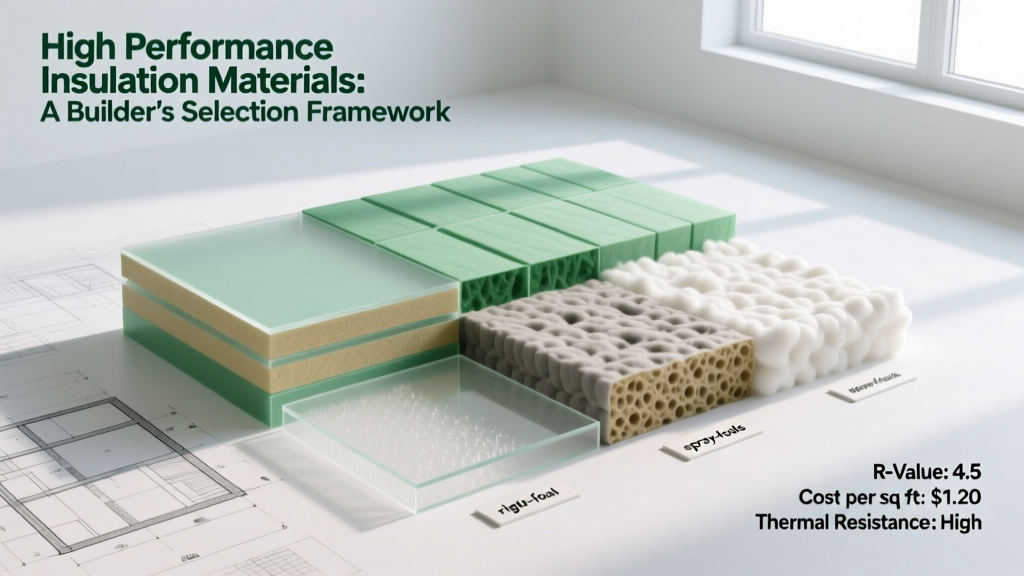
Specifying high performance insulation materials requires moving beyond simple R-value comparisons. As the 2026 IECC and ASHRAE 90.1 standards push commercial and residential envelopes toward net-zero readiness, architects and builders must evaluate insulation through a multi-variable lens. The right selection framework balances thermal resistance, moisture dynamics, acoustic dampening, spatial constraints, and lifecycle cost. This guide provides a technical decision matrix to help you select the exact material for your specific assembly.
Core Metrics: Beyond Just R-Value
While R-value measures resistance to conductive heat flow, it fails to account for real-world environmental stressors. A material that performs exceptionally in a 75°F laboratory may fail in a sub-zero climate or a high-humidity coastal zone.
Thermal Drift and Temperature Dependence
Closed-cell foams rely on blowing agents trapped within the cellular structure. Polyisocyanurate (polyiso), for instance, experiences thermal drift. At 75°F, polyiso delivers an R-value of roughly 6.5 per inch. However, as temperatures drop below 40°F, the blowing gases condense, and the R-value can plummet to 5.2 per inch. Conversely, extruded polystyrene (XPS) and mineral wool maintain stable R-values across extreme temperature gradients.
Placing high-R-value vapor-impermeable insulation (like closed-cell spray foam or foil-faced polyiso) on the exterior of a wall assembly can shift the condensing surface inward. Always run a WUFI hygrothermal analysis to ensure the sheathing temperature remains above the dew point during peak winter months. For a deeper understanding of moisture control layers, refer to the Building Science Corporation's guidelines on thermal and moisture control.
High Performance Insulation Materials: The Decision Matrix
The following matrix compares premium insulation categories based on critical performance metrics and current 2026 market pricing.
| Material Type | R-Value / Inch | Perm Rating | Cost (Installed) | Primary Limitation |
|---|---|---|---|---|
| Vacuum Insulation Panels (VIPs) | R-30 to R-50 | 0.0 | $12.00 - $18.00 / sq ft | Cannot be cut or penetrated on-site |
| Silica Aerogel Blankets | R-10 to R-10.4 | Variable | $4.50 - $7.00 / sq ft | High material cost, compressible |
| Closed-Cell SPF (2 lb density) | R-6.5 to R-7.0 | < 1.0 (at 5 in) | $1.80 - $3.20 / board ft | Requires certified installers, off-ratio risks |
| Polyisocyanurate (Foil-faced) | R-5.2 to R-6.5 | < 0.1 | $0.70 - $1.10 / board ft | Thermal drift in cold climates |
| High-Density Stone Wool | R-4.2 to R-4.3 | Vapor permeable | $0.90 - $1.40 / board ft | Lower R-value per inch requires more depth |
Application-Specific Selection Framework
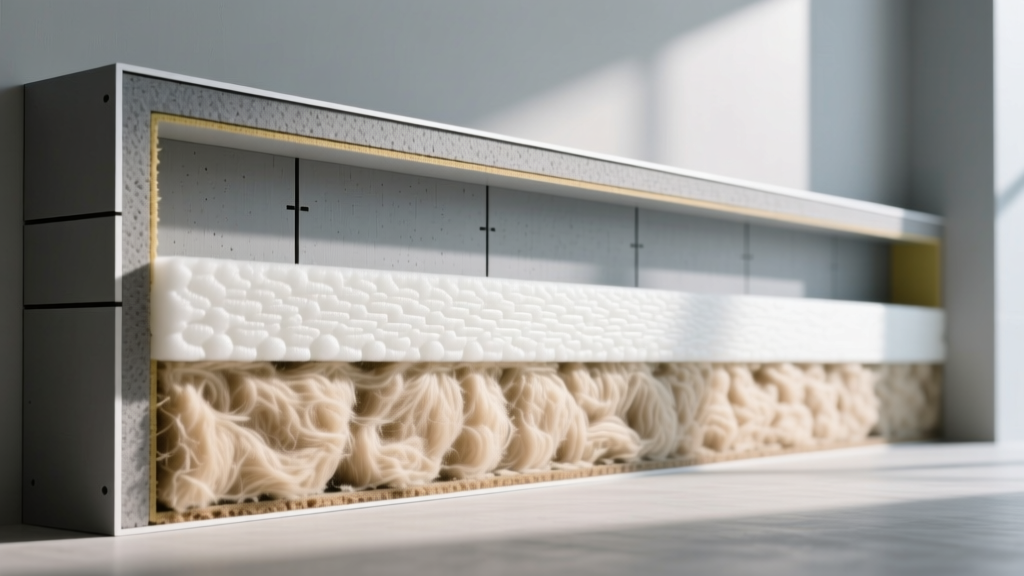
Use the following scenarios to map your project constraints to the optimal high performance insulation materials.
Scenario A: Space-Constrained Retrofits and Historic Facades
When preserving interior square footage or maintaining historic exterior sightlines is mandatory, thickness is the primary constraint. Vacuum Insulation Panels (VIPs) and Aerogel blankets (such as Aspen Aerogels' Spaceloft) are the only viable options. Aerogel can be wrapped around complex structural geometries and steel columns where rigid boards fail. VIPs are best suited for flat, unobstructed cavity applications like beneath raised floors or within prefabricated curtain wall cassettes.
Scenario B: High-Moisture Commercial Envelopes
For below-grade applications, plaza decks, or unvented cathedral ceilings in coastal climates, moisture resistance is non-negotiable. Closed-cell spray polyurethane foam (ccSPF) at a 2.0 lb/ft³ density acts as both a thermal barrier and a Class II vapor retarder. It conforms to irregular substrates, eliminating the convective loops that occur at the seams of rigid boards. Ensure the substrate moisture content is below 15% prior to application to prevent adhesion failure.
Scenario C: Acoustic, Fire-Rated, and Continuous Exterior Assemblies
When the assembly requires a 2-hour fire rating or high STC (Sound Transmission Class) ratings, combustible foams are disqualified. High-density mineral wool (e.g., ROCKWOOL Comfortboard 80 or Owens Corning Thermafiber RainBarrier) is the mandatory choice. Mineral wool is non-combustible (up to 2,150°F), hydrophobic, and maintains its structural integrity under severe wind loads when used as continuous exterior insulation (ci).
Installation Edge Cases and Failure Modes
Even the most expensive high performance insulation materials will underperform if installation edge cases are ignored. The U.S. Department of Energy emphasizes that installation quality directly dictates real-world thermal performance.
"A wall designed for R-30 with continuous insulation can easily perform at R-22 if thermal bridging through steel fasteners and structural penetrations is not mitigated."
- Fastener Thermal Bridging: Standard steel screws penetrating 4 inches of polyiso can reduce the effective assembly R-value by up to 20%. Specify composite, fiberglass, or thermal-washer-equipped fasteners for continuous insulation layers.
- SPF Temperature Sensitivity: Closed-cell SPF requires precise 1:1 chemical mixing. If ambient temperatures drop below 50°F, the resin and isocyanate must be heated to 120°F–140°F at the spray gun. Failure to do so results in friable, uncured foam with drastically reduced R-values and severe off-gassing.
- VIP Puncture Risks: A single drywall screw driven blindly into a wall cavity containing VIPs will rupture the panel's barrier film. The vacuum is lost, and the R-value drops from R-40 to roughly R-4 instantly. Always map VIP locations and install physical protection boards over them.
Cost vs. Lifecycle ROI Analysis
High performance insulation materials carry a premium upfront cost, but the ROI calculation must factor in HVAC downsizing and energy code compliance. For example, upgrading from standard fiberglass batts (R-13) to a hybrid assembly of ccSPF (R-21) and exterior mineral wool (R-10) in a 10,000 sq ft commercial facility may add $28,000 to the envelope budget. However, this reduction in thermal load often allows engineers to downsize the rooftop HVAC units by 15-20%, recouping $12,000 to $18,000 in immediate mechanical capital costs, with the remainder paid back via utility savings within 4 to 6 years.
Finalizing Your Specification
Selecting high performance insulation materials is not a one-size-fits-all exercise. Map your specific constraints—spatial limits, moisture exposure, fire codes, and budget—to the decision matrix above. For complex commercial envelopes, always pair your material selection with a 2D or 3D hygrothermal simulation to verify that your chosen high-performance assembly will perform as engineered over its 50-year lifecycle. Consult the latest ASHRAE technical resources to ensure your specification aligns with current climate-zone mandates.
Written by
Sarah WhitfieldSarah Whitfield is a chartered quantity surveyor (MRICS) and construction cost analyst with 15 years of experience in material pricing, procurement strategy, and project budgeting. She earned her degree in Construction Management from the University of Reading (UK) and has worked on projects ranging from $2M custom homes to $180M mixed-use developments across North America and Europe. Sarah currently leads cost estimating for BuildMat Insight, maintaining a proprietary database of 4,000+ material price points updated quarterly. She is a frequent contributor to RSMeans cost data panels and has presented at the International Cost Engineering Council (ICEC) congress. Based in Denver, CO, Sarah is an avid trail runner and volunteer mentor for Women in Construction.
More from Sarah Whitfield
View all
Wood & Lumber
What Are the Different Types of Wood? A Builder's Guide
Compare structural softwoods, finish hardwoods, and engineered lumber. Analyze Janka ratings, MOE values, and 2026 pricing for construction.
Aug 4, 2026

Walls & Panels
Steel Framing vs Wood Framing: Corrosion and Moisture Defense
Compare steel framing vs wood framing for moisture resistance. Learn about galvanized coatings, condensation risks, and corrosion protection strategies.
Jul 21, 2026

Stone & Masonry
How to Cut Stone Veneer: Wet Saw vs Grinder Comparison
Compare the best tools for cutting stone veneer. We review wet saws, angle grinders, and chop saws to help you achieve clean, chip-free cuts.
Jul 21, 2026