Electrical Wire Insulation Material Cost Breakdown 2026
Analyze 2026 electrical wire insulation material costs. Compare PVC, XLPE, and MI cable pricing, lifecycle value, and NEC code impacts for building projects.

The True Cost of Electrical Wire Insulation Material
When estimating electrical rough-in budgets for commercial and residential construction, project managers typically fixate on copper price volatility. However, the electrical wire insulation material is the hidden variable that dictates conduit sizing, environmental resilience, installation labor, and long-term replacement cycles. In 2026, shifting polymer supply chains and updated fire safety codes have significantly altered the cost landscape for building wire insulations.
Choosing the correct insulation is not merely a matter of matching the National Electrical Code (NEC) minimums; it is a strategic financial decision. A cheaper upfront insulation material can inflate conduit costs and labor hours, while a premium insulation can reduce overall system footprint and extend the asset's lifecycle by decades.
2026 Pricing Matrix: Standard vs. Specialty Insulations
The following matrix breaks down the baseline material costs for common building wire insulations. Prices reflect Q1 2026 wholesale averages for 12 AWG and 4 AWG copper conductors, excluding contractor markup and regional freight surcharges.
| Insulation Type | Polymer / Material | Max Temp Rating | Avg Cost / 1,000 ft (12 AWG) | Avg Cost / 1,000 ft (4 AWG) | Primary Application |
|---|---|---|---|---|---|
| THHN / THWN-2 | PVC with Nylon Jacket | 90°C (Dry) / 75°C (Wet) | $165 - $185 | $820 - $890 | Standard residential & commercial branch circuits |
| XHHW-2 | Cross-Linked Polyethylene (XLPE) | 90°C (Dry & Wet) | $180 - $205 | $880 - $960 | Commercial feeders, wet environments, tight conduit runs |
| MI Cable | Magnesium Oxide (MgO) in Copper Sheath | 250°C+ | N/A (Starts at 6 AWG) | $14,500 - $18,000 | Life safety circuits, fire pumps, high-rise stairwells |
| Teflon (PTFE/FEP) | Fluoropolymer | 200°C - 250°C | $450 - $600 | $2,800 - $3,500 | Aerospace, high-temp industrial, specialty lighting |
Breakdown of Primary Building Wire Insulations
Polyvinyl Chloride (PVC) - THHN/THWN-2
PVC remains the dominant electrical wire insulation material in North America due to its low cost and ease of manufacturing. THHN (Thermoplastic High Heat-resistant Nylon-coated) features a PVC base with a thin nylon outer jacket. The nylon provides excellent abrasion resistance when pulling wire through metal conduits.
- Cost Advantage: Lowest upfront material cost per linear foot.
- Installation Drawback: PVC becomes highly brittle below freezing. Electricians pulling THHN in unheated buildings during winter must use specialized lubricants and face a higher risk of jacket cracking, which violates OSHA electrical safety standards regarding compromised insulation.
- Conduit Fill Penalty: The nylon jacket increases the outer diameter (OD) of the wire. This bulkier profile reduces the number of conductors allowed in a single conduit run per NEC Chapter 9 tables.
Cross-Linked Polyethylene (XLPE) - XHHW-2
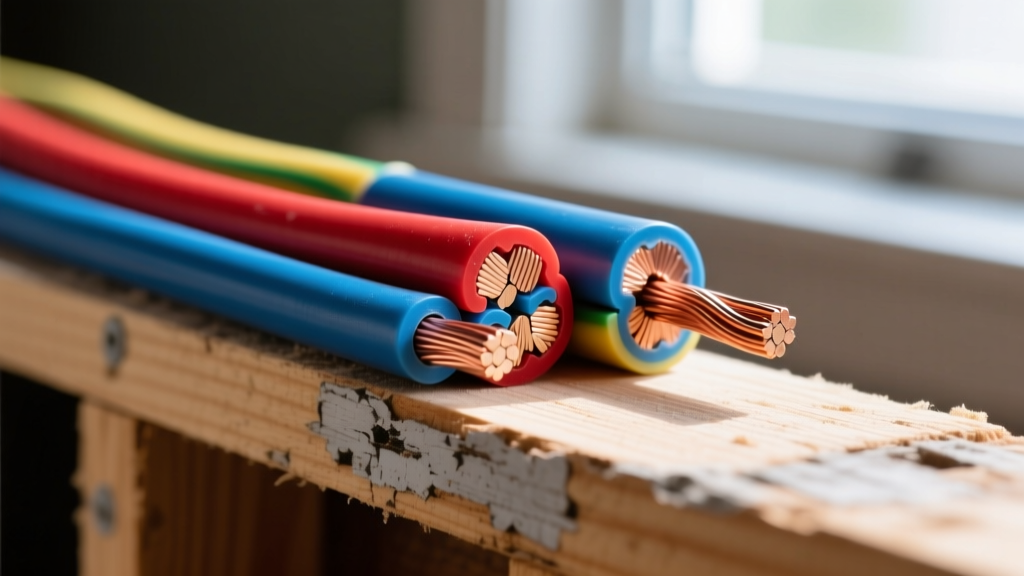
XLPE is a thermoset polymer created by cross-linking polyethylene chains, resulting in a vastly superior thermal and chemical resistance profile compared to PVC. XHHW-2 lacks the outer nylon jacket, relying on the inherent toughness of the cross-linked material.
- The Conduit Fill Arbitrage: Because XHHW-2 lacks a nylon jacket, its OD is 5% to 8% smaller than an equivalent THHN wire. In large commercial projects, this allows you to fit more conductors in the same EMT (Electrical Metallic Tubing) or downgrade to a smaller conduit size, offsetting the 10-15% premium in wire material costs.
- Moisture Resistance: Unlike PVC, which can suffer from plasticizer migration and insulation breakdown in continuously wet environments, XLPE maintains its dielectric strength in wet locations at its full 90°C rating.
Specialty and Fire-Rated Insulation Costs
Mineral Insulated (MI) Copper-Clad Cable
For critical life-safety circuits—such as hospital surgical suites, high-rise fire pumps, and emergency stairwell lighting—standard polymer insulations are insufficient. MI cable utilizes highly compacted magnesium oxide (MgO) powder as the electrical wire insulation material, encased in a continuous, seamless copper or stainless steel sheath.
Cost Reality: MI cable is extraordinarily expensive, often costing 15 to 20 times more per linear foot than XHHW-2. Furthermore, installation requires specialized labor. Terminating MI cable demands precision stripping, baking out moisture from the exposed MgO powder, and installing proprietary potting compound seal kits. A single termination kit can cost $40 to $85, and a journeyman electrician may spend 45 minutes on a single connection.
Fluoropolymers (PTFE / FEP) and the 2026 PFAS Factor
Teflon-based insulations offer the thinnest jacket profiles and highest temperature tolerances. However, project managers must factor in the regulatory environment. With tightening global regulations on PFAS (per- and polyfluoroalkyl substances) taking effect in 2026, the manufacturing and disposal costs of fluoropolymer insulations are rising. Specify PTFE only when strictly required for extreme temperature zones (e.g., inside industrial ovens or high-intensity lighting fixtures) where XLPE would melt.
Lifecycle Cost Analysis: Upfront Price vs. Long-Term Value
To accurately assess the electrical wire insulation material cost, estimators must look beyond the spool price and evaluate the total installed cost and lifecycle depreciation.
Scenario A: 400A Commercial Feeder (PVC/THHN)
- Wire Cost (500 kcmil): $4,200
- Conduit Required: 3-inch Rigid Steel
- Conduit & Fittings Cost: $1,150
- Pull Labor: 18 hours
- Total Installed: ~$6,500
Scenario B: 400A Commercial Feeder (XLPE/XHHW-2)
- Wire Cost (500 kcmil): $4,650 (+10.7%)
- Conduit Required: 2.5-inch Rigid Steel (Due to smaller OD)
- Conduit & Fittings Cost: $850 (-26%)
- Pull Labor: 14 hours (Less friction, no nylon binding)
- Total Installed: ~$6,250
As demonstrated, the 10% premium paid for XLPE insulation is entirely absorbed—and slightly exceeded—by the savings in heavy-wall steel conduit and reduced labor hours. Over a 40-year building lifecycle, XLPE's resistance to thermal degradation also delays the need for costly infrared thermography inspections and premature feeder replacements.
2026 Market Trends Impacting Insulation Pricing
Several macroeconomic factors are currently influencing the cost of electrical wire insulation materials:
- Polymer Resin Indexing: PVC and XLPE prices are tethered to crude oil and natural gas liquids. While copper gets the headlines, a spike in ethylene prices directly inflates the jacketing cost of building wire.
- Green Building Mandates: LEED v5 and updated municipal codes are increasingly mandating Low-Smoke Zero-Halogen (LSZH) insulation in public transit hubs and high-density residential towers. LSZH materials (typically polyolefin blends loaded with aluminum trihydrate) carry a 25% to 40% cost premium over standard PVC but are now non-negotiable in many commercial bids.
- Automotive EV Competition: The massive demand for high-temperature, thin-wall XLPE and silicone insulations in electric vehicle battery harnesses has strained the supply of specialized cross-linking polymers, occasionally causing lead-time delays for large-gauge XHHW-2 building wire.
Frequently Asked Questions
Can I mix THHN and XHHW-2 wires in the same conduit?
Yes, the NEC permits mixing insulation types in a single raceway, provided the ampacity of the entire circuit is calculated based on the lowest temperature rating of any conductor in the bundle. However, mixing them complicates conduit fill calculations because their outer diameters differ. It is best practice to keep insulation types uniform per run to ensure compliance with fill percentages.
Why is MI cable so much more expensive than standard polymer wire?
The manufacturing process for Mineral Insulated cable is highly specialized. It involves drawing a copper tube filled with loose magnesium oxide powder through a series of dies to compress the powder and reduce the diameter, followed by repeated annealing. The material cost, combined with the slow manufacturing speed and expensive termination hardware, drives the high price point.
Does the color of the insulation jacket affect the cost?
Standard colors (black, white, red, blue, green) are produced in massive volumes and carry no price premium. Custom or specialty colors (like purple for high-voltage or specific orange for isolated ground circuits) may require minimum order quantities (MOQs) from manufacturers and can incur a 5% to 15% upcharge due to line-flushing and setup downtime at the extrusion plant.
Written by
Sarah WhitfieldSarah Whitfield is a chartered quantity surveyor (MRICS) and construction cost analyst with 15 years of experience in material pricing, procurement strategy, and project budgeting. She earned her degree in Construction Management from the University of Reading (UK) and has worked on projects ranging from $2M custom homes to $180M mixed-use developments across North America and Europe. Sarah currently leads cost estimating for BuildMat Insight, maintaining a proprietary database of 4,000+ material price points updated quarterly. She is a frequent contributor to RSMeans cost data panels and has presented at the International Cost Engineering Council (ICEC) congress. Based in Denver, CO, Sarah is an avid trail runner and volunteer mentor for Women in Construction.
More from Sarah Whitfield
View all
Wood & Lumber
What Are the Different Types of Wood? A Builder's Guide
Compare structural softwoods, finish hardwoods, and engineered lumber. Analyze Janka ratings, MOE values, and 2026 pricing for construction.
Aug 4, 2026

Walls & Panels
Steel Framing vs Wood Framing: Corrosion and Moisture Defense
Compare steel framing vs wood framing for moisture resistance. Learn about galvanized coatings, condensation risks, and corrosion protection strategies.
Jul 21, 2026

Stone & Masonry
How to Cut Stone Veneer: Wet Saw vs Grinder Comparison
Compare the best tools for cutting stone veneer. We review wet saws, angle grinders, and chop saws to help you achieve clean, chip-free cuts.
Jul 21, 2026