Brickyard Building Materials Vacaville: Guide to Masonry Repairs
Expert guide to sourcing brickyard building materials Vacaville for masonry repair, tuckpointing, and fixing climate-specific brick damage.

Sourcing Authentic Brickyard Building Materials in Vacaville
When repairing masonry in Solano County, matching the original brick unit is the most critical step in preserving structural integrity and aesthetic continuity. Searches for "brickyard building materials Vacaville" frequently originate from homeowners and contractors attempting to replace damaged units in older properties near downtown Vacaville or the historic Nut Tree district. Early 20th-century structures in this region were often built using soft, low-fire clay bricks produced in local kilns. These historic units possess high porosity and low compressive strength compared to modern alternatives.
Standard masonry supply yards in the Vacaville area primarily stock modern, high-fire extruded face bricks (manufactured to ASTM C216 standards). While excellent for new construction, using these hard, dense bricks for localized patch repairs on a historic facade creates a severe structural mismatch. The harder modern brick will force thermal and moisture-induced stresses into the adjacent softer historic bricks, accelerating their deterioration. To source authentic reclaimed clay units that match Vacaville's historic palettes, contractors must often bypass big-box retailers and consult specialized regional salvage yards or custom masonry suppliers who stock reclaimed Northern California clay units.
Diagnosing Climate and Soil-Specific Brick Failures
Vacaville's unique environmental profile—characterized by expansive adobe soils and extreme summer temperature swings—dictates specific masonry failure modes that differ from coastal or northern California regions.
Adobe Soil Heave and Step Cracking
Much of Vacaville sits on highly expansive clay (adobe) soils. During the wet winter months, these soils absorb moisture and swell, causing differential foundation heave. This movement manifests as stair-step cracking along mortar joints, particularly at the corners of brick veneers and load-bearing walls. Unlike structural settling, which happens once, adobe heave is cyclical. Repairing these cracks requires flexible polyurethane caulking at the brick-to-foundation interface and, in severe cases, underpinning the foundation before tuckpointing the masonry joints.
Thermal Expansion and Compressive Buckling
With summer temperatures routinely exceeding 100°F, long runs of brick masonry in Vacaville experience significant thermal expansion. Brick expands at a rate of approximately 0.000004 inches per inch per degree Fahrenheit. On a 40-foot wall experiencing an 80-degree temperature swing from winter night to summer afternoon, this equates to nearly a quarter-inch of linear expansion. If original builders omitted vertical expansion joints, or if previous repairs filled them with rigid mortar, the wall will buckle, crack, or push against adjacent structural framing. Remediation requires saw-cutting new vertical expansion joints every 20 to 30 feet and filling them with a closed-cell backer rod and a high-modulus polyurethane sealant like Tremco Spectrem 1.
Vacaville is located in a high seismic risk zone. Unreinforced masonry buildings are highly vulnerable to lateral loads. Cosmetic repointing does not improve seismic capacity. If you are repairing a URM structure, consult a licensed structural engineer to evaluate the need for epoxy doweling, shotcrete backing, or center-core drilling before proceeding with standard brickyard building materials repairs.
Step-by-Step Tuckpointing for Northern California Climates
Repointing (tuckpointing) is the most common brick repair procedure, but doing it incorrectly in Vacaville's hot, dry climate guarantees premature failure. The National Park Service Preservation Brief 2 emphasizes that new mortar must be softer and more permeable than the brick it surrounds.
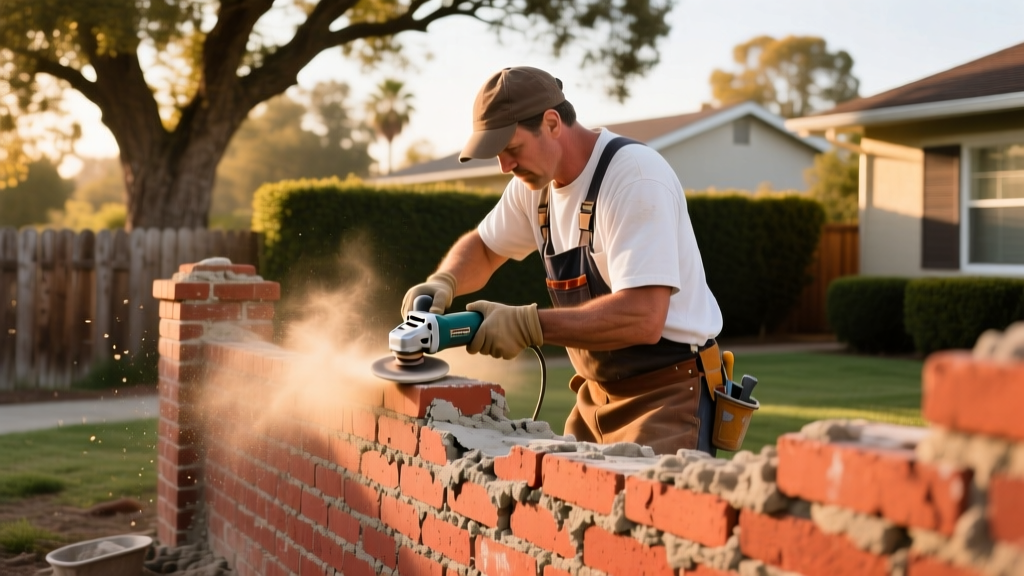
- Joint Raking: Use a diamond-tipped masonry grinder with a vacuum shroud to remove deteriorated mortar to a depth of 2 to 2.5 times the joint width. For a standard 3/8-inch joint, rake out at least 3/4 inch. Avoid angle grinders on vertical joints to prevent scoring the historic brick arrises.
- Pre-Wetting (Critical Step): Vacaville's low summer humidity and high heat will flash-dry fresh mortar, causing it to shrink, crack, and lose adhesion. Thoroughly soak the raked joints with a low-pressure spray nozzle 12 hours before repointing, and again 1 hour before applying mortar. The brick should be damp, but not dripping.
- Mortar Mixing: Mix only enough mortar to be used within 90 minutes. For pre-1940s soft brick, use a Natural Hydraulic Lime (NHL 3.5) mixed with sharp, well-graded local sand at a 1:2.5 ratio. For post-1950s extruded brick, a pre-blended Type N mortar (like Quikrete Type N) is appropriate.
- Packing in Lifts: Pack the damp joint tightly using a pointing trowel and jointer. Apply the mortar in 1/4-inch lifts (layers), compacting each layer before applying the next to eliminate air pockets and ensure deep bonding.
- Tooling and Curing: Tool the joint to match the historic profile (usually a concave or grapevine joint in this region) when the mortar is thumbprint-hard. Mist the repointed wall lightly twice a day for three days to ensure proper hydration, especially if the temperature exceeds 85°F.
Mortar Selection Matrix for Vacaville Structures
| Era of Construction | Brick Type | Recommended Mortar | Compressive Strength |
|---|---|---|---|
| Pre-1930 | Low-fire, soft clay | Type O or NHL 3.5 Lime | < 750 psi |
| 1930 - 1960 | Medium-fire transitional | Type N (1:1:6 mix) | 750 - 1,500 psi |
| Post-1960 | High-fire extruded | Type N or Type S | 1,800 - 2,500 psi |
Efflorescence Removal and Cleaning Protocols
White, powdery efflorescence is common on Vacaville brickwork, driven by winter rains and summer irrigation overspray dissolving soluble salts within the masonry. The Brick Industry Association Technical Notes strongly advise against using high-pressure water or unbuffered muriatic acid, which can etch the brick face and drive salts deeper into the pore structure.
For mild efflorescence, dry-brushing with a stiff natural-bristle brush followed by a low-pressure water rinse is sufficient. For heavy, crystallized salt deposits, apply a specialized masonry cleaner like PROSOCO Sure Klean® Limestone & Masonry Cleaner. Dilute the solution at a 1:4 to 1:6 ratio with water, pre-wet the wall thoroughly to prevent acid absorption, apply the cleaner, dwell for no more than 5 minutes, and rinse aggressively with a garden hose. Never allow the chemical to dry on the brick surface.
Cost Breakdown for Vacaville Brick Repair Projects
Labor rates in Solano County reflect the broader Bay Area and Sacramento market influences, generally ranging from $95 to $140 per hour for skilled union or certified masons. Below is an estimated cost matrix for common brick repair scenarios using standard brickyard building materials in the Vacaville area for 2026.
| Repair Procedure | Unit of Measure | Material Cost | Installed Cost (Labor + Mat) |
|---|---|---|---|
| Standard Tuckpointing (Type N) | Per Sq. Ft. | $1.50 - $2.50 | $14.00 - $22.00 |
| Historic Lime Repointing (NHL) | Per Sq. Ft. | $3.00 - $5.00 | $24.00 - $35.00 |
| Brick Replacement (Reclaimed) | Per Brick | $4.00 - $8.00 | $18.00 - $30.00 |
| Expansion Joint Retrofitting | Per Linear Ft. | $6.00 - $10.00 | $35.00 - $55.00 |
Final Considerations for Local Sourcing
When procuring brickyard building materials in Vacaville, always request a physical sample of the brick and mortar to test against the existing structure before committing to a bulk order. Perform a simple scratch test on the historic brick with a masonry nail; if the nail easily scores the brick, you are dealing with a soft, low-fire unit that mandates a lime-based mortar. Proper material selection, combined with an understanding of Solano County's unique soil and thermal dynamics, ensures that masonry repairs will withstand the local environment for decades rather than failing within a single seasonal cycle.
Written by
Marcus ChenMarcus Chen is a licensed structural engineer (PE) and building materials analyst with over 12 years of experience across residential, commercial, and industrial construction. He holds a Master of Science in Civil Engineering from UC Berkeley and spent six years at Thornton Tomasetti before transitioning to independent consulting and technical writing. Marcus specializes in material selection for seismic-prone regions, concrete reinforcement strategies, and lifecycle cost analysis. His work has been cited by the American Concrete Institute (ACI) and the Structural Engineers Association of California (SEAOC). When he is not on a job site or at his desk, you will find him hiking the Sierra Nevada or restoring a 1920s craftsman bungalow in Oakland, CA.
More from Marcus Chen
View all
Construction Cost
How Much Did the Eiffel Tower Cost to Build?
How much did the Eiffel Tower cost to build in 1889? We adjust for inflation and compare its budget to modern skyscraper construction.
Aug 4, 2026

Fire Resistance
What Is a Fire Resistant Material? Testing & Certification Guide
Discover what is a fire resistant material through ASTM and UL testing. Learn how fire ratings, certifications, and assemblies work in construction.
Aug 4, 2026

Construction Cost
How Much Did the Burj Khalifa Cost to Build?
How much did the Burj Khalifa cost to build? We break down the $1.5B project and extract 5 money-saving strategies for your next build.
Jul 30, 2026